
The College of Nursing and Health Sciences is pleased to announce the recipients of its 2026 Dean's Awards for faculty. These honors highlight faculty whose work advances the college’s strategic priorities while strengthening student learning, scholarship, and community impact.
Dean’s Faculty Innovation in Teaching Award
The Dean’s Faculty Innovation and Teaching Award recognizes faculty whose teaching meaningfully engages students through experiential learning, fosters reflective thinking, and advances CNHS priorities such as integrated clinical simulation, internationalization, interprofessional education, and integrative health. The 2026 recipient is Dr. Melissa Scheiber.

Dr. Scheiber is an innovative educator known for bringing intentionality and creativity to the classroom. Her teaching emphasizes evidence-based strategies that support student success, including case-based instruction, applied problem-solving, and scaffolded learning experiences that promote deeper understanding. A standout example of her work is the development of a human cell biology course designed specifically for undergraduate nursing students. Rather than adapting an existing course, Dr. Scheiber led a comprehensive redesign in collaboration with nursing faculty to fully align with accreditation standards and program outcomes. The course integrates biology and chemistry concepts within a clinically relevant framework, exemplifying the interdisciplinary, practice-focused approach that defines CNHS curriculum innovation.
Patricia Prelock Nursing and Health Sciences Research Award
The Patricia Prelock Nursing and Health Sciences Research Award honors a faculty member who demonstrates outstanding research excellence and mentorship, with particular emphasis on securing external funding and advancing impactful scholarship. The 2026 recipient is Dr. Laura Lewis.

Dr. Lewis was recognized for her exceptional program of scholarship and her national and international leadership in autism and neurodiversity research. Her work includes high-impact publications, National Institutes of Health (NIH) funding, and meaningful community-engaged research that improves healthcare experiences for autistic individuals and their families. Equally notable is her commitment to mentorship. Under her guidance, students and trainees have published manuscripts, presented at conferences, pursued advanced graduate education, and received prestigious awards, reflecting her significant influence as a mentor and leader.
Curriculum Innovation Grant Award
Dr. Sara Benham received a 2026 Curriculum Innovation Grant for Project Bridge: Building Relationships in Interprofessional Development for Guiding Early Childhood. Developed in collaboration with Professors Margaret Maynard and Carissa Wengrovius, the project advances innovative approaches to interprofessional education and early childhood development, strengthening collaborative learning across disciplines.

Dean’s Award for Inclusive Excellence
The Dean’s Award for Inclusive Excellence recognizes faculty who advance equity, inclusion, and transformative education through their teaching and engagement. The 2026 recipient is Dr. Sefakor Komabu-Pomeyie.
“One of the most impactful aspects of Professor Sefakor’s teaching is her ability to translate complex topics like health equity into meaningful, real-world discussions,” wrote a student who nominated her for the award. “Rather than treating these concepts as abstract ideas, she challenges us to reflect on our own communities and consider how systemic inequities shape everyday experiences. Through discussions, reflections, and collaborative activities, she creates opportunities for critical engagement and encourages us to think about how we can be part of the solution. In doing so, she doesn’t just teach about change, she empowers us to drive it.”
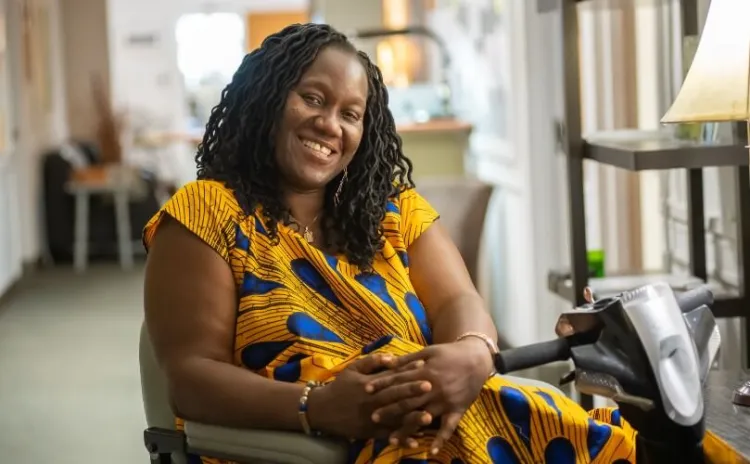
This recognition reflects Dr. Komabu-Pomeyie’s commitment to inclusivity, empathy, and transformative education, core values that define CNHS.
Together, these awardees exemplify CNHS’s commitment to advancing teaching, research, and practice in ways that benefit students, communities, and the broader health sciences field.