College of Engineering and Mathematical Sciences

Type of Degree

CGS

School or College

College of Engineering and Mathematical Sciences

Area of Study

Science, technology, engineering and mathematics

Program Format

On-campus, Full-time, Part-time

Credit hours to graduate

12

Autonomy and robotics are transforming industries from manufacturing to healthcare. This 12-credit certificate builds skills in intelligent systems, AI, and robotics to prepare professionals to design and deploy next-generation autonomous technologies.

Program Overview

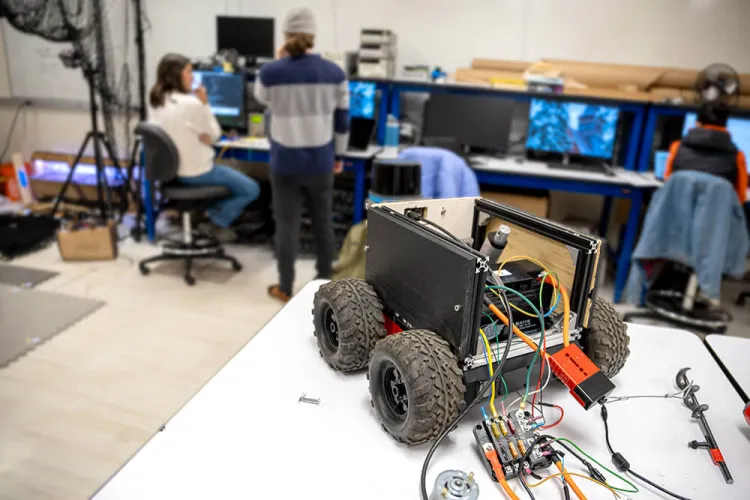
View of a robotic vehicle in the foreground and students in the background

Autonomy and robotics are reshaping the modern world. From advanced manufacturing and intelligent transportation systems to robotic surgery, precision agriculture, energy infrastructure, and next-generation defense technologies, these rapidly evolving fields are driving innovation, strengthening economies, and improving quality of life across industries.

Autonomous systems combine tools and concepts from control systems, signal processing, computer programming, and artificial intelligence to enable engineered systems to perceive, decide, and act independently. Robotics integrates mechanical design, actuator and sensor systems, mathematical modeling, and embedded programming to create machines capable of performing complex, real-world tasks. Together, autonomy and robotics form the technological backbone of many of today’s most transformative advancements.

The 12-credit Certificate of Graduate Study in Autonomy and Robotics (CGS-AR) provides a rigorous foundation in autonomous systems, robotics, and artificial intelligence. Designed to formally recognize advanced training in these areas, the program equips students with the interdisciplinary knowledge and technical skills required to lead in this rapidly growing field. While particularly well-suited for graduate students in Electrical Engineering, Mechanical Engineering, and Computer Science, the certificate is open to students across related disciplines seeking expertise at the forefront of intelligent systems.

Curriculum

The 12-credit CGS-AR program consists of four courses from the list of preapproved courses below. At least one course must be chosen from: “Autonomy: Control & Planning”, “Autonomy: Robot Perception” or “Introduction to Robotics

Course NumberTitle
EE 5540Real-time control
EE 5550Autonomy: Control & Planning (formerly, Autonomy I)
EE 5560Autonomy: Robot Perception (formerly, Autonomy II)
EE 5503Modern Signal Processing
EE 6130Convex Optimization
EE 6110 System Theory
EE 6520Nonlinear System Theory
ME 6120Advanced Dynamics
ME 5XXX (to be taught first time in Fall 2026 or Sprint 2027)*Fundamentals of Robotics
One of CS 5540 or EE 5611*CS 5540 (Advanced Machine Learning), EE 5611 (Machine Learning for engineers)
CS 5060Advanced Evolutionary Robotics
CS 6020Modeling Complex Systems I
CS 6540Deep Learning
CS 5xxx*Natural Language Processing

**EE/ME/CS 

6391, 6392, 6991, 6993, 6995, 7491, 7991, 7995 

Research credits, internship credits, independent study

* These courses are planned for addition to the catalog. 

** Students can count a maximum of three credits of research credits, internship credits, or independent study towards the certificate. For these credits to count towards the degree, the topic must be directly aligned with autonomy and robotics. Student must present scope of work and/or a syllabus and receive approval from one of the faculty participating in this certificate prior to registering for these credits should they wish to count these credits towards the certificate requirements.

Admissions

  • Applicants are expected to hold a bachelor’s degree in engineering or a related field. 
  • Students entering the certificate program are expected to have prior knowledge of control systems, linear algebra, differential equations, and computer programming.

Participating Faculty

Hamid Ossareh

Associate Professor, Department of Electrical and Biomedical Engineering

hossareh@uvm.edu

Luis Duffaut Espinosa

Assistant Professor, Department of Electrical and Biomedical Engineering

lduffaut@uvm.edu

Laura Treers

Assistant Professor, Department of Mechanical Engineering

laura.treers@uvm.edu

Jason Hibbeler

Senior Lecturer, Department of Computer Science Vice Chair

jason.hibbeler@uvm.edu

Outcomes

Students earning a Certificate of Graduate Study in Autonomy and Robotics will be able to:

  • Demonstrate advanced knowledge of robotics and autonomy, including kinematics, dynamics, real-time control, planning, and decision-making.
  • Mathematically model engineered dynamical systems, e.g., DC motors, smart grids, ground and aerial vehicles, and/or robot manipulators.
  • Use computer programming and simulation tools to model, design, and simulate the behavior of robots and autonomous systems.
  • Design and analyze algorithms for robotics and autonomous systems, such as optimization, path and motion planning, and machine learning.
Loading...