Newfane resident, Charlene Galarneau, PhD, is currently researching Vermont's Better Babies Contests as part of a larger project on southern Vermont eugenics. Her recent essay, "The Better Babies Contest, 1913" describes the first Vermont State Fair Better Babies Contest held in Rutland. The essay won second prize in the Vermont State Fair Historical Museum Writing Contest at the 2025 State Fair.
In the early third of the twentieth century, many national, state, and local leaders in academia, politics, medicine, and social reform, embraced the idea that society's problems including poverty, crime, and disease, were caused largely by "inferior" persons and families. Germ plasm, what we today call genes, was believed to be inherited and to carry "good" traits, such as strength and intelligence, and "bad" traits, such as criminality and feeble-mindedness. These traits, it was believed, were passed from generation to generation biologically.
Importantly, in this early U.S. eugenics era, as historian Martin Pernick notes, "the meaning of heredity could reach far beyond genetics" and "calling a trait 'hereditary' meant that you got it from your parents, regardless of whether 'it' was transmitted by genes or germs, precepts or probate." Thus nature and nurture, biology and the environment, made for healthy and fit persons.
Eugenics was the science and practices of creating "well-born" persons in the name of improving society. In Vermont (and elsewhere), particular families–typically poor and/or immigrant families and persons with disabilities and other alleged "defects," were understood by some leaders as weakening, if not destroying, Vermont's robust Yankee "stock." This discriminatory eugenic thinking asserted that a better community, a better Vermont, would require, among other things, that "unfit" or "low-grade" persons not have children.
Social service case workers created family genealogies to identify the ostensible multi-generational inferiority of some families. These "pedigree charts" were used to justify efforts to prevent the procreation of those family members through sterilization, institutionalization, and restrictions on marriage.
These relatively well-known eugenic strategies to prevent "inferior" babies were accompanied by less wellknown strategies that focused on the promotion of "superior" babies. How did one determine the fitness or quality of a baby? One way was through "better babies contests."
In 1913, the popular national magazine, Woman's Home Companion created a Better Babies Bureau to promote a better babies movement, primarily through better babies contests organized by local and state fairs or by nearby women's clubs. Held nation-wide at fairgrounds, local churches, and community halls, these contests assessed babies according to standardized measures, not unlike the judging of cattle and horses at agricultural fairs. Local physicians and nurses scored and ranked the babies within age and gender categories and awarded the "better" and "best" babies with medals, cash, and/or certificates.
In the 1920s, “Fitter Family Contests” expanded the scope of individual baby examinations. Family contests included submission of family genealogy information and the assessment of two parents and their children. In 1925 and 1926, Vermont newspapers carried articles about the Fitter Family Contests at the Eastern States Exposition in Springfield, MA.
Most of Vermont's better babies contests took place in a less-than two decade period starting in 1913 in Bennington, Burlington, and at the State Fair in Rutland. The Rutland Daily Herald described the State Fair's 1913 "Better Babies Contest" as a "scientific" competition that ranks babies "on exactly the same basis or principles that are applied to live-stock shows. Mere beauty does not count." Part of the national Better Babies movement, this contest aimed "to insure better babies" and "a better race of Americans."
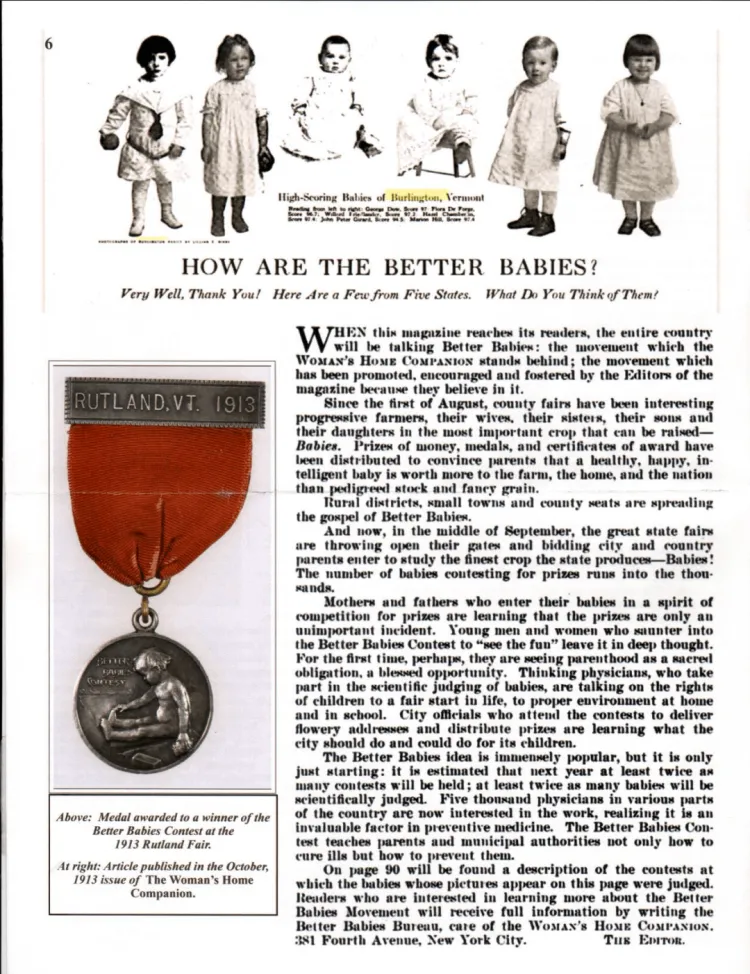
In retrospect, these goals blended evolving efforts in child welfare, "scientific motherhood," and medical professionalism with Vermont's emerging eugenics movement that privileged some children's and families' lives over others.
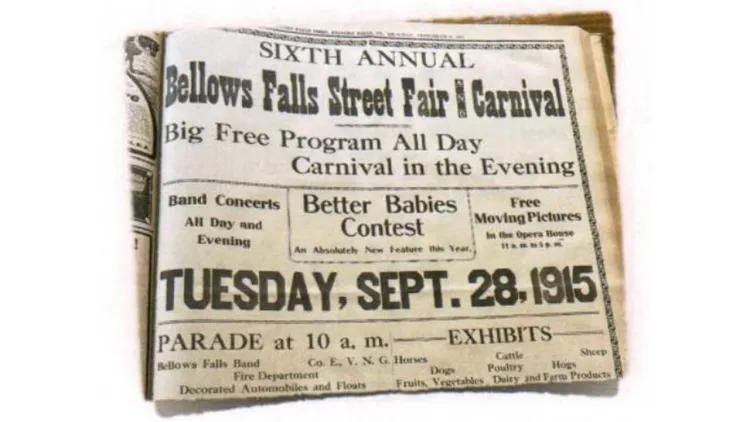
Windham County's first Better Babies Contest took place on September 28, 1915 at the Sixth Annual Bellows Falls Street Fair and Carnival. Organized by the Civics Committee of the Bellows Falls Woman's Club and supported by the Woman 's Home Companion, the contest was held in the Congregational Church's Bible School building on School Street.
Several days before the contest, the Bellows Falls Times reported, "This is not an exhibit. It is a scientific examination by local physicians of children from six months to 24 months old. It gives parents an opportunity to learn if their children come up to the standard of normal development." Twelve doctors, all members of the Rockingham Medical Association, examined 33 babies "and the tests given were mental and developmental, measurements, physical examinations, moral and dental examination, and tests of the eye, ear, nose and throat."
The idea that there was a single, scientific "standard of normal development" by which all children could, even should, be judged and ranked contributed to the eugenic conviction that some lives were "better," that is, had greater value than others. And that some lives deemed "abnormal" were not worth living-and in some cases, according to eugenic principles, should be prevented.
A month later, after individual scores were tabulated, the Bellow Falls contest winners were announced with fanfare, and prizes were awarded at a public event at the High School Assembly Hall. Seven month old Margaret Louise Farrar of Chester was the champion baby with 990 of 1000 points. Doctors and nurses offered the mothers in attendance educational presentations in the hope of improving mothering knowledge and skills.
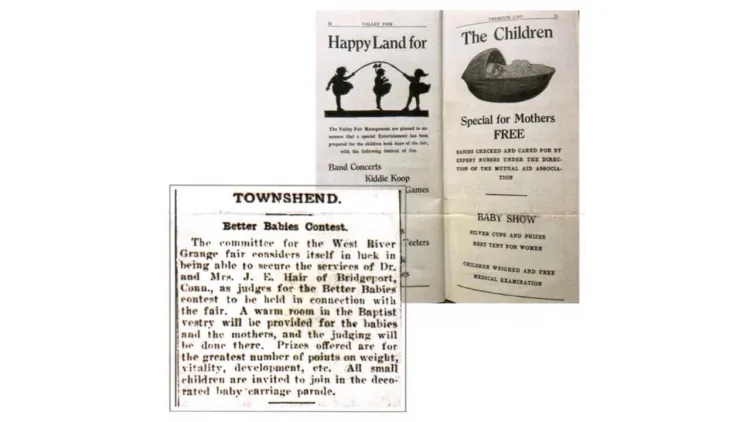
Windham County Better Babies Contests were held also in Townsend and Brattleboro. Townsend held its first contest at the West River Grange Fair on October 5, 1917. The Brattleboro Reformer announced that "A warm room in the Baptist vestry will be provided for the babies and their mothers, and the judging will be done there. Prizes offered are for the greatest number of points on weight, vitality, development, etc." A decorated baby carriage parade followed the contest.
Townsend's 1921 Grange Fair Better Baby Contest was open to "every baby in this or surrounding towns under three years old... These little folks will be divided into three classes–babies under one year, between one and two years, and between two and three years." Dr. C. S. Leach and child welfare nurse, Miss Elizabeth Harvey, both of Brattleboro, along with an out-of-town physician did the judging. Better baby contests continued in Townsend in 1922 and 1926.
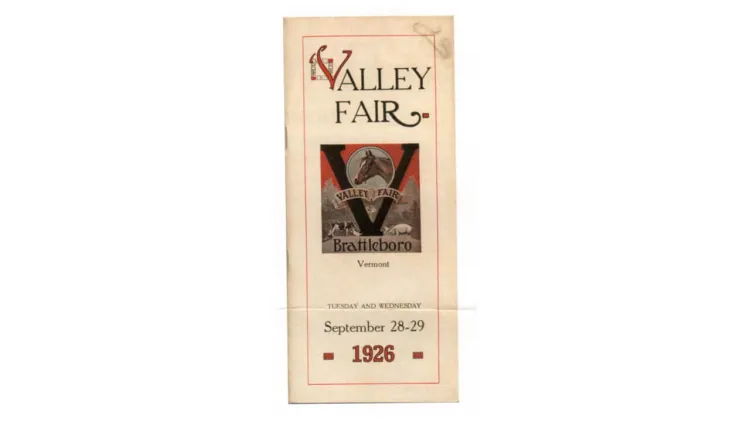
The Brattleboro Valley Fair (aka The Valley Fair) held a "Baby Show" in 1926 and again in 1927 and 1928. The Fair Programs for these years advertise a "Baby Show" with "Silver Cups and Prizes," "Children Weighed and Free Medical Examination," and a "Rest Tent for Women." The "Silver Cups and Prizes" suggest that these were competitive events but the standards by which babies were judged are unknown.
Also at the 1930 Brattleboro Valley Fair, the American Eugenics Society set up an "educational" exhibit to promote eugenic thinking and practices. In the same year, the Society set up "an exhibit of heredity, with guinea pigs as examples," at the Champlain Valley Exposition in Essex Junction.
While some fairs restricted contestant eligibility to town residents, others invited nearby town, and even out of state residents to participate in their Better Babies Contests. South Vernon, VT residents were welcomed to enter in the 1915 "Better Babies" Conference in Bernardston, MA. In 1916, a Grafton VT-born baby won the Better Babies Contest gold prize at the Hampshire County Farm Conference in western Massachusetts.
Other Vermont communities held better babies contests over the years including White River Junction, Manchester, West Windsor, St. Johnsbury, Poultney, Barre, East Burke, and Lyndon. By and large, contests took place occasionally, not annually.
By 1930, most Vermont Better Babies contests had ended due to the demise of local fairs, the challenges of war and the Depression, and the significant organizational effort that the contests required. Notably at about this same time in 1931, the State of Vermont legalized the eugenic sterilization of women and men deemed incapable of producing "well-born" babies, in the service of a "fit" future Vermont.
The author thanks Laura Wallingford-Bacon and Laura Paris of the Historical Society of Windham County; Pat Fowler, Margery Ladd, and Cathy Bergmann of the Bellows Falls Historical Society; Jeanne Walsh of Brooks Memorial Library; and Joe Rivers and Lee Ha of the Brattleboro Historical Society for their generous and informed research assistance.
This article was published in the Fall/Winter 2025 edition of The Historical Society of Windham County newsletter News & Views and is reprinted with permission.