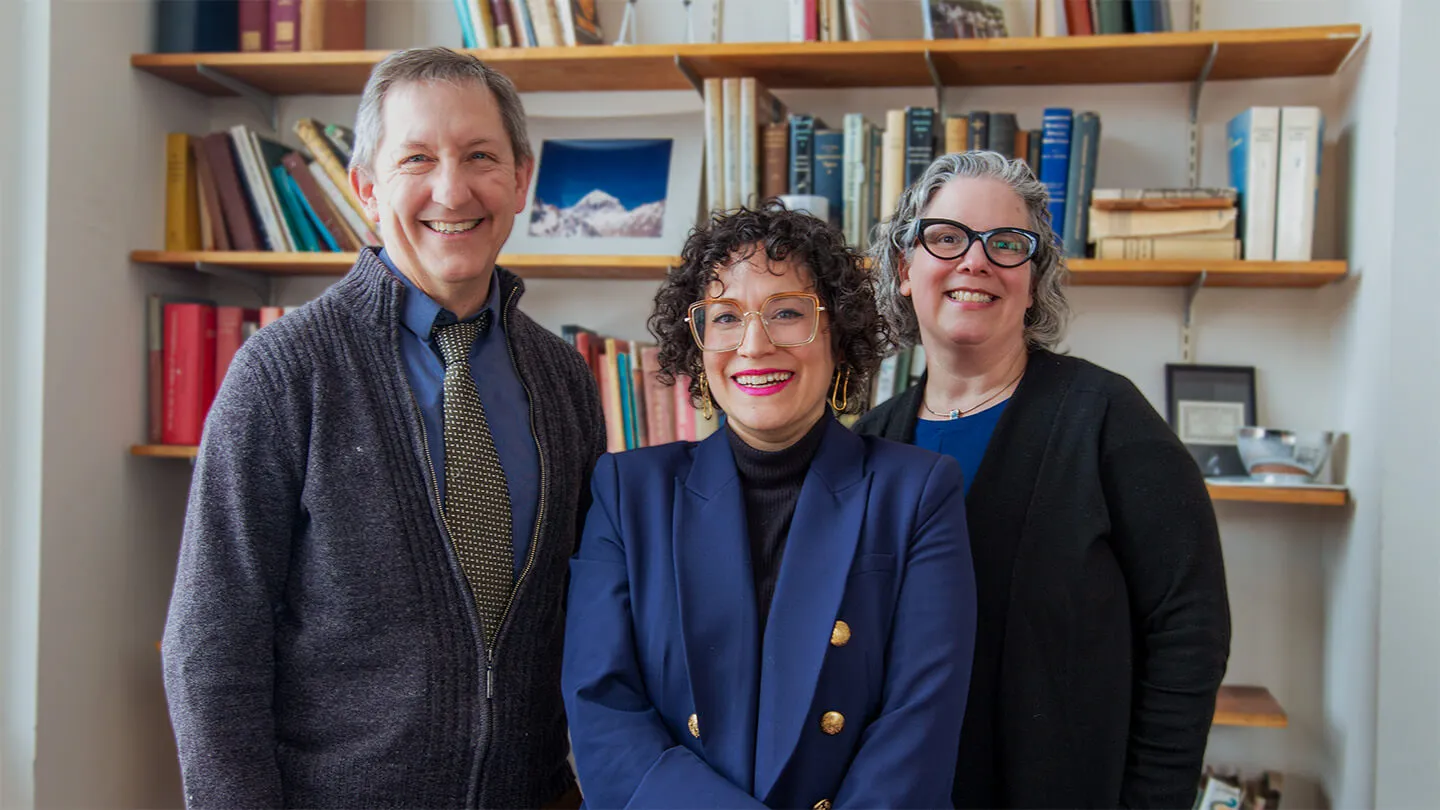
Vermonters are known for their love of the land and fiercely independent spirit, and what role—if any—religion plays in their lives is rarely considered. But three faculty members in the University of Vermont (UVM)’s Department of Religion are seeking to change that with help from the National Endowment for the Humanities (NEH). Thomas Borchert, Vicki Brennan, and Ilyse Morgenstein Fuerst, all professors within the department, have received a $150,000 NEH grant to study religion in Vermont by training undergraduate students to do research and providing those students with opportunities to put that training into practice. They have set themselves an ambitious goal with this project: to investigate the complex, unexplored landscape of religious and spiritual life in Vermont.
Considered one of the least religious states in the country, Vermont does indeed boast a relatively small church-going population. In fact, the Pew Research Center’s 2023-24 Religious Landscape Study ranked Vermont the least religious in the United States, with only 13 percent of adults considering themselves “highly religious.” But the researchers suspect there’s a lot more to the story. “Although many Vermonters do not actively go to religious institutions, there are many that do, and so making sense of the experiences of these people is one of our goals,” says Borchert, who is also chair of the Department of Religion. He notes that there are also many Vermonters who focus on alternative religiosities or see themselves as “spiritual but not religious.”
Academic research on religion in Vermont is so sparse as to nearly be nonexistent. Borchert discovered this several years ago when he typed the terms “religion” and “Vermont” into a search engine and the only things that came up were a few outdated newspaper articles. That was the catalyst for an initial project, led by Borchert and funded by a REACH grant from the university, that produced a database and map of active Vermont religious institutions. “We found there were something like 650 of them, which seemed a lot to me given the size of Vermont and the perception that there’s no religion here,” Borchert says. This was followed by a Public Humanities Fellowship from the UVM Humanities Center, led by Brennan and Borchert, which had students examine the sounds of religion in Vermont as well as politics in religious spaces.
The new project will provide interested undergraduate students with applied research and internship opportunities that haven’t been readily available up until now. Students will be able to build on the ideas and skills they learn in their religion courses by working with archives and communities in the state and producing public-facing reports on their findings.
Internships have presented their own challenges, as UVM is a public university bound by the Establishment Clause of the First Amendment. “We’re not pro- or anti-religion; we describe and understand how religion works in society. So, the who, where, and how of having students do internships in this area has been a real question for us over the years,” Borchert explains. But, one day, he was talking with a colleague who has developed internship opportunities for his students with new American communities and a light bulb went off. “It occurred to me that I had not been creative enough in considering ways for students to be involved with research and internships,” he says. “Religious institutions do a lot of work that is considered more social service than religious.”
So, when the call for grant applications came out from the NEH, Borchert, Brennan, and Morgenstein Fuerst worked together to formulate a plan to overcome these hurdles and marry the gathering of knowledge about the state of religion in Vermont with the creation of new learning opportunities for students.
That work will begin in earnest this summer. “That’s when the three of us will design a class to train students to do research on religion in Vermont,” Borchert says. “We’ll also develop a network of institutions where students can either do that research or work in internships.” The course will debut in spring 2027, then the trio plans to direct 10 student projects in the summer and fall of that year.
All of this will benefit the state in a way that, arguably, only a land-grant university—with its research capabilities and mandate to provide benefits to the state—could. “It’s not always easy for the humanities to lean into UVM’s land grant mission,” Borchert says. “But it seems that understanding what roles religion plays in the lives of the people and communities in the state of Vermont will do just that.”
Borchert is eager to begin working with his colleagues and students to make that happen. “The familiar narrative about religion in our state is that there is none,” he says. “The goal of this project is to train students to create the knowledge we need to tell the real story.”