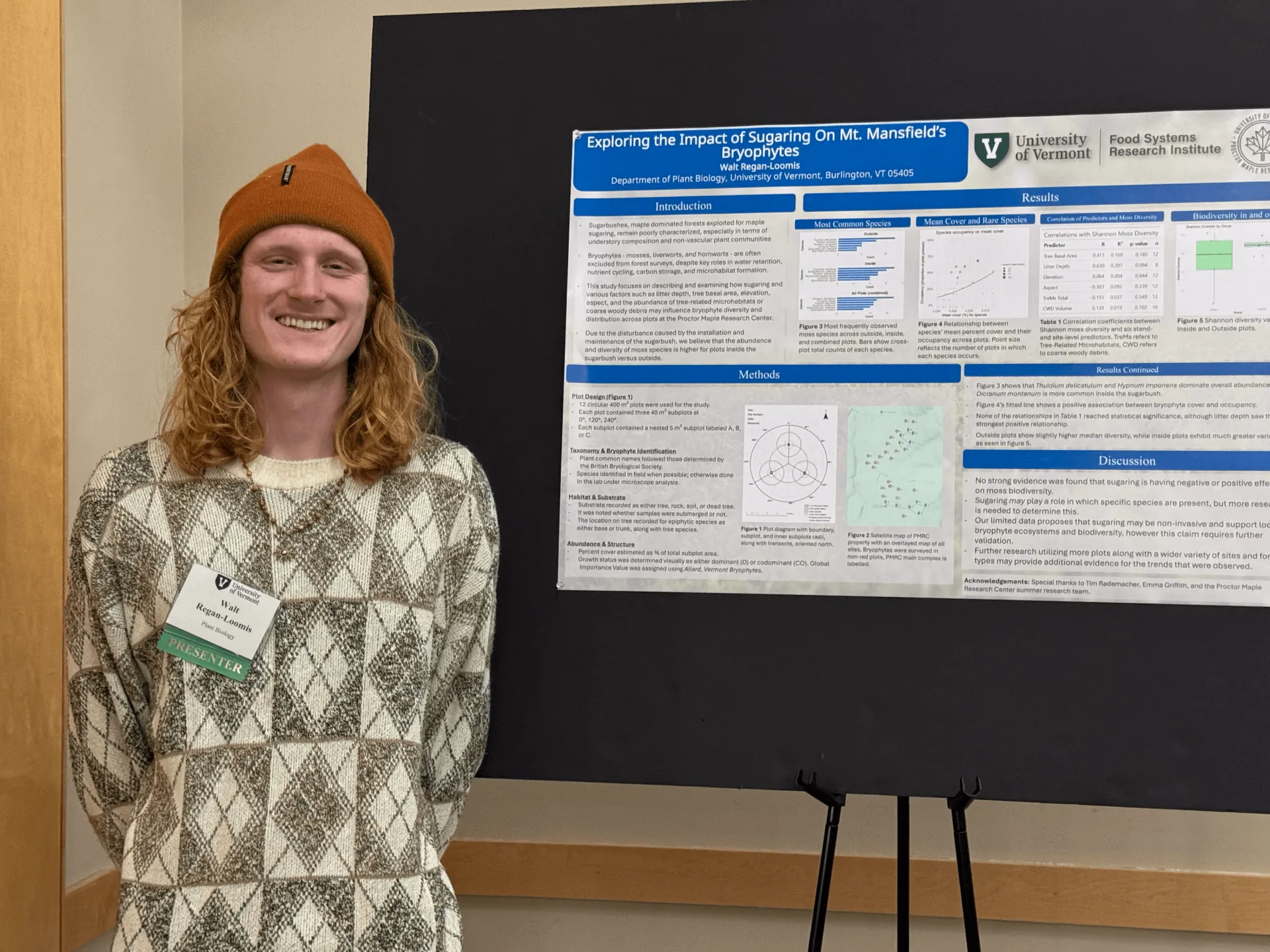
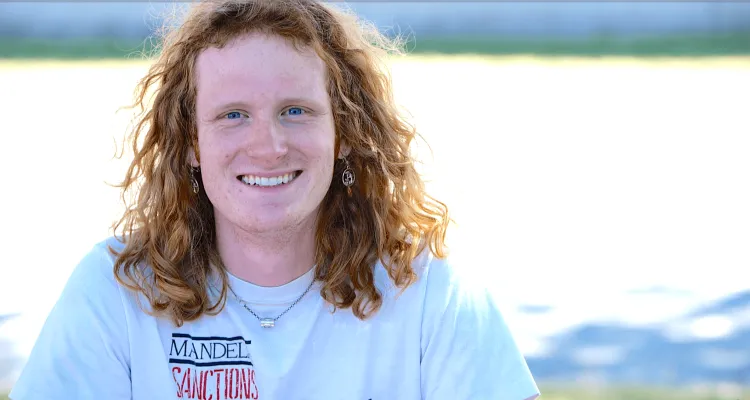
Originally from Sudbury, Massachusetts, this rising senior has spent their time at UVM cultivating a deep curiosity about plant ecology, biodiversity, and sustainable agriculture. Their studies have been deepened through hands-on research and strong faculty mentorship. Majoring in Plant Biology with a minor in Agroecology, they credit their decision to attend UVM to an unforgettable campus tour led by a student who had attended his same high school.
“Hearing about how connected the campus was to the surrounding environment, and seeing how engaged the students were, made me fall in love with the school pretty quickly,” they recall. Once on campus, that first impression only deepened. UVM’s strong research culture, its relationship to Vermont and New England ecosystems, and its agricultural Extension programs made it clear they had found the right place.
A defining experience during his undergraduate career has been conducting research at the Proctor Maple Research Center as part of a multi-level biodiversity study. The project aimed to disentangle the ecological effects of sugaring by examining organisms ranging from fungi to trees to animals across different research plots. By comparing sites inside active sugar bushes with plots outside them and at other locations, the study explored how maple syrup production intersects with ecosystem health.
Their focus within the study was on bryophytes—mosses, liverworts, and hornworts—as well as understory plant composition. After analyzing their data, they found little correlation between bryophyte biodiversity and whether plots were located inside or outside the sugarbush. “That was really exciting,” they say, noting that the findings support the idea that sugaring does not negatively affect moss abundance, even if species composition changes slightly.
Regan-Loomis emphasizes that sugaring is a unique agricultural practice. Unlike most forms of agriculture, it does not destroy the existing environment or rely on monoculture systems. Trees are not tapped until they are at least 40 years old, and syrup is harvested from a fully functional forest ecosystem. Combined with other Proctor research showing that tapping and vacuum tubing do not cause long-term reductions in tree growth or sugar content, the research suggests that sugaring has the potential to be a truly non-invasive food production system.
In Vermont, where roughly half of the nation’s maple syrup is produced, this research carries particular significance. Preserving biodiversity across tapped lands could offer a powerful alternative to other, more invasive land uses, such as intensive timber harvest or agricultural clearing.
Throughout their time at UVM, faculty support has been instrumental. Professors taught them the technical skills needed to conduct research, encouraged them to apply for grants and internships, and helped them build confidence as a scientist. Above all, Proctor Maple Research Center stands out as the most meaningful place in his academic journey. “I have never been involved in a place that feels as special as Proctor,” they say, citing its history, the scale of its research, and the collaborative community it fosters.
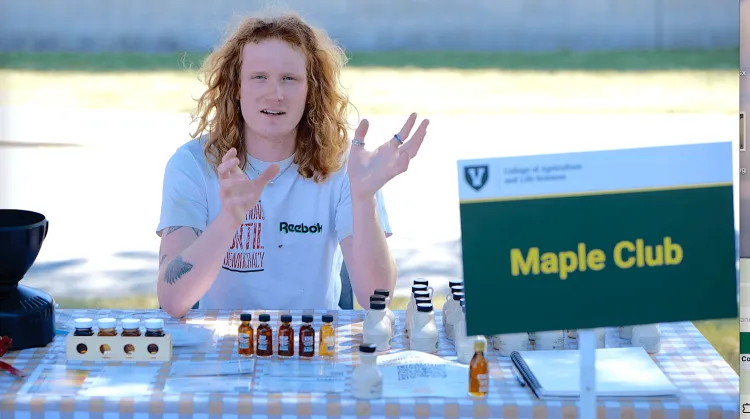
Regan-Loomis expresses deep gratitude to the many mentors who supported him in his journey. Steve Keller, Karsten Fatur, and Jeanne Harris in Plant Biology; and Derek Allen and Michelle Brunell at the UVM Greenhouse, Phoebe Plank at Proctor; and all the instruction he received at the Horticulture Research and Education Center, where the agroecology courses are held.
But there is one mentor in particular, Regan-Loomis suggests, who has been their primary champion, and that is Dr. Tim Rademacher, Director of Research at the Proctor Maple Research Center; “Nearly every achievement I’ve had at UVM can be tied back to Tim Rademacher in some way,” they add, emphasizing the lasting impact of the dedicated mentorship. “Tim has been incredibly supportive of me, all while somehow balancing an insane amount of work he's been doing at Proctor. I genuinely have no idea where I would be without him.”
Regan-Loomis’ advice to new students is heartfelt, “Ask questions. Curiosity is contagious. A lack of background knowledge can be made up for with an unrelenting desire to learn. If you find yourself wondering about something, try to reach out to faculty and professors; nearly all of them would love the chance to talk about what they are an expert in, and if you find yourself even more interested, you can hopefully gain a connection and potentially work with them!”
Looking ahead, they plan to continue asking questions about plant ecology in a changing climate and how crops must adapt to feed future generations, ideally through graduate study at UVM or beyond.