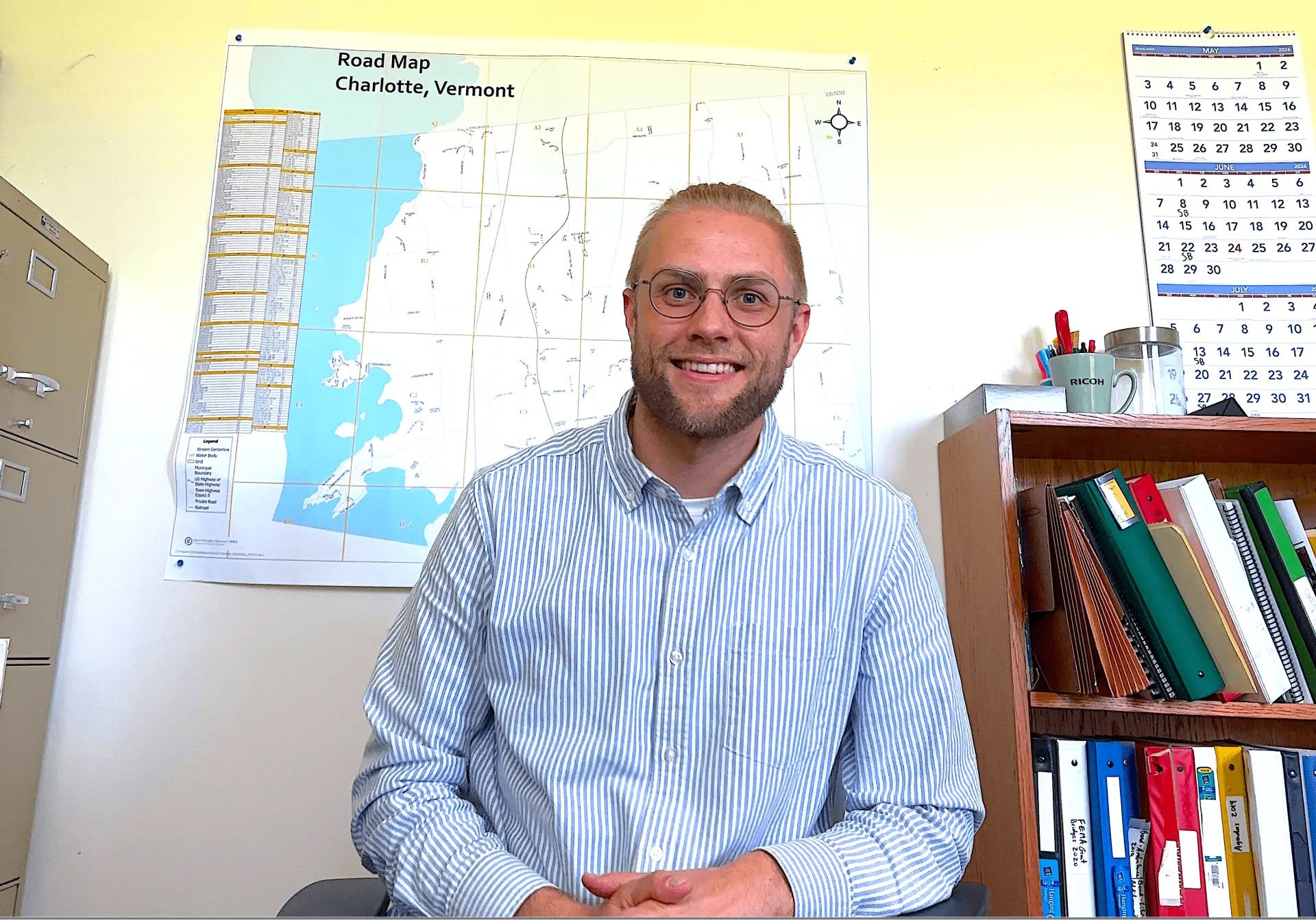
For Bierman, the challenges of this new role are exactly the point.
“I’ve been working toward this for about eight years,” he said. “It feels like I finally made it to my goal.”
Bierman stepped into the role this spring while still pursuing a UVM Master of Public Administration (MPA) program at the University of Vermont, a path that has prepared him for public service and fast-tracked him into it.
UVM’s MPA Program
Bierman admits he discovered the MPA program while looking at Master of Business Administration programs that focused on non-profits. He realized that his desire to work in municipal administrations was more closely aligned with the MPA curriculum.
“A perfect example is a course I’m doing this summer called Building Resilient Communities. It’s about disaster preparedness, risk reduction, emergency management, and things like that. Before I’d even started the job, I saw that I would have a named role with the Charlotte Emergency Management Plan. I was like, Wow! This is exactly what I need to know. So now I’m getting FEMA certification, which is very important for smaller towns in Vermont since we've seen recent trends in flooding. The MPA program feels like it’s the perfect preparation for this role.”
Small Town, Big Responsibilities
Bierman inherits a town government still catching up after a period of management turnover. Charlotte had a long-time administrator until 2024, then they had another young administrator for about a year and a half, then they had a part-time interim administrator for about 6 months.
“Catching up is the number one priority,” he said. “There’s been a lag in the Select Board’s work plan… with projects that keep coming back each year because there hasn’t been the management capacity to complete them.”
With full-time leadership now restored, Bierman aims to demonstrate what’s possible.
“I want to show the town that these projects are achievable and that I can help move them forward.”
Charlotte’s rural character is central to its identity and to Bierman’s leadership approach, “A lot of people here really appreciate that small-town feel,” he said. “That’s something I connect with personally. I grew up in a similar-sized town in Minnesota.”
Maintaining that character while meeting modern demands will require careful balance. Vermont municipalities, like many across the country, face rising costs, aging populations, and limited staffing.
“All towns in Vermont are financially strained right now,” Bierman said. “We need to think about how we can do the work more efficiently without adding additional burden to taxpayers.”
One of Bierman’s immediate focuses is on modernizing Charlotte’s technology systems, “We’re looking at cloud upgrades and moving into more modern technology,” he said. “We’re also working on upgrading from DSL internet service to fiber, which will make a big difference for staff.”
The goal: free up time and capacity.
“If we can reduce labor-intensive tasks, staff can spend more time on public engagement and creative problem-solving.”
The skills needed to succeed
Despite being the youngest employee on staff, Bierman is quick to emphasize that his leadership philosophy emphasizes collaboration. For this approach, he draws on lessons from his MPA coursework, particularly the idea that leadership is more effective when it’s non-hierarchical.
“People are more likely to want to contribute when the leader isn’t just giving orders,” he said, “When you’re working together to solve problems for the town.”
Bierman’s approach is especially important in a community with highly experienced staff and engaged residents.
“There’s a wealth of knowledge here. My role is to help bring that together.”
Like many Vermont towns, Charlotte relies heavily on volunteers to support boards, committees, and civic life.
“There are so many people who know so much,” Bierman said. “My goal is to create an environment where they want to stay involved and don’t get burned out.”
His previous experience coordinating volunteer-driven organizations has prepared him for this dynamic, “It’s about making participation meaningful, something people enjoy and want to keep doing.”
Managing for the future of Vermont
Already, Bierman has encountered the unpredictability of his new role. On any given day, he might field requests ranging from infrastructure planning to local arts projects.
“You really can’t predict what’s going to come across your desk,” he said. “That’s part of what I love about the job.”
One major early undertaking is an energy project to install solar panels and upgrade heating systems at the town’s fire station. The project requires coordination across multiple entities, from state agencies, to the Bond Bank, to attorneys, contractors, and federal programs.
“It’s incredibly complex,” Bierman said. “But it’s also a great example of the kind of work that can make a real impact in our community.”
Asked how he hopes residents will describe his leadership, Bierman offers a single word: “Effective.”
It’s a simple goal, but one that reflects the core of his approach.
“I want the Town of Charlotte to be able to accomplish what it sets out to do,” he said. “I don’t want ‘low capacity’ to be the reason something doesn’t happen.”
Bringing the Community Together
Beyond logistics and administration, Bierman sees one of his biggest challenges as fostering unity in a polarized world.
“Every town has visions about what should change or stay the same,” he said. “My goal is to help people feel like this is everyone’s town.”
Bierman feels that the way to achieve this starts with true listening.
“There’s validity in every perspective,” he said. “People want to be heard, and that’s where you begin.”
Charlotte is already grappling with how to evolve civic participation, including experimenting with hybrid Town Meeting formats to increase access while preserving tradition. For Bierman, the most encouraging aspect of the role so far has been the people of Charlotte themselves.
“The number of people who care — and who are willing to volunteer their time — is incredible,” he said.
He recently attended a men’s breakfast at the local senior center and was struck by how amazing it feels to be part of such a vibrant community of caring individuals.
“Life can be hard sometimes, but we need people in our social networks to talk with, and smile and laugh. Just being friends and being neighbors. That’s been very encouraging. Also, the number of people who volunteer to serve on the town’s many boards, commissions, and committees. And if we didn’t have these dozens of volunteers willing to put their heart and soul into the work, then so much couldn’t happen. These people aren’t getting paid, they simply care. That is a very heartening piece of my job, seeing how many people care. I care a lot, and it’s great to be around people who also care.”
He sees strong social connections as the real foundation of effective local government.
“It’s not just about getting things done,” he said. “It’s about people coming together.”
With a mix of fresh perspective, academic grounding, and hands-on experience, Bierman is stepping into the role at a moment of both challenge and opportunity. But for him, caring for the community in Charlotte and navigating the complexity of rural municipal management is exactly where he wants to be.