She was on what she calls a “Folino’s wave” – a significant spike in her consumption of the delicious Burlington pizza – when inspiration struck UVM junior Hayden deCamp. While making a late-night venture to the downtown establishment over the summer, she realized just how intimidating walking the streets of Burlington can feel, especially at night. She wanted to make a change.
While her plans are still in the preliminary stages, deCamp has grand visions of alterations to the street design around her downtown neighborhood that would promote safety and comfort for local residents. From physical modules that could be installed on any street, to very “place-specific” designs, deCamp is brimming with ideas.
Working to solve problems like this in the Burlington community is a key aspect of the newly launched Community Centered Design (CCD) major within the Department of Community Development and Applied Economics (CDAE). For example, a Design Innovation course taught by David Lea Hohenschau shows students how to integrate “myriad real-world contexts” into their work, yielding more adept, empowered designers.
The question ‘how can we design for a better tomorrow?’ defines and drives the interdisciplinary CCD major, in which deCamp has found a new home. A former Public Communication major within CDAE, deCamp’s answer to that question is all about big picture thinking.
“A lot of the program is based around creating a designer who doesn’t just go in and design something in a bubble,” she explains. “When you’re designing for people or for a community, you need to be very aware of what those people need and want, and they need to be a part of the process every step of the way. It’s a constant give-and-take.”
Since starting at UVM, deCamp has taken every design class she could get her hands on, even if it only counted for elective credit. One of those design classes was with Professor Steve Kostell.
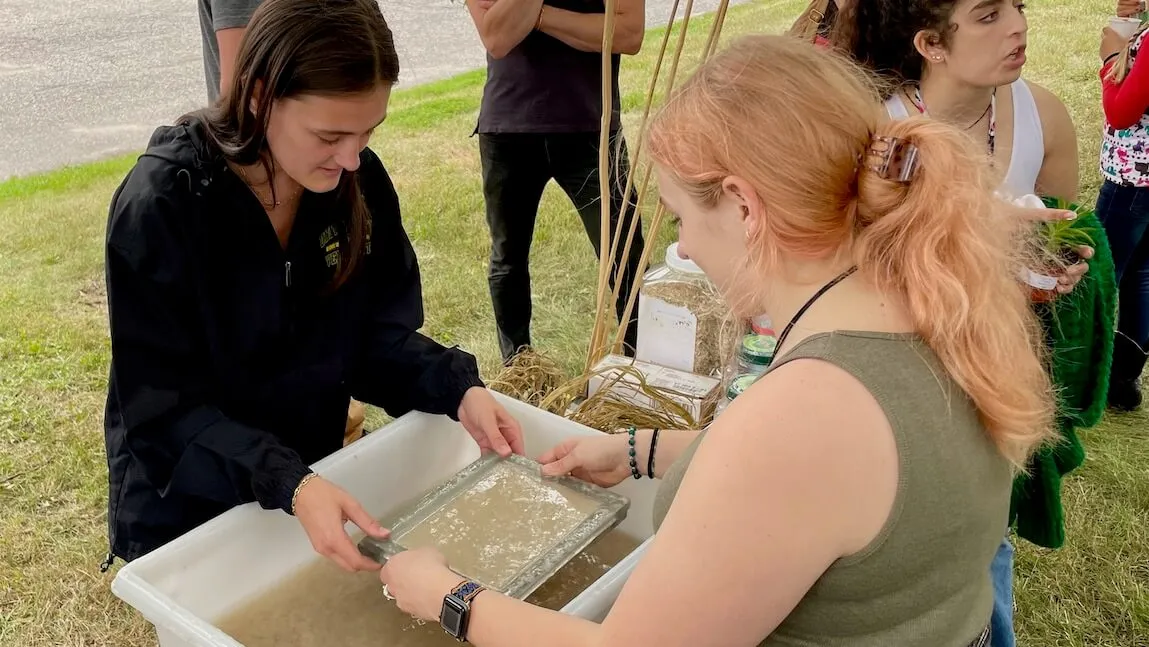
Over this past summer, deCamp worked alongside Kostell in his lab for six weeks, helping to create paper produced from locally grown hemp. The hemp products were supplied through a collaboration with UVM Extension professor Heather Darby and the Borderview Research Farm, an applied research facility that is partnered with UVM.
Kostell and deCamp envision transforming the paper into compostable packaging material, specifically to-go packaging for food products. From there, the hemp paper would make its way back into the ground as fertilizer, thus creating a “regenerative” loop.
On top of the sustainability aspect, what made this project so rewarding for deCamp was the local element.
“In Burlington, people really value local food and local farms, but sometimes that’s all they consider,” she explained. “I think our project pairs really nicely with that local food movement. Plus, it helps bring awareness to a broader concept of how to impact change within a system.”
Just as her design courses teach her how to design with the larger picture in mind, CDAE courses are grounded in a systems-based, interdisciplinary approach – and have changed the way deCamp thinks. However, she also sees the very specific, skills-based approach present in some CDAE courses as being crucial to her success.
When discussing the programs Google SketchUp and Adobe Illustrator, which deCamp has been learning in other courses, she noted how “these skills are so important to creating a final design and showing your ideas. As a designer, you need to be able to show what you’re thinking about. I can come up with a crazy idea in my head, but I need to be able to translate that into something where you can see it too.”
These skills will soon come into play in her work with Kostell as the project evolves. Using some newfound abilities in SketchUp, deCamp hopes to soon design and print a 3D mold that would be used to physically form the hemp paper into packaging. From there, who knows how far the project will grow.
Perhaps someday, she will take home her Folino’s pizza leftovers in a package of her very own design.