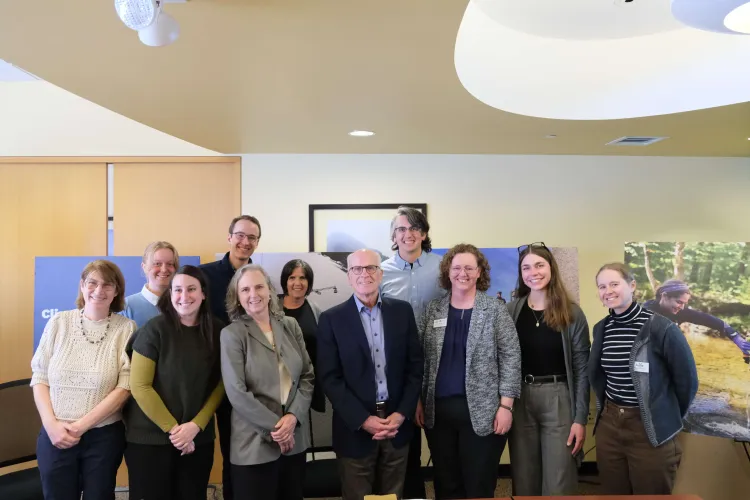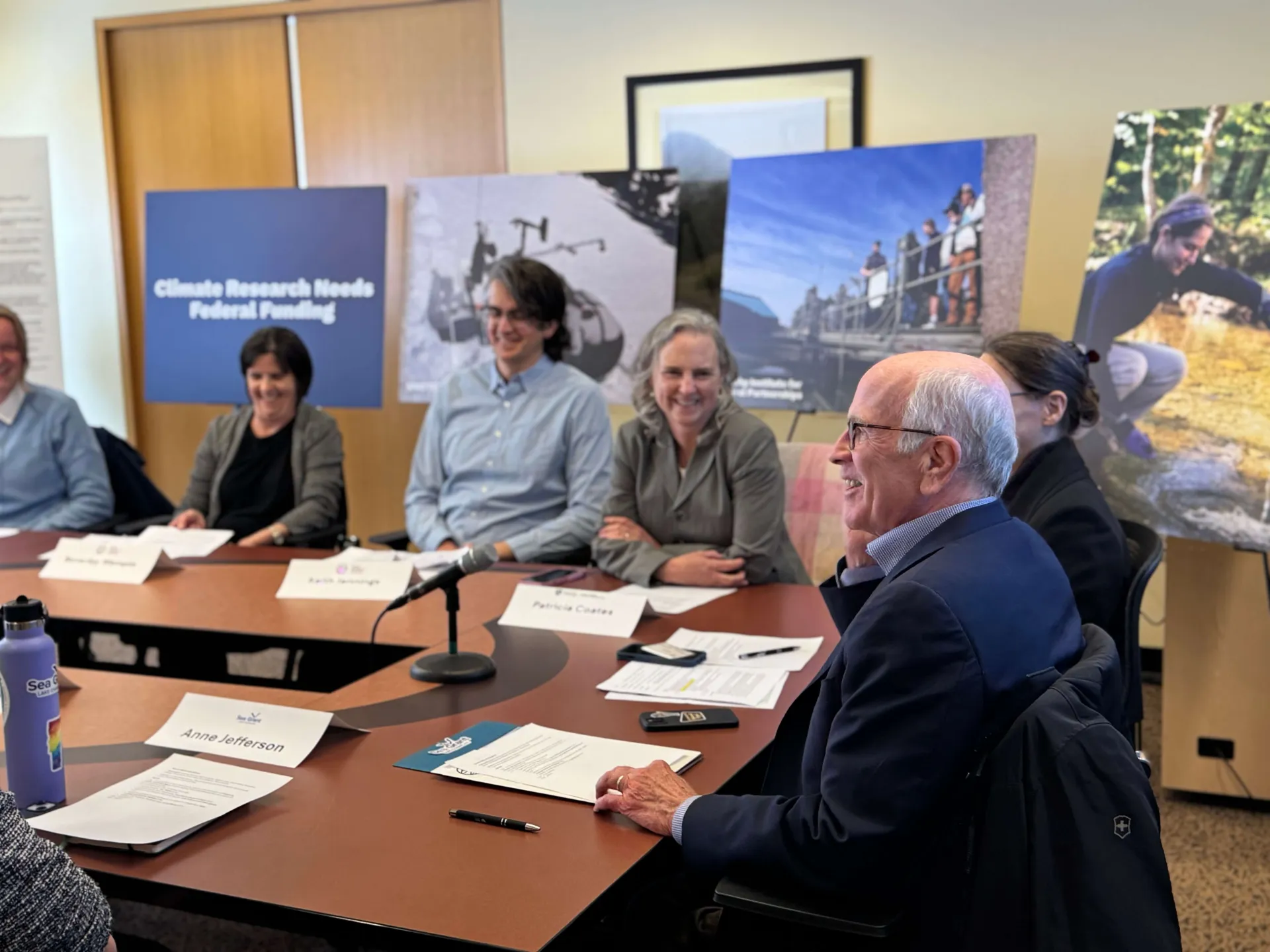
On Tuesday, April 7, 2026, U.S. Senator Peter Welch (D-VT) visited the University of Vermont's Water Resources Institute to learn more about research and partnerships that improve everyday Vermonters’ lives, from flood resiliency to water quality to weather predictions.
During his visit, Senator Welch met with university partners to discuss research that occurs through the Cooperative Institute for Research to Operations in Hydrology (CIROH), the Leahy Institute for Rural Partnerships, and Lake Champlain Sea Grant.
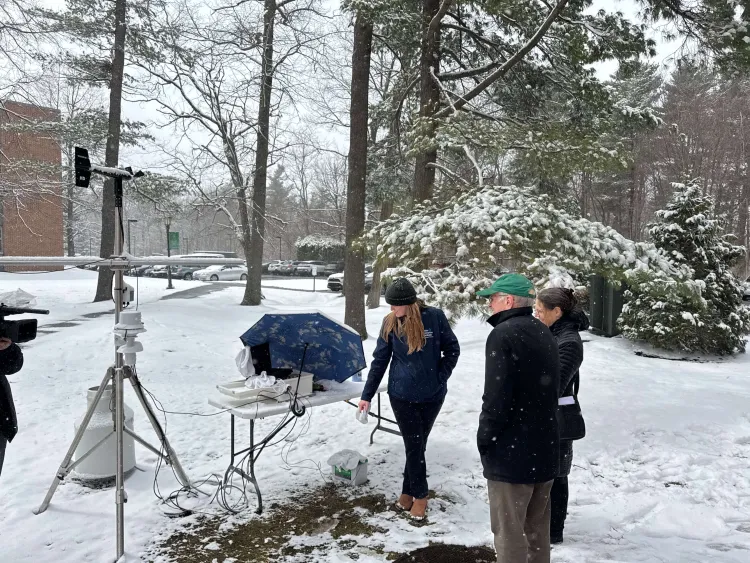
The visit began with a demonstration of the Vermont Mesonet—a proposed statewide network of weather stations that will provide timely data necessary for extreme weather response, agricultural planning, and a wide array of research initiatives. Samantha Koehler, the Senior Meteorological Technician, introduced the instrumentation, and explained how the stations will measure precipitation, temperature, wind speed and direction, relative humidity, soil moisture, and snow depth every five minutes.
The Vermont Mesonet aims to close critical gaps in the state’s forecasting and flood warning capabilities. Radars in Chittenden County, for example, are blocked by mountains and do not reach certain rural areas in the state. This leaves forecasters “in the dark” while making forecasts and supporting flooding response efforts.
With support from the Leahy Institute for Rural Partnerships, a prototype monitoring station has been placed in Lydonville, VT. The station will be fully operational in early May. Once completed, the network will fill a long-standing infrastructure gap and support long-term resilience in rural communities across Vermont. Vermont is currently one of only 12 states without mesonet coverage nationwide, though plans are underway to install 20 additional monitoring stations over the next 3 years.
Following the demonstration, discussions focused on UVM’s environmental research and its community impact. Anne Jefferson, Director of Lake Champlain Sea Grant, and Alison Spasyk, Flood Resilience Educator, shared how federal funding supports impactful research and outreach. They highlighted the essential role Sea Grant programs play in providing stability, continuity, and trusted expertise—especially during challenging times—while advancing hazard resilience efforts across the state. In 2025 alone, the flood resilience team engaged more than 500 community members through 30 different workshops, trainings, and meetings, to improve awareness of flood and water-related hazard, and the actions they can take to build resilient communities.
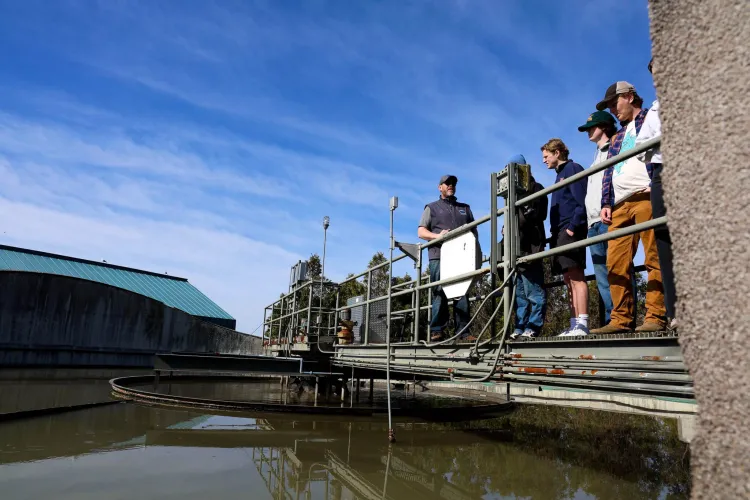
Beverley Wemple, the Director of the Water Resources Institute, emphasized the importance of education and workforce. Through support by the Leahy Institute, UVM partnered with the Vermont Rural Water Association to highlight rural water workforce needs and opportunities among UVM students and faculty. More than 65 students participated in trips to water treatment and wastewater facilities.
Wemple stated that these experiences led to a significant increase in water-related careers and rural community work. Prior to the visits, only 19% of the students had considered a career path in water treatment. Afterwards, 55% responded positively to the question, “the facility visit influenced my interest in a career path in water treatment” and 61% responded positively to the question, “the facility visit inspired me to think about work in a rural community setting.”
The Water Resources Institute also shared updates on additional initiatives, including the Cooperative Institute for Research to Operations in Hydrology (CIROH) and the Northeast Snow Survey Feasibility Study. CIROH focuses on forecasting streamflow, extreme floods and droughts, and water quality, with UVM serving as one of 28 member and partner institutions nationwide. Senator Welch is working alongside Katie Britt (R-AL) to strengthen CIROH through bipartisan legislation. This commitment will improve forecasting techniques and the use of water predictions in decision making.
Meanwhile, the Northeast Snow Survey Feasibility Study is a collaborative effort between Vermont, Maine, and New Hampshire to expand snowpack and weather monitoring. The initiative aims to develop a regional network similar to the western US’s SNOTEL system, which comprehensively monitors snowpack, weather, and hydrological variables across mountainous areas.
"Here in Vermont and across the country, researchers and scientists are making critical advancements to help strengthen our environment and our communities. It’s clear that federally-funded research and science requires hard work, innovation, and consistency— and it’s on Washington to better support the future of research. I’ll keep fighting to protect research that helps our state predict and address extreme weather, flooding, and water infrastructure,” said Senator Welch. “Vermont is fortunate to have the best of the best research right here in our state, and I’ll keep fighting to support this work.”
Read the full press release here.