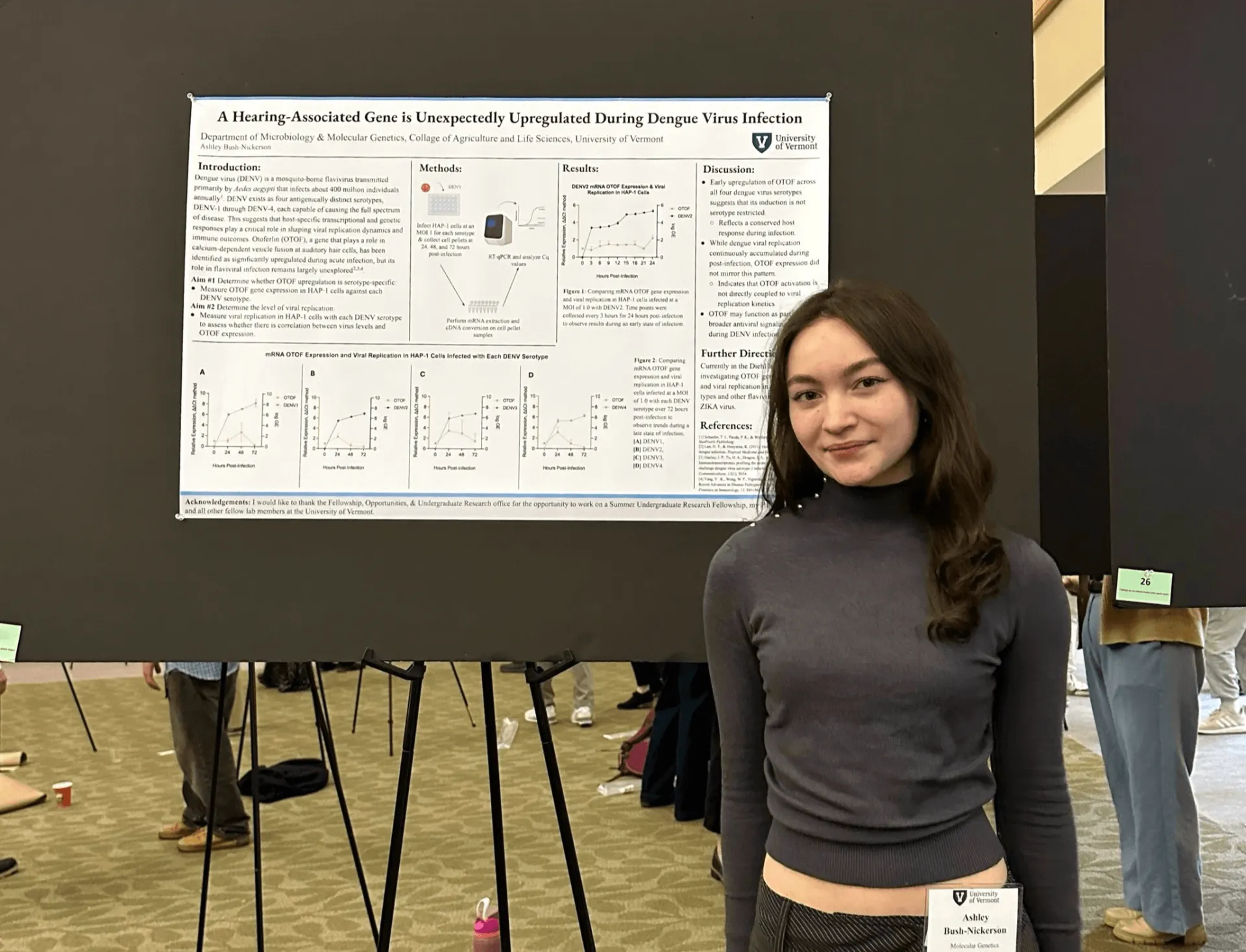
Bush‑Nickerson, a Molecular Genetics major with a minor in Chemistry, hails from Pawcatuck, Connecticut. She chose UVM for its unique blend of rigorous academics and a strong connection to the natural world. Vermont and UVM are environments that provided both the resources and inspiration Bush-Nickerson needed to thrive, “At UVM, I found a place where I could grow academically while also taking advantage of meaningful research opportunities,” she said.
Bush‑Nickerson credits much of her success to the mentorship she has received at UVM. Faculty members including Professors Kari Hodge and Rebecca Guy supported her early development, while her primary research mentors—Dr. Sean Diehl and graduate student Hector Granela—provided the guidance and training that enabled her to pursue independent research.
“They helped me build both the technical skills and the confidence to lead my own project,” she said.
A pivotal moment in her academic journey came when she received a Summer Research Award through UVM’s FOUR (Fellowships, Opportunities, and Undergraduate Research) office. This experience allowed her to design and execute her own research project, strengthening her foundation in molecular biology and laboratory work.
Original Research into Viral Infection
Bush‑Nickerson’s undergraduate research has focused on understanding how human cells respond to viral infections, with a particular emphasis on dengue virus (DENV), a global health threat that infects an estimated 400 million people each year.
Her work investigates otoferlin (OTOF), a gene traditionally associated with hearing, as a potential player in the body’s antiviral response. Through experiments conducted in human cell lines, she has identified that OTOF is consistently upregulated across all four dengue virus serotypes, suggesting it may serve as a previously unrecognized component of early immune defense.
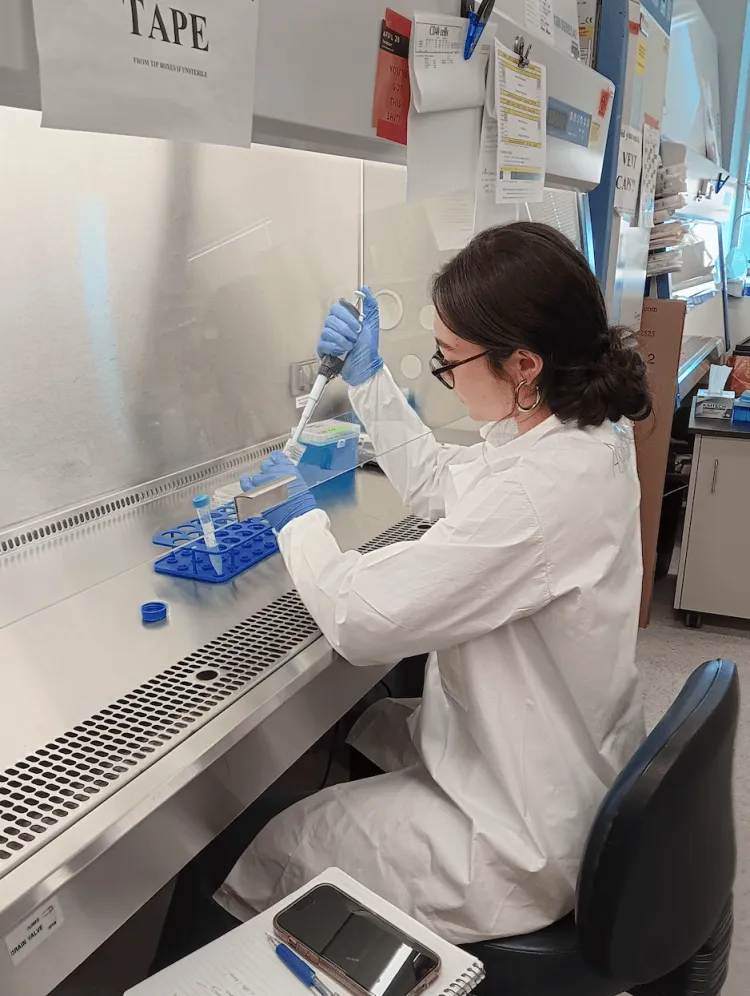
Using molecular techniques such as RT‑qPCR, Bush‑Nickerson tracks gene expression and viral replication over time following infection with dengue and, for comparison, Zika virus.
“What makes this research exciting is that OTOF’s role in immunity is largely unexplored,” she explained. “Linking a calcium‑sensing membrane fusion gene to antiviral defense opens up an entirely new direction for understanding how host cells respond to infection.”
Her findings could contribute to broader efforts to understand and potentially treat dengue and related viral diseases.

Advice for Future Students
Reflecting on her experience, Bush‑Nickerson encourages incoming students to embrace opportunity and step outside their comfort zones.
“Say yes more than you think you should,” she advised. “The experiences that feel uncertain are often the ones that shape you the most. Be curious and open.”
Looking Ahead
As she enters her senior year, Bush‑Nickerson is already focused on her future. She plans to pursue a Ph.D. in Molecular Biology immediately following graduation, continuing her commitment to advanced research.
“Research has always been central to where I see myself,” she said. “I’m excited to take what I’ve learned at UVM into a new academic environment.”
Recognition and Impact
The Kende Award is one of CALS’ most respected honors, celebrating students who demonstrate exceptional promise in their field. For Bush‑Nickerson, receiving the award was both humbling and affirming.
“I felt a deep sense of gratitude… for my mentors, the opportunities I’ve had, and the hard work along the way,” she said. “The people and experiences at UVM have shaped who I am as a scientist and as a person.”

The Alexander Kende Memorial Fund honors the memory of Alex Kende, a sixth-generation Vermonter who graduated in May 2000 with honors at the top of his class in the CALS Biological Science program. An exemplary student, Alex received the Lawrence K. Forcier Outstanding Senior Award and had been accepted into UVM’s College of Medicine Class of 2004. On December 1, 2000, a serious illness claimed the life of this fine young man who faculty described as a “magnetic personality with intellectual prowess, personal warmth and a stimulating presence in the laboratory.”
Through her groundbreaking research, dedication to learning, and passion for discovery, Ashley Bush‑Nickerson exemplifies the spirit of innovation and excellence that the Kende Award seeks to recognize, and this award positions her as a promising emerging scientist in the field of molecular biology.