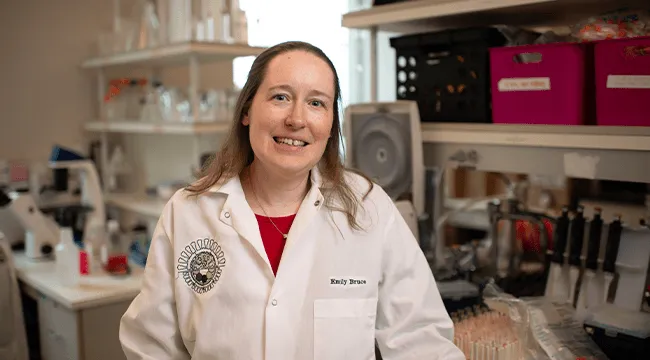
Emily Bruce, Ph.D., assistant professor of microbiology and molecular genetics, received a competitive award from the Burroughs Wellcome Fund to investigate how influenza viruses of animal origin—such as avian and swine flu—are transported in animals and how the animals serve as mixing vessels for human strains. This knowledge will improve the ability to prepare for and defend against future pandemics.
The Investigators in the Pathogenesis of Infectious Disease award supports accomplished early-career researchers studying the complex biological mechanisms underlying infectious diseases. The award provides $505,000 to support investigators pursuing innovative ideas and establishing independent research programs at the forefront of biomedical science. The award is highly competitive—fewer than 3 percent of qualified applicants were selected in 2026. The eight recipients are assistant professor–level scientists whose research is advancing the understanding of infectious disease mechanisms and shaping new approaches to prevention, diagnosis, and treatment.
Dr. Bruce’s research focuses on new pandemic-causing influenza A viruses that emerge from animals and spread to humans. Her study, “From Birds to People: Understanding the Role of Rab11 in Influenza Assembly and Reassortment,” examines a protein, Rab11, that controls influenza A virus genome trafficking in human cells. Bruce seeks to understand if Rab11 drives the process of reassortment, when two viruses co-infect a cell and exchange gene segments. She also wants to understand how Rab11 functions during infection in animals from which influenza viruses emerge.
“We have seen the crucial role host proteins play in the ability of influenza viruses to successfully ‘jump’ between species.” — Emily Bruce, Ph.D.
“Influenza A viruses pose a very high risk for the emergence of novel pandemics. This is due in large part to their segmented genomes,” Bruce explained. “When two influenza A viruses infect the same cell, new viruses can be generated with a combination of parental genome segments that endow novel properties,” potentially creating a new disease that can infect humans. “I will study this process in cells and organoids of avian, swine, and bovine origin, as well as human lung cells. These experiments will provide foundational knowledge necessary to understand the process of viral reassortment and how it occurs in the reservoir species that pose the greatest risk of influenza virus spillover.”
Bruce has worked at the intersection of molecular virology and cell biology throughout her career. She first discovered Rab11’s role in influenza flu virus infection during her doctoral studies as a Gates Cambridge Scholar at the University of Cambridge. “This finding has been replicated by multiple labs over the last decade, during which we have seen the crucial role host proteins play in the ability of influenza viruses to successfully ‘jump’ between species,” she said.
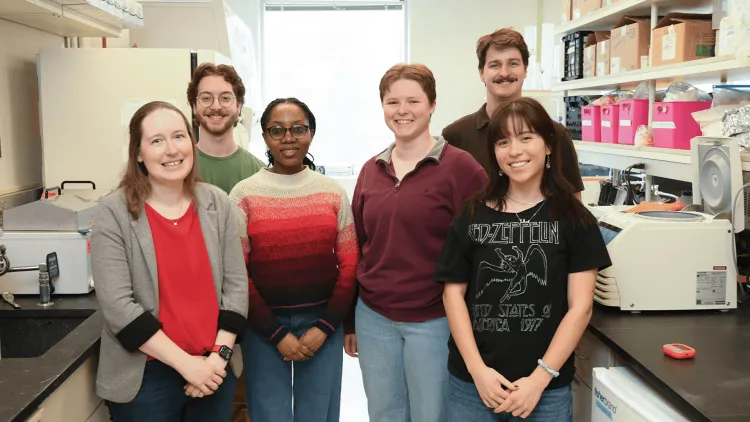
Bruce’s laboratory team at the Larner College of Medicine recently discovered that different flu viruses use distinct strategies to infiltrate cells in the first place. They also found that it is possible to target specific molecules to prevent the viruses from entering new cells, thereby stopping their replication. This discovery, published in the Journal of Virology on June 2, 2026, provides fundamental insights into how seasonal influenza viruses infect people and illuminates a path for developing better medications to prevent infections in the future.
Read media coverage of this research
Read more about research in the Bruce Lab
Read more about the 2026 Investigators in the Pathogenesis of Infectious Disease awards