Test & Protect
The Test & Protect project encourages Vermonters within the Lake Champlain Basin to test their lawn soils to help protect water quality in the Lake Champlain watershed. Trained volunteers provide workshops and demonstrations on proper soil sampling at participating libraries.
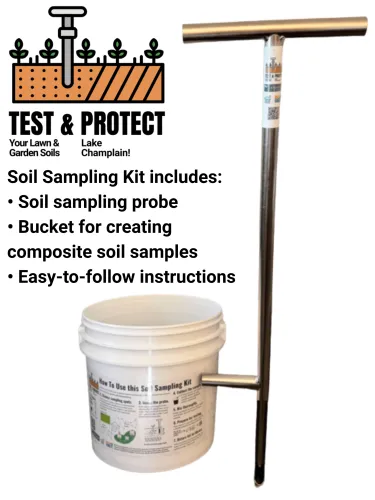
The libraries also receive a soil sampling kit as part of their Library of Things for patron use.
The project is led by UVM Extension, in collaboration with the Composting Association of Vermont, and is funded by the United States Environmental Protection Agency (USEPA) under assistance agreement LC00A01871 to NEIWPCC in partnership with the Lake Champlain Basin Program.
Participating Libraries
Thank you to the following public libraries that are partnering with us on this program by hosting demonstrations and workshops. These libraries have also agreed to house soil sampling kits -- soil sampling probe and collection bucket with instructions -- as part of their Library of Things for patron use.
Year 1 Participating Libraries
- Burnham Memorial Library (Colchester)
- Charlotte Public Library (Charlotte)
- Deborah Rawson Memorial Library (Jericho)
- Fletcher Free Library (Burlington)
- Hitchcock Museum and Library (Westfield)
- Ilsley Public Library (Middlebury)
- Poultney Public Library (Poultney)
- South Burlington Public Library (South Burlington)
- St Albans Free Library (St. Albans)
- Worthen Library (South Hero)
On the Map
Upcoming Soil Sampling Made Simple Events
Upcoming Soil Sampling Made Simple Events
Trained Extension Master Gardener and Vermont Master Composter volunteers are offering the following soil sampling workshops/demonstrations.
| Date | Time | Library | Town | Featured Volunteer/s |
|---|---|---|---|---|
| Sept 5, 2026 | 11:00 a.m. to noon | Poultney Public Library | Poultney | Mac Slivka & Naomi Bombardi-Wilson |
| Sept 12, 2026 | 10:30 to 11:30 a.m. | Charlotte Public Library | Charlotte | Karen Tuininga |
| Sept 14, 2026 | 3:30 to 4:30 p.m. | Burnham Memorial Library | Colchester | Sonya Stern |
| Sept 19, 2026 | 10:00 to 11:00 a.m. | Deborah Rawson Memorial Library | Jericho | Sue Cromwell & Karen Gonnet |
| Oct 6, 2026 | 5:30 to 6:30 p.m. | Poultney Public Library | Poultney | Mac Slivka & Naomi Bombardi-Wilson |
| Oct 7, 2026 | 5:30 to 6:30 p.m. | South Burlington Public Library | South Burlington | Thomas Brown & Audrey Tassey-Ayer |
| Oct 7, 2026 | 6:00 to 7:00 p.m. | Worthen Library | South Hero | Bob Chutter |
| More workshops coming in Spring 2027! |
More Soil Health Partnerships & Resources
Soil Health Resources
Visit Gardening Resources to find information on a wide range of gardening topics.
Soil Lead Screening with USDA NRCS
Our program collaborates with the USDA Natural Resources Conservation Service (NRCS) on their free soil lead screening events. Originally, part of the SoilSHOP program, USDA NRCS soil scientists perform real-time screening for lead content on soil samples. Extension Master Gardener volunteers are on hand to provide gardening information.
See the info sheet distribution as this event: Lead (Pb) Health Resources for Further Information (PDF)
Lead can cause health problems in almost every organ and system in your body — to keep you and your family safe, we are conducting this free soil lead screening.
This Soil Screening, Health, Outreach, and Partnership (soilSHOP) event provides community members with free lead screening of soil gathered from their gardens. Through soilSHOPs, ATSDR and partner organizations provide health education and outreach to help people learn if their soil is contaminated and how to reduce exposures.
Did You Know?
- Lead is common in both urban and rural settings.
- Lead poisoning is a preventable disease.
- There is no known safe level of exposure to lead.
- You should avoid exposures to all sources of lead.
What is Lead?
Lead is a naturally occurring bluish-gray metal found in small amounts in the earth's crust. Lead can be found in all parts of our environment. Much of it comes from human activities including burning fossil fuels, mining, and manufacturing. Lead has many different uses. It is used in the production of batteries, ammunition, metal products (solder and pipes), and devices to shield X-rays. Because of health concerns, lead from gasoline, paints and ceramic products, caulking, and pipe solder has been dramatically reduced in recent years. (Thank you to the Agency for Toxic Substances and Disease Registry — ATSDR — for providing this information.)
Follow the steps below to collect your Soil Sample. (It's a good idea to wear garden gloves when you are collecting your soils.)

Step 1: Identify the area for your soil sample.
Plan to collect samples from areas with vegetable/edible plants only (no need to sample ornamental gardens). Soil from a large garden can be collected as one sample. If you have multiple, separate edible gardens in different locations, sample them separately. Limit of 3 sample bags/person.
Step 2: Collect Soil.
To collect soil, you will want to dig from the surface down to 6 to 8 inches deep.
For a large area, collect soil from 5 to 10 random spots throughout the area, and combine in a clean container.
For a small area, collect soil from 3 random spots and combine in a clean container.
Step 3: Mix soil well in clean container.
Step 4: Remove pebbles, rocks, and roots, and air dry.
Do not use a flame, oven or hairdryer to dry the soil!
Step 5: Transfer 2 cups of the mixed soil into a clean one-quart plastic baggie.
Note: For more than one sample, repeat steps 1-5. Rinse your container between samples.
Questions?
Please contact Deb Heleba at debra.heleba@uvm.edu with your questions about this project.
If you have gardening and soil testing questions, please contact our Gardener Helpline.