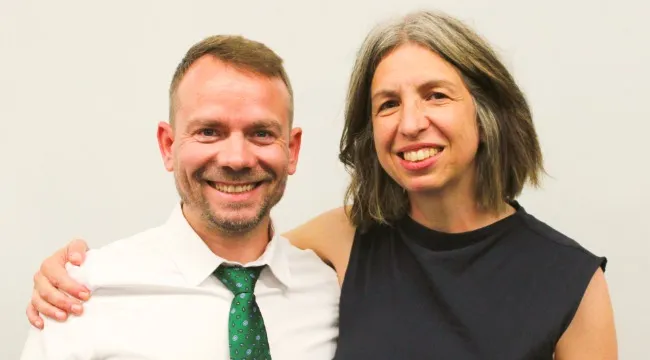
Vișinel Balan survived the brutal conditions of Romania’s orphanage system in the 1990s. After 26 years in the institutions that he refers to as “concentration camps,” Balan is now the director general of child protection social services in Giurgiu County and is his country’s leading advocate for children’s rights and the deinstitutionalization of child and adult care.
On a recent visit to UVM, Balan spoke with Camelia Măianu, a senior lecturer within the College of Education and Social Services.
Their conversation began with a consideration of communist dictator Nicolae Ceaușescu, who became the second and final leader of Communist Romania in 1965, and whose government banned abortion and contraception to encourage population growth.
Ceaușescu believed the state could provide for children better than their families, and by 1989, when Ceaușescu was overthrown and executed, more than 100,000 children, Balan among them, were raised in these state institutions.
Măianu’s connection to this work spans decades: after her family fled Ceaușescu’s Romania in 1979, she returned in the early 1990s to volunteer in orphanages and later conducted research there as a Fulbright scholar.
Since 2012, she has helped bring the attachment-based Circle of Security Parenting program to thousands of Romanian professionals, though says public institutions have remained beyond the program’s reach. Măianu sees UVM’s relationship with Balan as an opportunity to help bring attachment and trauma-informed practice into the public child welfare system at the institutional level.
Camelia Măianu: You've said, "Institutionalization is an emotional crime against every child." What do you mean by that?
Vișinel Balan: Institutionalization does not belong in the human experience. It's like keeping animals in a zoo. You may provide food and shelter, but institutionalization is a crude form of government to condemn its citizens.
I was placed in an institution when I was two months old. Throughout childhood I was repeatedly transferred from one institution to another with no preparation. At age three, the transition was so traumatic that I would hit my head against the wall until I passed out.
To escape the beatings, I often ran away. I lived on the streets and slept in train stations. At age eight, I was moved again, this time to a school-age institution. We were loaded onto a bus, crying and terrified, and beaten for crying.
At fourteen I was placed in foster care, but the abuse there caused me to run away again.
If institutionalization dehumanizes people, how did you survive?
Some people gave me a chance. There were families who wanted to adopt me but were unable to. They continued to support me. Despite everything, there were individuals who believed in me and helped me continue.
Can you describe what daily life was like within these institutions?
It was deeply dehumanizing. When I was very young, it was so cold that I would urinate on myself just to feel warm for a few moments. I rocked myself back and forth so intensely that it felt like I might fly away. Children who wet themselves were publicly humiliated. Staff would strip them, tie their hands, parade them through the institution, beat them, and encourage older children to beat them as well.
We were constantly told we would never amount to anything and that our future was life on the streets. Many of us believed it because we saw older youth age out of the system, become homeless, and return to the orphanage grounds begging for food.
Many of my friends died. My friend whom I dedicated my book to, who was trans and committed suicide, is one of those examples.
What inspired your advocacy work?
People in my life who encouraged me to transform vulnerability into power.
Though my outspokenness began very early, my formal activism began around 2012, when I conducted a national study of young adults who had grown up in institutional care. I traveled throughout Romania, visiting 145 centers and interviewing hundreds of people.
That research led to the creation of a council of formerly institutionalized youth. More than 400 young people came together to advocate for policy change.
You mentioned that your activism actually began much earlier.
Yes. As a teenager, I spoke out when staff abused younger children. If I saw someone being beaten, I felt responsible. At fifteen or sixteen I volunteered with a nonprofit organization that worked with children living with HIV. I also learned early that authority could be challenged.
One time I was invited to an event dressed as Santa Claus. Political leaders didn't appreciate my criticism, so they summoned me and demanded to know who I thought I was. I replied, "I'm Santa Claus." Eventually some of those same people became supporters and helped open doors for my education.
What was your experience as Vice President of Romania's National Authority for Children's Rights?
There were good and bad aspects. The good part was that young people suddenly had access to someone in leadership. The bad part was that I was repeatedly criticized by my superiors for allowing these young people into the agency.
One case involved a young man who arrived carrying a large knife because he was desperate and angry. Staff wanted security to stop him. Instead, I invited him upstairs. I sat with him, offered him coffee and water, and listened to him for three hours. No one had treated him with dignity before. He left feeling heard.
Ultimately I clashed with leaders when I pushed for transparency around a youth suicide involving anti-LGBTQ discrimination. When officials tried to hide those circumstances, I spoke publicly. I was fired the next day.
You're currently leading a county child protection agency. What changes have you made?
One of my first actions was visiting every residential facility for adults with disabilities. I spent entire days listening to residents and learning their stories. Many described lifelong physical and sexual abuse. After hearing their experiences, I vowed to close those institutions. I often call them concentration camps because that is how people were treated. We closed every large residential center in our county.
People were moved into houses and apartments integrated into communities. Some now live independently. At first they were terrified. Today, many tell me they never want to return to institutional settings.
You've often emphasized the importance of mentors. Why?
Mentors changed my life. Some of those people who believed in me told me, "You focus on school, and we'll help with everything else."
Mentors can be adults, but they can also be classmates. One of my desk mates helped me learn to read and complete my schoolwork. Today he's a judge.
Is there one mentor who stands out?
Yes. A priest at a monastery. One day after a brutal beating, I ran away and ended up there. The priest saw the injuries on my back and wanted to call the police. He gave me work to do and explained that if I didn't go to school, hard manual labor would be my only option. His message stayed with me: education creates opportunity.
Many of our students are preparing for careers in social work, counseling, education, and other helping professions. What would you tell them?
Never forget to love the people you serve. Real change begins when people feel seen, heard, respected, and valued.
This interview has been edited for length and clarity.
Read more about Balan’s life and work in this 2014 article published by The Guardian.