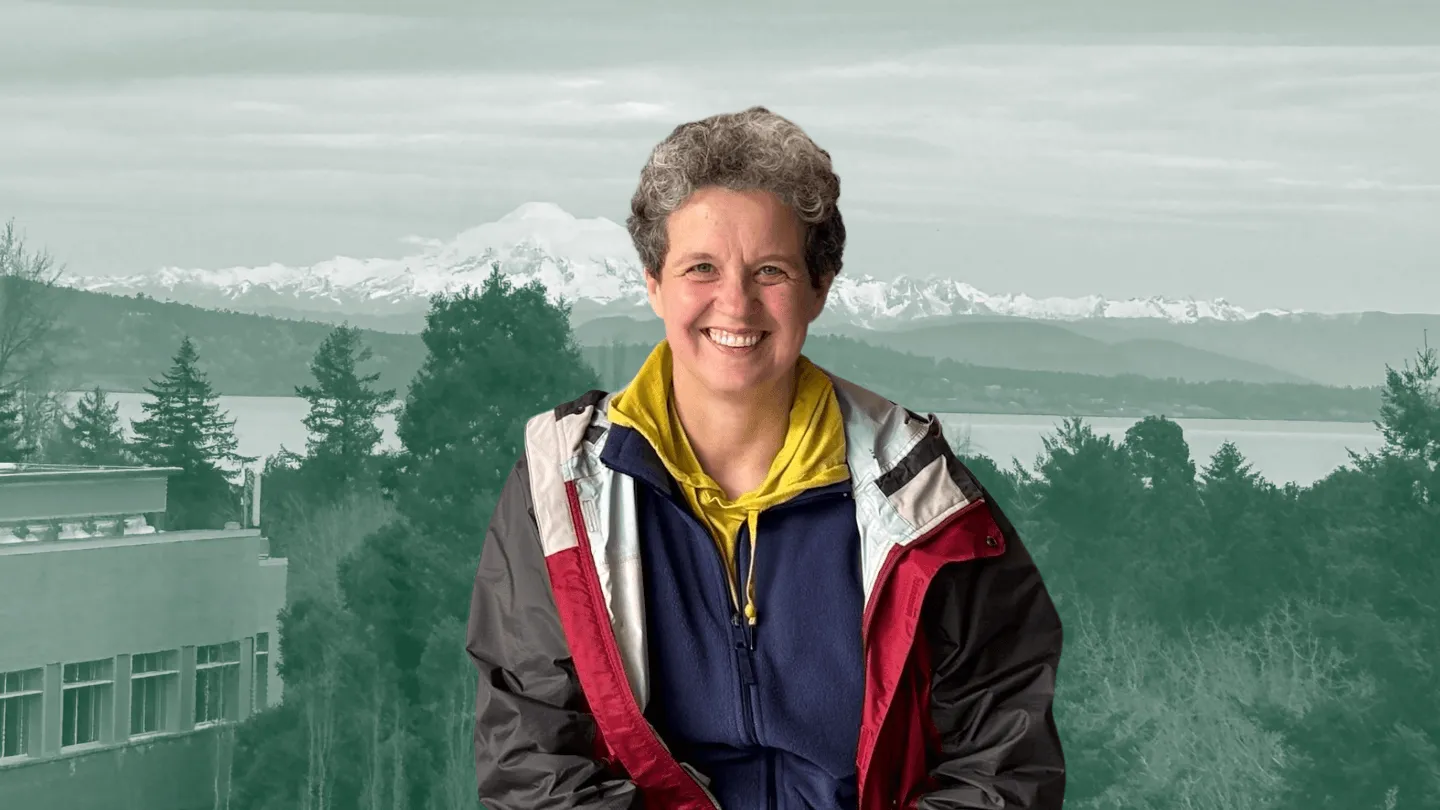
In late October, UVM Professor Maureen Neumann will take the stage at the Lowell High School Auditorium, in Lowell, Massachusetts, to accept the Distinguished Alumni Award, an honor shared by Lowell luminaries including author Jack Kerouac, U.S. Senator Paul Tsongas, and Metropolitan Opera star Rosaline Elias.
Neumann, who teaches in the Education Department within the College of Education and Social Services (CESS), has her message prepared.
“I want to pay homage to the teachers,” she said during a recent conversation in her office, brimming with 20 years’ accumulation of classroom supplies. “I could not have gotten here without my teachers.”
She recalled a Mr. Gallagher, who wore “Mork from Ork suspenders” and “exuded a love and curiosity of learning that was infectious.” She credited a French teacher, Mr. Boisjoly, for inspiring her to “think of a world outside,” and likewise cited her high school’s historically diverse demographics for inspiring curiosity and learning from different cultures.
Neumann has spent the past year doing just that. The STEM educator and researcher in mathematics and education technology received a 2025 Fulbright Global Scholar Award and in 2026 traveled to Canada, Germany, and New Zealand. Her mission was to understand best practices, barriers, and innovative strategies for leveraging Generative Artificial Intelligence (GenAI) in teacher education programs and K-12 classrooms.
After eight months abroad and over 60 interviews across five countries, including the Netherlands and the United States, Neumann is ready to share and engage her findings.
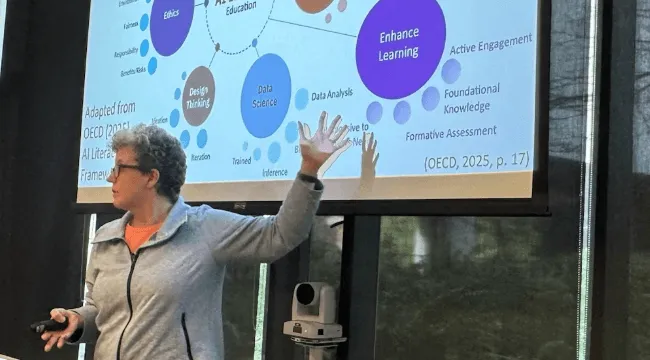
Neumann relayed how each country is similarly expressing concerns over AI’s impact on the environment, equity and access, cognitive offloading, training biases, workforce impact, mental health, and user design. She also noted how the U.S.'s hands-off approach to AI governance stands apart from the global perspective. Though Canada and New Zealand have yet to instate AI-specific guidance, Neumann cited the European Union’s Artificial Intelligence Act and General Data Protection Regulation as major AI-regulating infrastructure.
“The EU was a beacon of light, like, ‘Hey, you can put guardrails on this,’” Neumann said. “A lot of people in New Zealand were talking about how Australia’s beginning to put those guardrails on with their recent social media regulation.”
Though Neumann did not travel to Australia, she highlighted the University of Sydney’s two-track system as one approach to AI use in classrooms. Within this system, teachers opt for either “no AI” or “minimal AI,” where educators either ban AI outright or limit its use to low-level tasks, such as brainstorming and thought partnership.
“The whole point of learning is productive struggle. You learn from effort. You learn from failing.” —Maureen Neumann
Neumann believes in meaningful—and inevitable—benefits to AI in education as long as proper foundations are in place. During her research, she spoke with faculty who articulated that students who cognitively offload their learning to AI in introduction courses are not building core competencies. At the same time, these faculty believe that a strong foundational knowledge helps students use AI effectively in their senior capstone classes, better preparing them for life post-graduation.
Neumann cited AI’s usefulness in testing by developing practice exams and creating study guides, while also calling out the detriment of asking machines to do the heavy lifting.
“The whole point of learning is productive struggle,” she said. “You learn from effort. You learn from failing.”
Back at UVM, Neumann plans to disseminate her research broadly through presentations, brown-bag workshops, conferences, articles, and a class in the Spring 2027 semester for pre-service teachers. Developing this course has involved consultations with CESS program leaders to help identify what, exactly, their students need to know about AI and to establish objectives for what these students should be able to do.
Does Neumann plan to share her global AI findings with her audience in Lowell?
“No,” she said. “I’m going to tell them that my great-grandmother arrived in America as a young girl, worked in a mill, and spoke very little English,” and how through hard work, struggle, and “a whole bunch of teachers…here I am.”