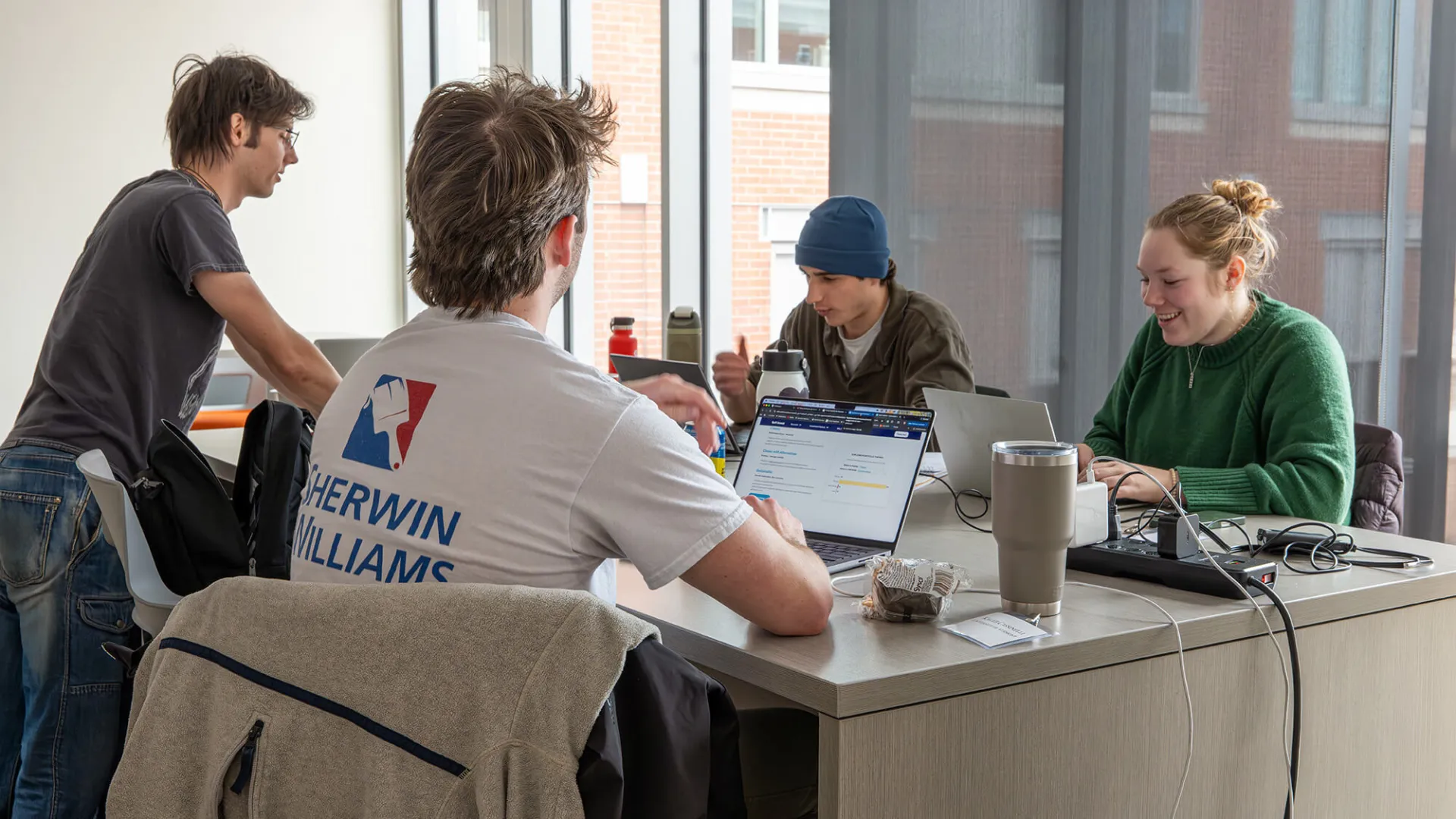
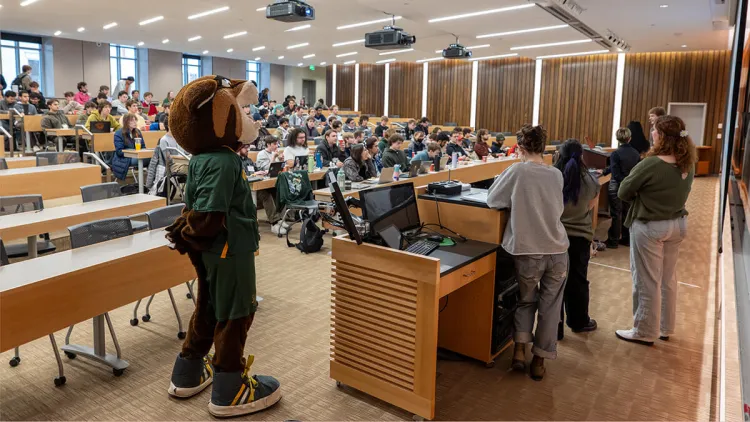
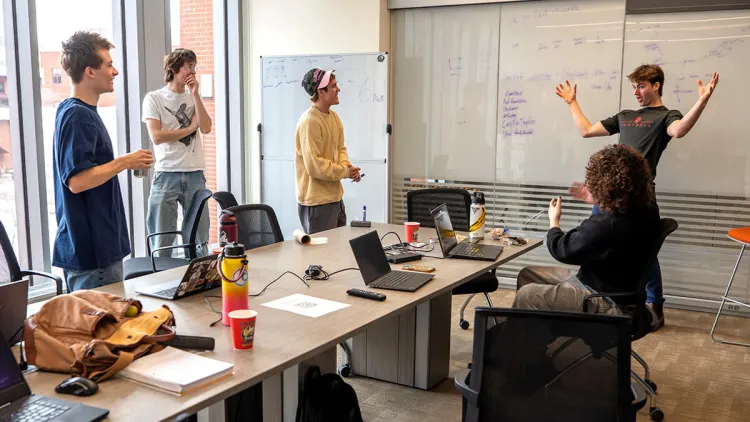
18 teams of computer science and business students were dispatched throughout Innovation Hall this past Saturday for an 8-hour collaborative sprint to solve open-ended real-world problems and compete for $5,000 in prizes by building a project from scratch during the 3rd annual UVM Hackathon.
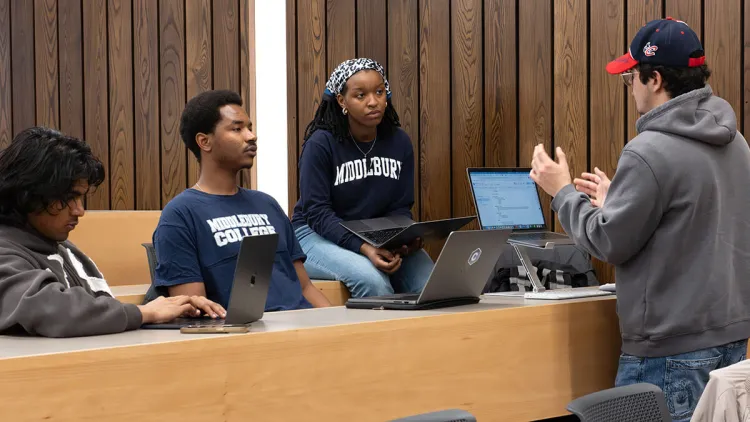
Organized by SWiCS (the Society of Women in Computer Science ), CS Crew, and the College of Engineering and Mathematical Sciences, the event featured over 100 students of all skill levels working together to develop unique solutions in response to prompts inspired by real-world scenarios. This year, students from Middlebury College, Champlain College, and Brown University traveled to UVM to join the competition.
The 2026 Hackathon Organizing team included students Nina Braddock, Kali Banghart, Riley Stutzman, Layla Musallam, Henrik Van Tassell, and Lee Ericson. In addition, a dedicated group of UVM alums, faculty, staff, and graduate students served as judges, mentors, and support staff: Jordan Bourdeau, Eve H., Aaron Perkel, Vincent M., Jason Hibbeler, Jackie Horton, along with former CS Crew members Paul Kiripolsky, Eli Smith, Gian Cercena, Elijah Coolidge, and Jill Dupree.
Event Sponsors included SymQuest, Flagstar, Benchmark Space Systems, Logitech, Versana, Reach Capital, and Google Gemini.
What is a hackathon?
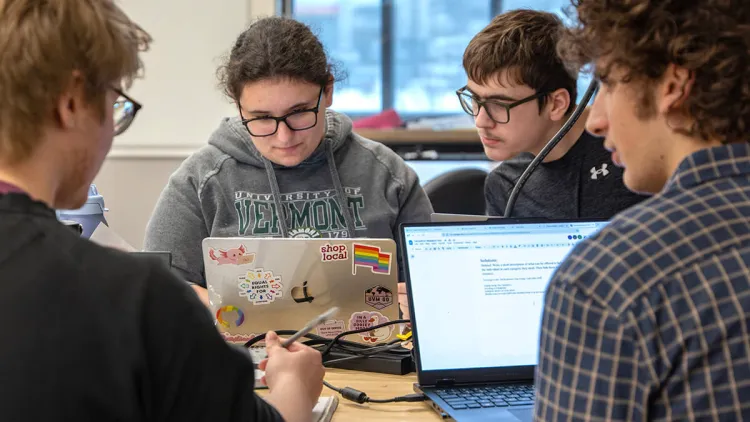
Imagine a high-speed collision between a science fair, a startup incubator, and a Red Bull-fueled brainstorming session. That’s a hackathon. Despite the name, it has nothing to do with "hacking" into the mainframe or wearing a black hoodie in a dark room. It’s actually a "marathon of making."
Combining "hack" (exploratory coding) and "marathon,” hackathons are time-bound problem-solving events that focus on innovation, rapid development, and teamwork. Participants choose between a selection of prompts that allow them to leverage the full creativity of their members. During the event, mentors are available to support teams and plenty of food is provided to fuel the teams’ endeavors. At the end of the day, teams share their projects with each other and the judges who then select the best projects for the top prize for each challenge.
This year's challenges:
1) FinTech for Financial Literacy: Create a FinTech (finanical technology) solution that helps college students and/or recent graduates to improve their financial literacy and make smarter financial decisions while ensuring the security of the system.
2) Sustainable Tech Solutions: Build a sustainable technology solution that can help individuals, businesses, or communities reduce their environmental impact.
3) Best Use of AI Powered by Reach Capital: Reach Capital wants you to build an AI-powered solution for frontline workers (construction, retail, healthcare, etc.) that meets them where they are — on the job and on the go. The winning team will receive Logitech webcams and be considered for a grand prize: a meeting with Reach Capital’s expert investors!
2026 Winning Teams
- 1st Place > Handoff AI (Middlebury College): Esdras Ntuyenabo, Ineza Mizero Ines Kevine, Dante Aguilar, and Prashanth Babu
- 2nd Place > Loan Lens - Redacted: Holden Richard, Nicolas Fay, Tyler Sheehan, and Mason Ritchie
- 3rd Place > Chaunceys Chosen (Champlain College): Ryan Buck, Deris OMalley, Thomas Flavin, and Christopher Eichert
2026 Hackathon Image Gallery