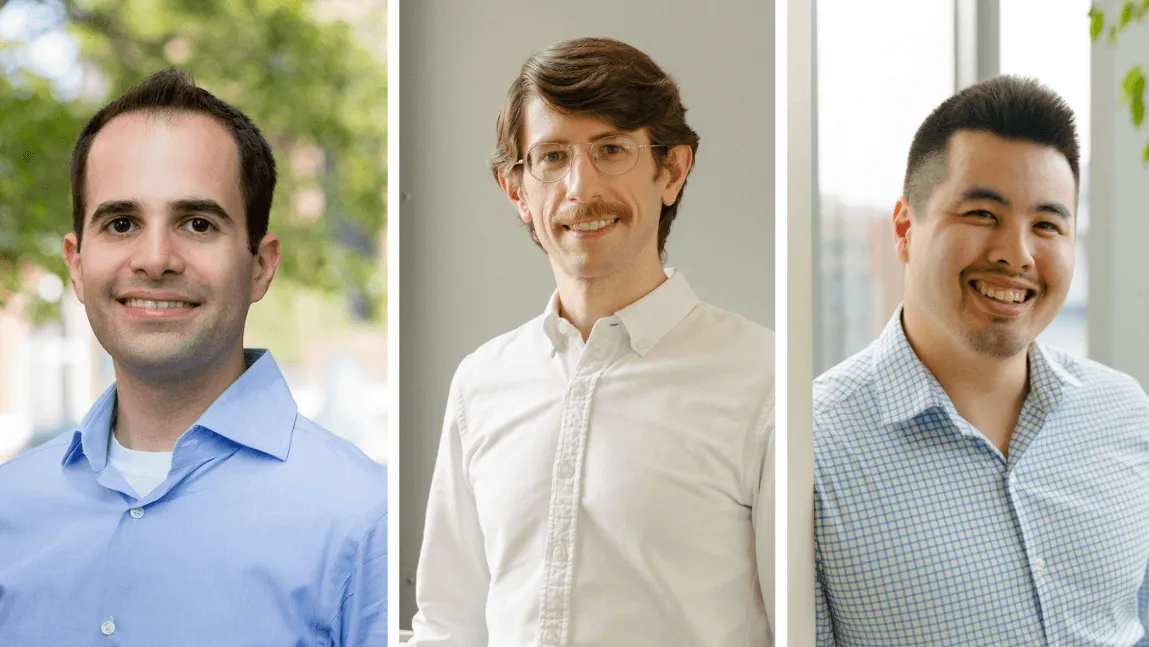
College of Engineering and Mathematical Sciences (CEMS) assistant professors Nick Cheney and Joe Near from the Department of Computer Science and Hamid Ossareh, Associate Professor of Electrical Engineering, have received National Science Foundation CAREER Awards. The honorees join over 30 other CAREER grant winners at the University of Vermont (UVM) from the last 20 years.
The National Science Foundation (NSF) is an independent federal agency created by Congress in 1950 "to promote the progress of science; to advance the national health, prosperity, and welfare; [and] to secure the national defense..."
The agency’s Faculty Early Career Development (CAREER) Program offers the NSF’s most prestigious awards in support of early-career faculty who have the potential to serve as academic role models in research and education and to lead advances in the mission of their organization. The awards, presented once each year, include a federal grant for research and education activities for five consecutive years.
Linda Schadler, Dean of the College of Engineering and Mathematical Sciences, puts the awards into context. “Recognition of UVM faculty with CAREER awards signals the high quality of our faculty and the impactful work they are doing,” she said. Christian Skalka, Chair of the Computer Science department, agrees. "These awards reflect the exceptional talent and impact of our Junior Faculty," he said. "Due to their efforts and to the innovative, supportive community we're working to create in the Department and in CEMS, we are achieving a higher level of impact and visibility in the broader scientific community." As for the winners themselves? Read on to see how their work – in artificial intelligence, data privacy, and automated control – is critical right now.
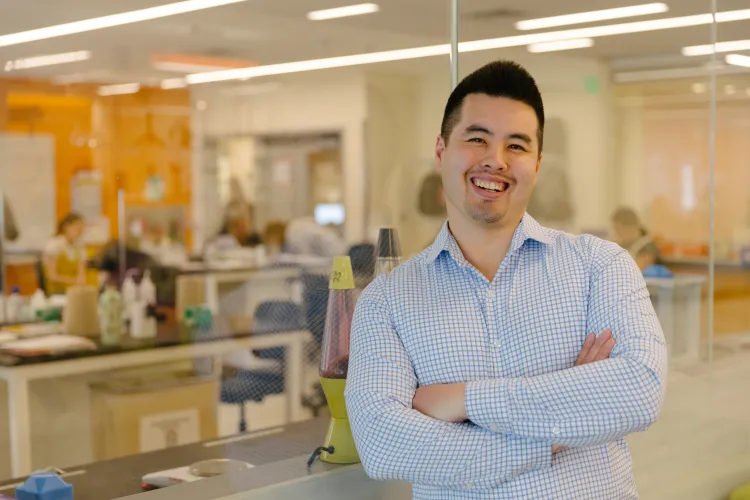
Nick Cheney
"Nick Cheney is conducting pioneering research on biologically-inspired neural networks with profound implications for machine learning and AI." -- Christian Skalka
What interests you most about Artificial Intelligence and Machine Learning (AI/ML) right now?
This CAREER award takes inspiration from how human/animal brains and bodies grow and evolve to improve the construction of artificial neural networks (synthetic "brains" that power many of our current AI/ML tools via "deep learning").
We draw inspiration from biological systems – how human/animal brains and bodies grow and evolve to improve the construction of artificial neural networks (synthetic "brains" that power many of our current AI/ML tools via "deep learning"). We’re not looking how a particular brain looks or is organized, but trying to understand and replicate the processes that originally designed them.
The idea of growing neural structures is in stark contrast to how most deep neural networks are built right now -- static structures that are manually engineered based on our very limited knowledge of how these systems work best.
What excites and interests me most in this field right now are three complementary, but antagonistic, ideas: (1) that larger neural network models tend to be more effective, and (2) these very large networks are also more easily trained (which is surprising since in most other contexts, more complex models are more difficult to optimize), but yet (3) it turns out that only a very tiny fraction of these huge neural network models are then actually used for making predictions about data.
This surprising disconnect suggests, at least to me, that there are opportunities to better understand something very fundamental about how deep neural networks of different size and shape learn -- perhaps including methods that require far less data, computation, and energy than current approaches. I'm excited to try to better understand this phenomenon and use it to build more efficient, adaptable, and robust machine learning systems!
What do you love about teaching?
I love the experience of learning something brand new from scratch, to be a complete novice and get to experience the fun part of the learning curve where you’re improving so rapidly. I try to be a novice whenever I can in my research, learning about new topics every day from many awesome collaborators that are experts in their own fields. Being able to guide students through this type of learning experience over and over again is what I love about teaching -- seeing students come in on the ground floor and build up their own expertise and confidence is so gratifying.
The energy and curiosity that students bring is so infectious and feeds into my own research and learning as well. I think that there is no better expression of this, and no better learning outcome for students, than what we see in project-based learning. Here students have the opportunity to dive deep into the weeds of a research project -- figuring out the complexities and practical challenges of real-world problems and being able to overcome these speed bumps with the guidance of a helping hand.
A major aim of this CAREER award is to stand up the UVM Data Collider, an organization to make it easier to connect students in project-based data science and machine learning courses at UVM with stakeholders, open problems, and real-world datasets across the university and medical center, or from government, non-profit, and industry partners around the state and beyond who are looking to connect with talented data-scientists-in-training.
What does winning the NSF CAREER award mean to you?
It's quite an honor to be selected for an award like this. It’s a humbling and surreal experience to be in the same boat as many outstanding scientists and educators that I look up to who have previously won this award. It's also a great opportunity and well-deserved recognition for the students in my lab, whose work this award will fund and who generated the prior enabling results that led us to be competitive for this award from the start. It's also quite reassuring that NSF saw the potential in our lab's long-term vision and found our work to be worth taking the risk to support. The emphasis on the broader impacts of CAREER awards is also such validating feedback on the work that we, as a lab, have put in on educational outreach, inclusive culture, tech transfer, and interdisciplinary science. The support from colleagues and the community here has been so gratifying, and their help in securing, celebrating, and (soon) carrying out this award is extremely meaningful as well.
What projects are you looking forward to working on in the future?
This award is part of a much broader portfolio of work in my lab funded by the National Science Foundation, Department of Defense, U.S. Department of Agriculture, National Institutes of Health, and industry partners like MassMutual, Medidata, and Google -- so there are many directions that we hope to push forward on bio-inspired AI. The broader trend that excites me across all these works is doubling down on use-inspired basic research, where we can identify fundamental problems in AI/ML that limit our collaborators' ability to tackle open problems in domains like health, wellness, and environmental science -- and where improving AI/ML models and algorithms may directly enable that important work. I hope that the work on all of these awards will enable us to better apply AI and ML in situations where we don't have the large, labeled, and static datasets (that are assumed to be present for so many current methods, but are rarely the case in practice) and make progress on problems with small uncurated datasets that continually change over time.
What do you appreciate about being at UVM?
As a proud native Vermonter, a UVM alum (B.S. '12), and someone with deep family ties to the university, it's wonderful to be a part of the UVM community and here in VT. There's so much to love, but by far what I'm most appreciative of are the people I get a chance to work with, and the support of my family to be able to take on that work. I have outstanding colleagues, brilliant collaborators, and a research lab full of dedicated and insatiably curious students. My home units of Computer Science and Complex Systems have such a collaborative, inclusive, and playful culture. So much of my work is interdisciplinary and relies on outstanding people across the university. Overall, it makes such a difference to come to campus and get to hang out and do interesting and meaningful work with so many close friends and top-notch human beings.
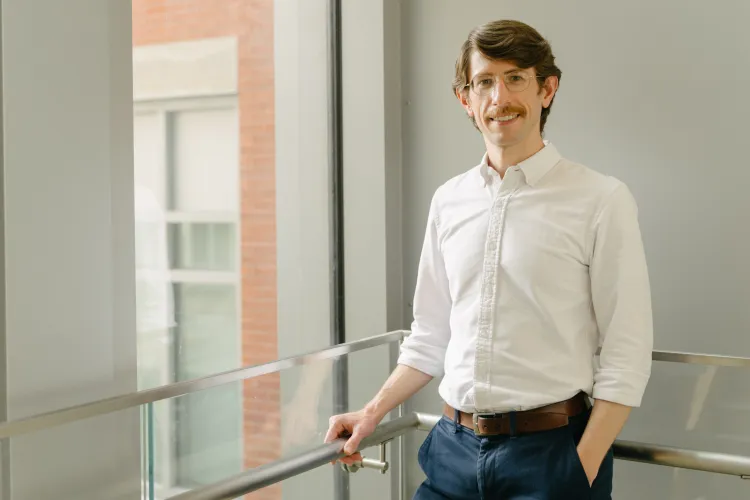
Joe Near
"Joe Near is an internationally recognized expert on data privacy working to improve security and trust in machine learning and computer networks." -- Christian Skalka
What interests you most about data privacy, applied cryptography, and programming languages right now?
This particular combination has been really exciting during the past few years, because the explosion in AI and big data analytics has led to many new privacy challenges. A lot of these challenges can only be addressed by combining ideas from these three areas.
What do you love about teaching?
I love the excitement that students bring to the subject, and the new ideas they generate – I find the whole process really fun and I look forward to it every week. Plus I find that teaching requires me to find the simplest, most essential part of a concept - and this process often helps me understand the concept better myself. I find that understanding really satisfying.
What does winning the NSF CAREER Award mean to you?
It's an exciting recognition of the hard work we have done over the past several years. My proposal was strong because I was able to point to significant results, led by current and former PhD students in my lab - including Chiké Abuah, Ivoline Ngong, Mako Bates, Krystal Maughan, and Syed Jafri.
What projects are you looking forward to working on in the future?
I'm really excited about the potential use of applied cryptography to enable better solutions for privacy-preserving AI and data science. The approaches deployed in industry today still require the collection of raw data; the ability to compute on encrypted data would eliminate this requirement and enable the kind of data-driven advances we're seeing today, without the associated privacy concerns.
What do you appreciate about being at UVM?
I really appreciate the community of students at UVM - both at the undergraduate and graduate levels. Their enthusiasm keeps me busy since there's always something new to think about!
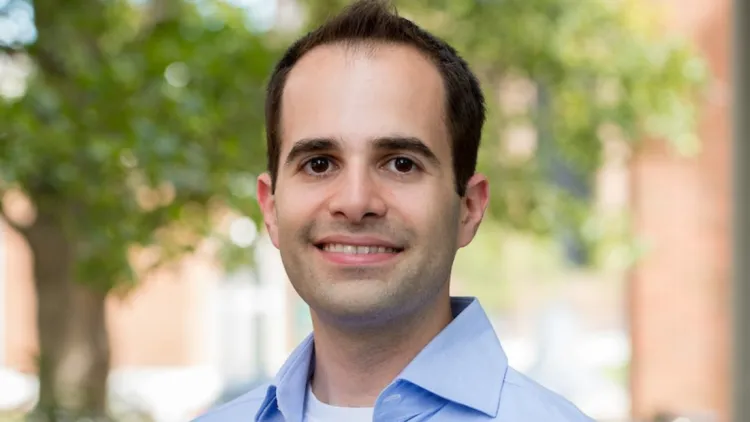
Hamid Ossareh
What interests you most about your work right now?
Automatic Control has played a pivotal role in shaping our modern society through technologies such as the power grid, cars, aircraft, and satellites. Traditionally, the controller design paradigm relied on identifying a mathematical model of the dynamical system for controller selection. However, the increasing complexity of engineered systems poses modeling challenges, resulting in underperforming controllers. Recent advances in sensors and computing have sparked a shift toward a “data-driven” (model-free) paradigm, but these controllers often lack interpretability and are difficult to tune. In my CAREER proposal, I aim to integrate model-based and data-driven paradigms to establish a new framework for control of complex dynamical systems that is easily tunable, interpretable, and provides guarantees of performance and safety. My passion for this field stems from scientific curiosity, theoretical interests, and the potential to revolutionize industries like power systems while creating numerous new possibilities.
What do you love about teaching?
I have a passion for teaching and empowering students with the knowledge, tools, and skills they need to succeed in their careers and make a positive impact on society. Having even a small influence on their lives brings me immense joy. I view course development as an art project, where I can exercise my creative freedom to craft engaging and comprehensive content. From designing the syllabus and creating lecture notes/assignments/exams to conducting office hours, I find great satisfaction in the challenge of creating effective and cohesive learning experiences.
What does winning this award mean to you?
I am honored and privileged by the fact that my proposal stood out among a pool of highly competitive submissions. The experience is quite humbling. This award gives me the freedom to pursue my educational and scientific passions, while at the same time working with undergraduate and graduate students that will become leaders in the field. This award is not mine alone. Credit also goes to my mentors, collaborators, and most importantly, my former and current students.
What projects are you looking forward to working on in the future?
I am excited to continue expanding my research in the area of data-driven control, and apply my research to power systems, automotive, and aerospace application areas.
What do you appreciate about being at UVM?
I love the tight-knit community of friendly faculty and energetic students, and the availability of resources to do cutting edge research.