As the climate changes, scientists are concerned about how well plants and animals will adapt to rapid warming. A new University of Vermont study explored the early embryonic life stage of a globally common fruit fly, Drosophila melanogaster, looking at how the eggs responded to temperature variability at the genomic level. The scientists compared genetically distinct flies from different climatic regions in North America, and what they found was surprising. Unlike adult fruit flies, which show little difference in their ability to tolerate extreme heat regardless of whether they hail from a warm or cold place, eggs from a fruit fly native to a warm area such as the Caribbean were more heat tolerant than fruit fly eggs from a cold climate like Vermont.
In other words, different life stages evolve differently in response to changes in the environment. The genes that evolve to make tropical eggs more heat tolerant are also responsible for coordinating important developmental processes, such as tissue and organ formation. This discovery runs counter to a previous assumption in the field of developmental genetics: that the genes controlling embryonic development do not readily evolve in response to environmental pressures.
This research, supported by the U.S. National Science Foundation, is an important step toward helping biologists understand how climate shapes life in its earliest stages—and what that may mean for the ability of species to survive in a warming world. This study is among the first to look at the genomics of environmentally triggered evolution across multiple life stages and at a global scale, comparing populations from multiple continents and seasons, ultimately showing that developmental genes evolve in response to changes in the temperature.
The research, led by UVM biologists Brent Lockwood and Joaquin Nunez, was published today in the Proceedings of the National Academy of Sciences.
Early-Stage Adaptation
Previous studies in this area looked mostly at adult fruit flies. “But it’s the early life stages that are absolutely critical,” says Nunez, assistant professor of biology. “There’s a developmental window in which organisms set up many of the physiological tools they’ll rely on later to survive and thrive. If you only look at adults, you miss these patterns.”
The findings don’t just apply to Drosophila melanogaster, either. “The significance of what we found in this study extends to all organisms with complex life cycles—in other words, any organism that develops from an embryo into a juvenile and then into an adult. We, including humans, may all experience environmental stressors that impact the earliest life stages, and this may influence our evolution,” says Lockwood, chair of UVM’s Department of Biology.
“This work combines NASA satellite weather data, global genomic datasets, and experiments we ran here at UVM,” says Nunez. “That synthesis lets us identify genes that define thermal boundaries in flies—and the approach is generalizable to other species. It's a framework for connecting climate, genetics, and physiology.”
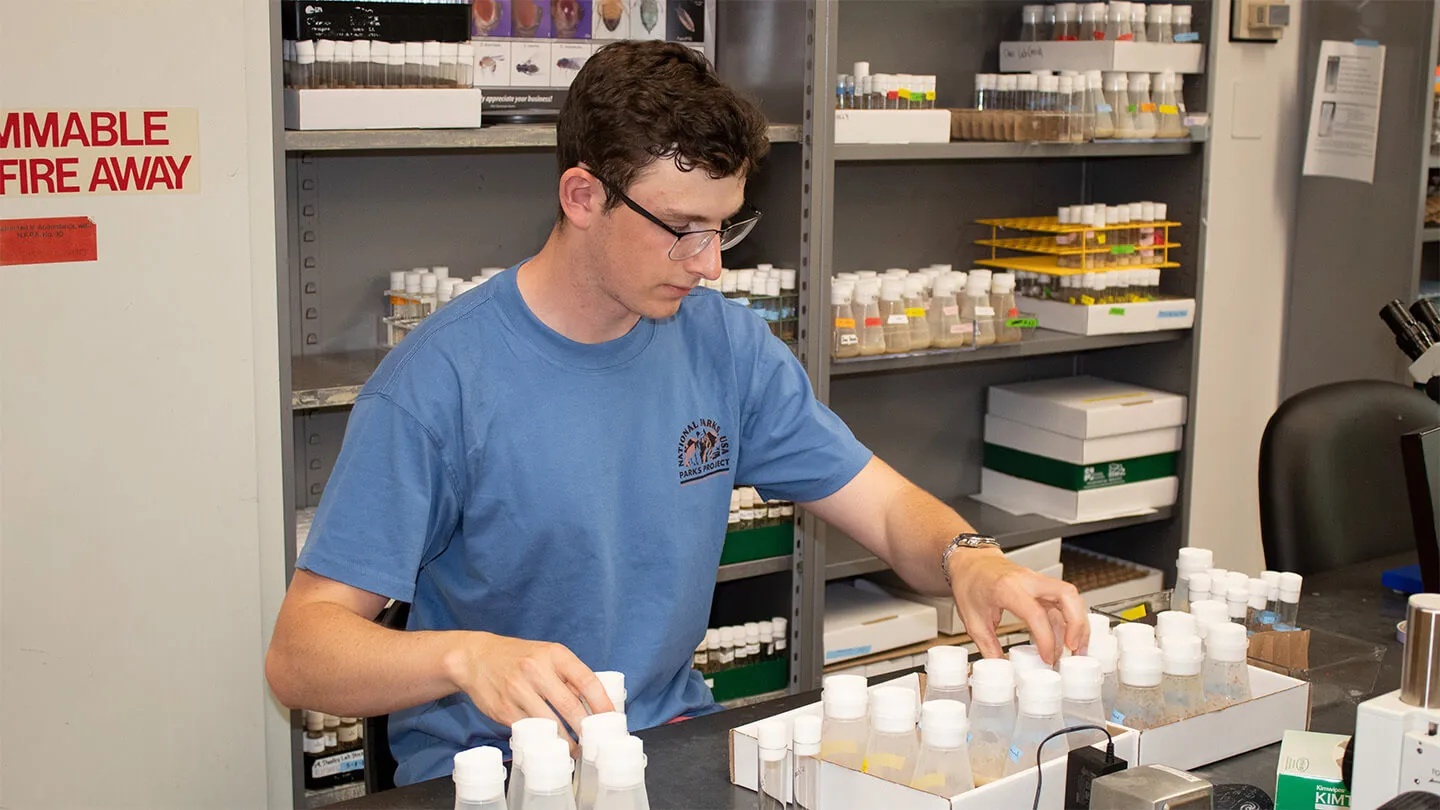
The team—including former postdoc Sumaetee Tangwancharoen (now a professor at Chulalongkorn University in Thailand) and current and former UVM students, Kylie Finnegan (B.S. ’22, M.S. ’24), Eliza Bufferd (B.S. ’25), Luke Proud (B.S. ’25), and Olin King (B.S. ’26)—identified two specific genes that affect the flies’ ability to tolerate temperature changes. The next step in their research is two-fold. First, they want to look at how the genes operate during embryonic development. “We know how they’re expressed overall, but we don’t know what that means in terms of how it’s affecting the physiology of the developing egg,” says Lockwood. The researchers also want to expand their scope to explore how this process works in other species of insects—and beyond.