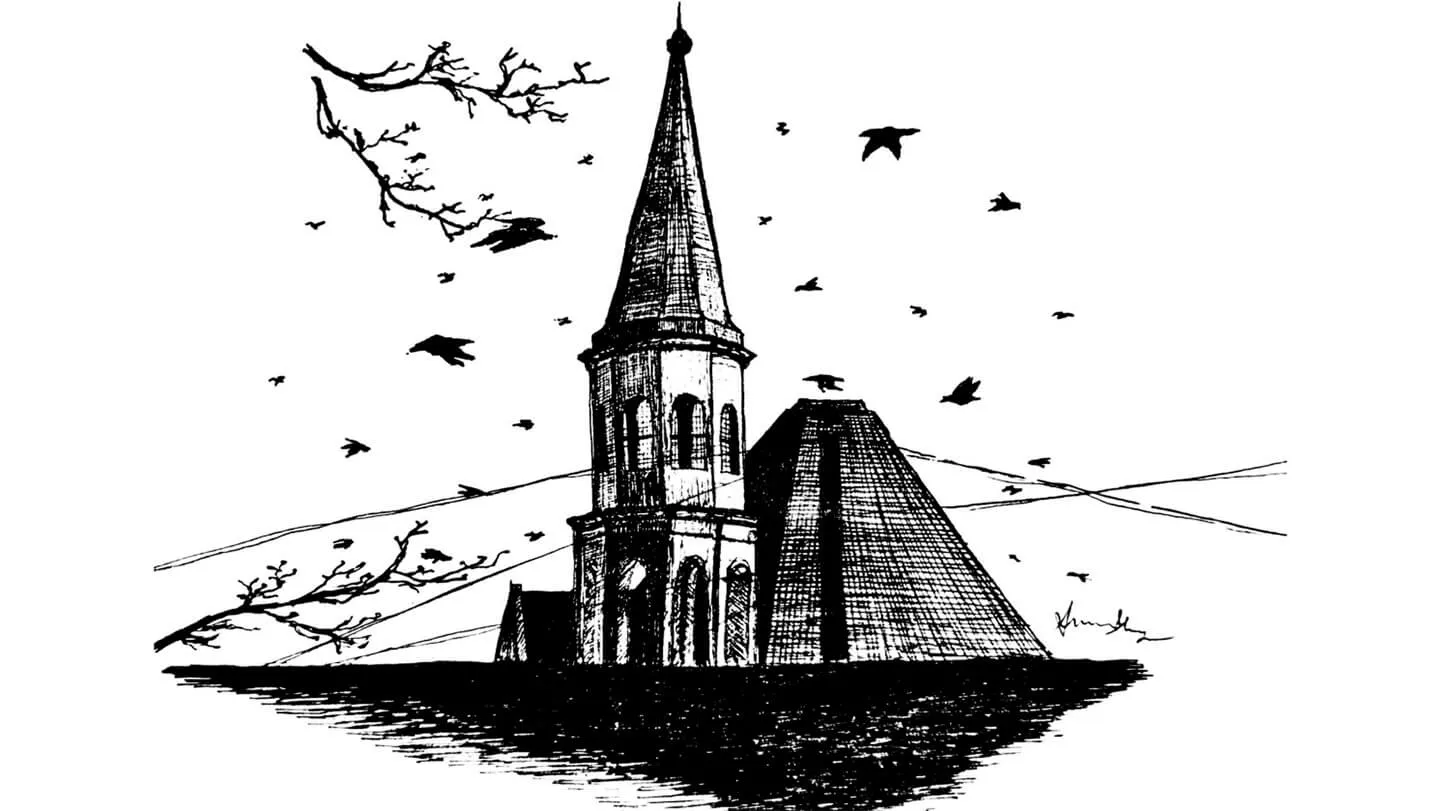
Labeled shapeshifters, tricksters, even harbingers of death, crows have quite a reputation. But Luis Vivanco, Ph.D., chair of UVM’s Department of Anthropology, and some curious undergrads are learning something quite different: that crows are extremely adaptable, playful, intelligent, and undeserving of our ill will.
All of this is happening in the C.R.O.W. (Corvid Relational Observatory and Workshop) Lab, a research initiative, supervised by Vivanco, that began with a simple question. In the fall of 2024, a student asked about crows and the crow roosts in Burlington. It wasn’t an idle question. Crow populations have rebounded in the Northeast since hunting them was outlawed, and on any given winter night, two or three thousand crows take roost in the city.
Intrigued by the student’s question, Vivanco started paying more attention to the crows, even recording their sounds as he walked his dog in an area where they roost. Students’ crow questions kept coming that semester, leading Vivanco to create the C.R.O.W. Lab.
The tongue-in-cheek name is Vivanco’s way of calling attention to what is happening with crows in Burlington, but it’s not a traditional scientific lab (though students do earn credit for their research). Think of it instead as a group of cultural anthropologists whose goal is to examine crows and crow-human relations. “It’s kind of a loose confederation of curious minds,” he says. The lab convened for the first time in the spring of 2025, with 12 students.
“We got together a few times and started thinking about what we want to know,” Vivanco says. “We collected readings from scholarship and online, and we would go out at 4 or 5 p.m. and look for the crow roosts.” The second lab began last month for the spring semester.
The lab meets as a group around three or four times a semester, and students also work in small groups and go on crow walks together. In addition, they meet with Vivanco individually and work on a semester-long project that, in the past, has ranged from drawing comics to making videos to creating maps.
Aaron Mayer ’28, a double-major in anthropology and classics, was one of the original dozen students. He was attracted to the C.R.O.W. Lab by the idea of studying multispecies ethnography, an anthropological approach that expands research beyond humans to include their interactions and coexistence with other species.
As Mayer researched the history of the association of crows with death, decay, and pestilence, he realized that he should be asking why we have assigned them such negative traits. “It is humans who provide the casualties of war, roadkill, and urban roosts that crows thrive on,” he says. “How can we scorn them for cleaning up our messes?”
Another of the 12, anthropology major Adrian Statkevicus ’27, was drawn to the C.R.O.W. Lab because he has long been surrounded by, he says, “people with varying opinions of crows and ravens, with family friends who either love them or hate them.” He was interested in how their personalities as highly intelligent birds might transcend the popular beliefs and assumptions about them.
One fascinating fact about crows is that they display intergenerational learning and can actually speak to each other. “It’s super cool that they have two windpipes with labia, which allow them to talk,” Vivanco says, adding that they’re also playful. “I’ve seen crows here on campus carrying things that they’ll intentionally drop and then swoop down and catch.” Vivanco has even witnessed a crow flying school. “Two older crows were flying along with some younger crows, giving them space, but talking to them in caws that I’d never heard before—encouraging, correcting, teaching,” he says.
For their projects, some of the students in the spring 2024 lab interviewed people who were observing the crows. Others conducted literature searches and looked at the scholarship. Statkevicus spent most of his time scouring old New England newspaper archives for mentions of crows or ravens, then illustrated these stories in mini zines.
A few students made comics for their final projects, as did Vivanco himself. The first crow comic Vivanco made, “On Interviewing Crows,” is a research memo. His second, “Lessons with Crows,” distills much of what the students learned. (The comics can be viewed at Vivanco's website, The Illustrated Wheel.)
Other students took different routes for their projects. One created a map of the diverse symbolic meanings of crows around the world. Another created a photo essay depicting when crows come in to roost in the late afternoon. Yet another shot a video of going on rambles around Burlington and running into other people who were looking for the crows.
Statkevicus says that during his own observations, he would watch the flocks that fly over UVM’s campus daily and record their flight times and pace from location to location in an effort to narrow down possible roosting patterns. “My time outside looking up into the sky, watching crows at sunset, was very peaceful and almost therapeutic—not to mention a good break from looking at screens all day—and it solidified for me the sound of a crow caw as a signal that you are not alone,” he says.
“My work in the C.R.O.W. Lab taught me that our anthropomorphizing of wild animals blinds us almost entirely to their own fascinating lives,” Mayer says. “Crows can mourn, form lifelong bonds, sled down snowy slopes, and exact revenge on meddling humans.” He adds that they teasingly pull at the tails of dogs, play tug-of-war, and harass other birds only to play victim when they face the consequences. “It is very appealing to say that crows are just like us, but we need to learn to flip this assumption on its head and recognize that we may be just like them.”
Vivanco adds that, in this spring’s second round of the C.R.O.W. Lab, he wants to continue to involve students in the open-endedness of the research. “We don’t know where it’s headed,” he says. “I love that feeling. You’re in the middle of a very complicated phenomenon wondering how to make sense of it. And the crow thing is very inviting because it’s right outside our doors.”