College of Arts and Sciences

Careers

The UVM Historic Preservation Program provides you with a broad-based approach to the field of historic preservation. Our primary goal is to prepare you for a wide range of career opportunities in the field, including employment with government regulatory and planning agencies, non-profit advocacy and community development organizations, museum and heritage sites, and cultural resource management firms. The Master of Science in Historic Preservation is the terminal degree in the field, and you will be ready to enter the workforce upon successful completion of your degree. 
Past UVM historic preservation graduates have gone on to work in careers such as: 

  • Architectural historian 

  • Outreach educator 

  • Compliance historian 

  • Cultural resource manager 

  • Grant administrator 

  • Restoration carpenter 

  • Timber framer 

  • Research historian 

  • Historic site manager 

  • Lawyer 

  • Historic preservation consultant 

UVM Historic Preservation Graduates Learn the Top Skills Employers Want

Critical Thinking and Problem Solving

Body

The process of analyzing, evaluating, and addressing deteriorated conditions in a historic building demands strong critical thinking and problem-solving skills. We will teach you how to identify the causes of material degradation, determine the degree of damage, and formulate a restoration plan based on accepted best practices in the field. 

Teamwork and Collaboration

Body

Historic preservation is an inherently collaborative field in which multiple partners must work together toward a common goal. You will undertake several semester-long, collaborative research projects that require close engagement with classmates as well as external partners, including property owners, subject matter experts, and regulatory officials. 

Written and Oral Communication Skills

Body

Every course offered in the UVM Historic Preservation Program includes written assignments, ranging from short essays to detailed research reports. All semester-long research projects include both a written report and an in-class oral presentation. As part of your summer internship, you must present an illustrated public lecture about your internship experience and create and share a scholarly poster presentation about your work.

Professionalism and a Strong Work Ethic

Body

The importance of professionalism is emphasized in all aspects of the UVM Historic Preservation Program. This includes meeting deadlines and the consistent production of high-quality work that is properly formatted, cited, and presented. The development of strong public speaking and presentation skills is equally important and ensures you will have professional success when collaborating with others. 

Initiative

Body

As a student, you will be given leeway in the selection of subjects of your research and writing projects. You must demonstrate personal initiative to identify potential projects, engage with property owners, and undertake the necessary research and documentation efforts to be successful.
Career Outcomes at a Glance

For detailed year-by-year data, visit UVM career outcomes page.

Alumni Spotlights: How the Liberal Arts Shaped Their Careers

Zachary J. Salman ’24 (M.S.)

Body
Person in glasses and a cap holding a heat gun by a wooden doorframe.

Lives in: Troy, NY 

Why historical preservation? “The historic preservation field is a melding of academia and trades, breaking through a divide that seems to be becoming more contentious today. My interest in architectural design, construction, and artisanship led me to explore the ways our built environment bears witness to the events of history and the importance of stewardship for that built history. That stewardship is crucial for both teaching future observers about how our present world came to be and revitalizing historic places in sensitive ways that retain and enhance their inimitable character.” 

Current position: Historic Preservation Technical Specialist, New York State Division for  
Historic Preservation 

What work looks like: “Currently I review scopes of work for the New York State Historic Homeownership Tax Credit, a 20-percent income tax credit for qualifying repairs to owner-occupied historic homes, and for the state's Historic Preservation and Heritage Area grant programs.” 

What he loves about it: “I love being a free public resource for technical knowledge about historic preservation and being in a position in which I can interface with New York State citizens in a positive and constructive way (pun intended).” 

What he gained from a liberal arts education: “I came from a small high school in rural West Virginia, and my liberal arts education defined a very dramatic transition in my personal development. It gave me direct relationships with people from different walks of life who I never would have met otherwise, as well as the foundation for building professional relationships and preparing for more dynamic and fulfilling career prospects. My liberal arts education was essential for finding my way to my ideal  
career. I began with little idea of what kind of job I wanted for myself, or even whether I would be happy in a history-related field, but my college experience allowed me to explore my possibilities and come out with a clearer picture.”

Jenny Fulton ’21 (M.S.)

Body
Person with a backpack taking a photo inside an ornate building with a grand staircase.

Lives in: Vermont and New York 

Why historical preservation? “From earliest childhood I’ve noticed architecture and places and how people engaged with them. As an undergraduate I didn’t know whether I preferred to research and write about this or to make it, but for sure I was curious and wanted to be on my feet and using my hands. After undergraduate I embarked on a career as a designer in theater, film, and, later, architecture, and it was fun for a couple decades. As I got older, my interests evolved back in the research and writing direction and led me to the UVM Historic Preservation graduate program and my current job. But I still maintain a design practice and take calls with New England’s IATSE Local 919, the stagehands union. Go liberal arts!” 

Current position: Preservation Planner II at Vanasse Hangen Brustlin, Inc.’s Winooski office 

What work looks like: “Fieldwork, documentation, communication, and a great deal of research, analysis, and writing. I am a cultural resource management consultant.” 

What she loves about it: “I get to be a history detective, I can advocate for sustainability and conservation—the greenest building is the one already built—and I work with some pretty cool, passionate people.” 

What she gained from a liberal arts education: “Research, analysis, and writing, for a start. An understanding of what we’ve been up to, over the centuries, as humans. An ability to think strategically, to make conceptual connections and grasp systems, to relish complexity and paradox, and to communicate in words and images. The older I get, the more useful the liberal arts degree gets.” 

Will Gansle ’20 (B.A.), ’23 (M.S.)

Body
Person wearing a backpack standing in a forested mountain landscape.

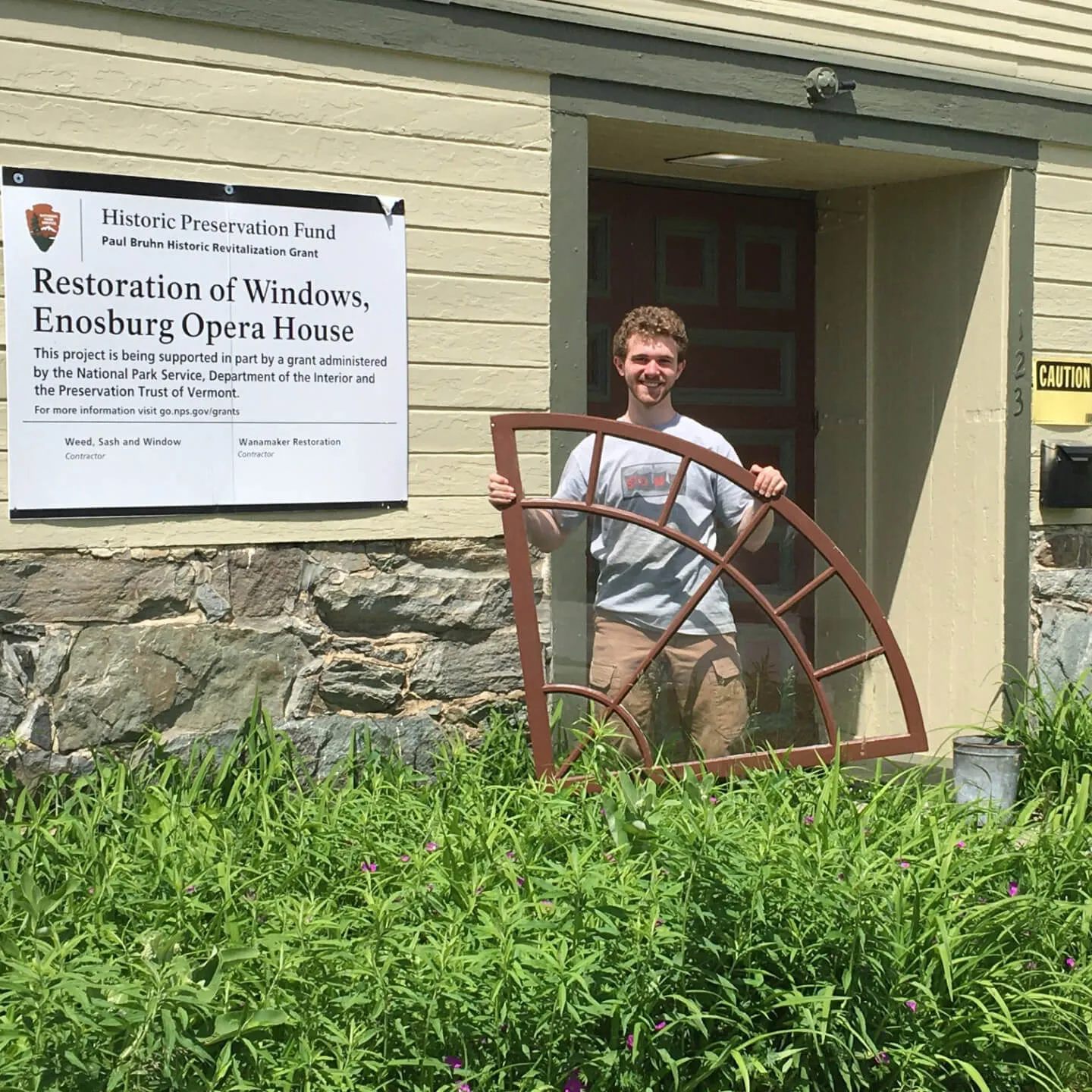
(also shown near the top of the page in front of the Enosburg Opera House)

Lives in: Burlington, VT 

Why historical preservation? “I have had a lifelong love of history and have wanted to be involved in some way in that field ever since I was a kid. I chose to complete my master’s in historic preservation because although I had previous carpentry experience, I value having a strong academic background in the field, and I think my two paths are mutually beneficial.” 

Current position: Historic Resources Specialist – Architecture at the State of Vermont Agency for Commerce and Community Development, Division for Historic Preservation 

What work looks like: “My job entails reviewing historic preservation projects for compliance with Section 106 of the National Historic Preservation Act of 1966, criterion 8 of Act 250 (Vermont’s land use statute), and 22 VSA (Vermont’s historic preservation statute). I read construction documents, interface with federal agencies and community representatives, and provide technical consultation and advice to municipalities and individuals on how to take care of the historic resources in their communities.” 

What he loves about it: “I love the sheer variety of projects I get to see—everything from the Haskell Free Library in Derby Line to a rejuvenation of a historic town complex in Londonderry. Each project is unique, has its own set of challenges, and requires flexibility and adaptability to take care of the historic resource.” 

What he gained from a liberal arts education: “I gained the ability to think critically and question what I’ve read, and learned how to conduct thorough and exhaustive research into the topic at hand. My liberal arts education also demonstrated the interconnectedness of all fields of study and illustrated the heavily interdisciplinary nature of my work, which combines perspectives from historians, architects, engineers, landscape architects, and myriad other disciplines. Personally, I regard a well-rounded education as one of my most important possessions. Attending an institution such as UVM for both my undergraduate and master’s degrees was a great privilege and has truly benefitted me by making me a more globally minded person who values all perspectives on whatever topic is at hand.” 

Ready to Turn Interest Into Action?

Inquire for details or begin your application today.