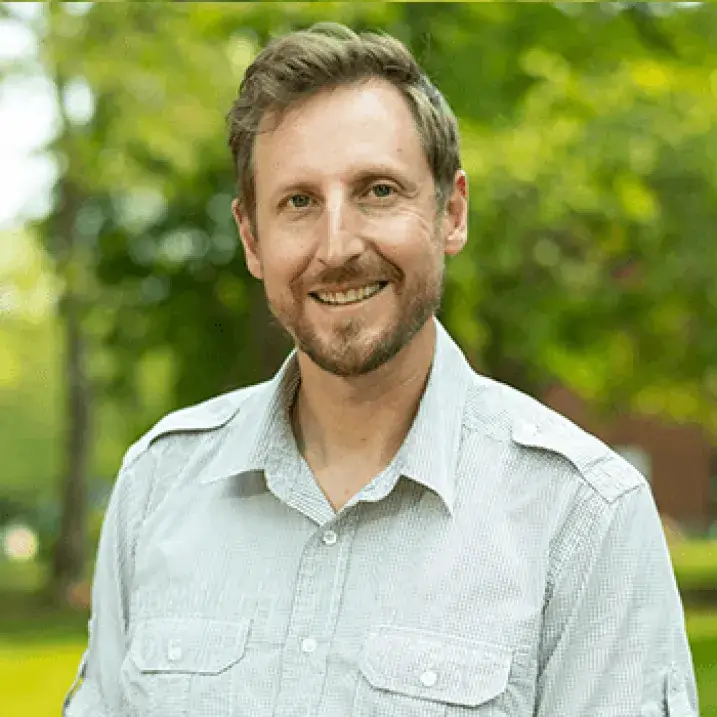
Harlan Morehouse
Assistant Professor, Geography and Geosciences
Co-Director, Environmental Studies
Affiliate, Gund Institute for Environment
- Ph.D., Geography, University of Minnesota
- MA Sociology and Social Anthropology, Central European University
- BA Literature and Social Sciences, Bennington College
print/web
print/web
JOURNALISTS: Need help scheduling an interview? Contact UVM media relations or search for a UVM expert.
Areas of expertise
Nature and society, social and cultural geography, technology and environment, artificial intelligence (AI), political ecology, environmental humanities.
BIO
Research Bio
My research sits at the intersection of political ecology, environmental humanities, and digital media studies. I investigate how technological systems—from algorithms to artificial intelligence—shape environmental knowledge, perception, and politics amid accelerating ecological change.
Across my scholarship, I focus on how digital media transform the ways people experience, imagine, and act in the world. Current projects examine how digital infrastructures and platform logics influence collective understandings of social and environmental change. Drawing on critical perspectives from geography, media studies, and social theory, my work traces the evolving entanglements of technology, power, and ecology.
Teaching
My teaching centers on critical, interdisciplinary approaches to human–environment relations across a range of scales and contexts. In the classroom, I encourage students to grapple with questions of power, place, and representation, and to critically assess how social and ecological processes shape one another.
Courses
- GEOG 50: Global Environments and Cultures
- GEOG 160: Geography of the United States
- GEOG 173: Political Ecology
- GEOG 179: Cultural Ecology
- GEOG 196: Geographical Perspectives on Catastrophe
- GEOG 245: The Anthropocene
Publications
Bio
Research Bio
My research sits at the intersection of political ecology, environmental humanities, and digital media studies. I investigate how technological systems—from algorithms to artificial intelligence—shape environmental knowledge, perception, and politics amid accelerating ecological change.
Across my scholarship, I focus on how digital media transform the ways people experience, imagine, and act in the world. Current projects examine how digital infrastructures and platform logics influence collective understandings of social and environmental change. Drawing on critical perspectives from geography, media studies, and social theory, my work traces the evolving entanglements of technology, power, and ecology.
Teaching
My teaching centers on critical, interdisciplinary approaches to human–environment relations across a range of scales and contexts. In the classroom, I encourage students to grapple with questions of power, place, and representation, and to critically assess how social and ecological processes shape one another.
Courses
- GEOG 50: Global Environments and Cultures
- GEOG 160: Geography of the United States
- GEOG 173: Political Ecology
- GEOG 179: Cultural Ecology
- GEOG 196: Geographical Perspectives on Catastrophe
- GEOG 245: The Anthropocene