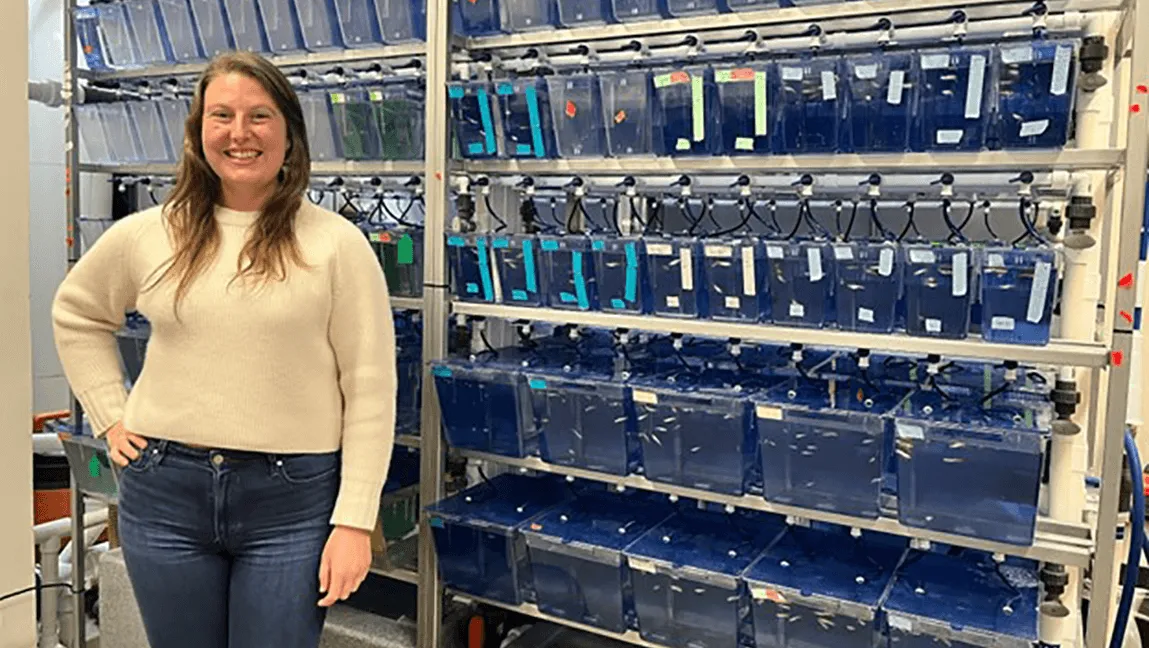
Helaina Stergas is a fourth-year PhD student in the UVM Biology Department. In her role as a PhD student, she is completing research in Dr. Alicia Ebert’s lab and teaching undergraduate Biology courses. Recently, Helaina was awarded the 2022-2023 Rodney L. Parsons Anatomy and Neurobiology Award which is given to one UVM doctoral student each year who demonstrates exemplary work in both research and teaching in an anatomical science field.
Helaina has been a part of the UVM community for nine years, and has worked in Dr. Alicia Ebert’s lab for eight. She began working in the Ebert lab when she was a sophomore undergraduate student majoring in Biological Sciences. Helaina learned about the Accelerated Masters’ Program that UVM offers through the suggestion of Dr. Ebert, who offered for her to continue studying after her time as an undergraduate. Immediately after graduating, she stayed at UVM to complete the AMP program, and considered staying for a PhD. After taking one year off, Helaina was eager to jump back into a PhD program. Now, she’s hoping to defend her dissertation at the end of this December.
A large part of Helaina’s decision to return here to complete her PhD was tied to her love of the community. She said, “I love UVM. I love the people here, I love the environment, and I love Burlington... that was a big part of me wanting to come back here for my PhD, I just didn’t feel like I was done in Burlington and at UVM.”
Helaina’s work in the Ebert lab is on eye development. Her main area of interest is cell migration in the central nervous system, where she focuses on how cells identify and reach their destinations in the cell migration process. As she described it, “I’m interested in how the cells talk to each other, in order to find their home in the adult structure.” In order to investigate this question, the Ebert lab studies proteins relevant to cellular communication, using zebrafish as a model organism. To learn the importance of the proteins in cellular communication, Helaina studies what happens when proteins are removed or reintroduced into organisms and how these modifications impact development.
Helaina has previously given talks on her research, which has helped her master the skill of discussing her work broadly. She said, “I’m interested in trying to figure out how we, as complex organisms, become who we are... Because a lot of people tend to be familiar with the concept of cells in our bodies... The way I describe it is that I am interested in how those cells get to their correct place. So, for instance, how the brain cells get to our head region as opposed to how our muscle cells get to be in our legs.”
Given the complexity of her work, Helaina values the ability to describe her research to others with non-science backgrounds. She says it's “something that I make myself do because it’s really important for communication.”
During her master's, Helaina began studying Crk and CrkL, two proteins. Crk and CrkL are critical in the cell communication process and in cell migration, specifically. Her project during her AMP was focused on whether Crk and CrkL were important in retina development. To gather data, the lab used CRISPR-Cas9 to mutate Crk and CrkL in zebrafish to study how their development was impacted. They found that the removal of Crk and CrkL inhibited development and led to disorganization in the retina, so her AMP research suggested the importance of the proteins in eye development. With the findings from her master’s, she was able to publish her first paper on the importance of Crk and CrkL, titled “Crk adaptor proteins are necessary for the development of the zebrafish retina.”
Now, her dissertation has expanded beyond Crk and CrkL to similar proteins. She said, “The Crk and CrkL project led me to look at these other protein families that do a similar job, and right now what I’m currently doing is seeing if they also play a role in retina development.” The current proteins of focus for her are Nck adapter proteins.
Though her time at UVM has mostly been dedicated to similar long-term projects in the Ebert lab, Helaina explained that the focus of her research became more specific over time.
“When I started doing this research in undergrad, I was just absolutely fascinated by the organismal structure itself... I used to spend literally hours sitting and watching the embryos—because what’s cool about zebrafish is that you can watch them develop under the microscope if you sit there long enough.”
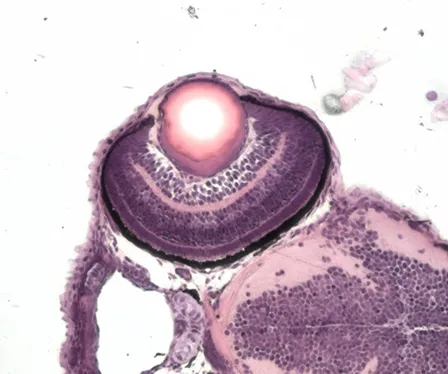
With time, her love of the field shifted from a broad interest in development to a specific curiosity about cellular communication. She said, “Now that I’ve gotten further into my dissertation research, I’m more interested in the nitty-gritty of cell signaling.” Her interest is now rooted in observing minute changes on a cellular level, to see how basic changes impact overall tissue development. She also shared that she’s since become interested in proteins. She said, “I find specific proteins really interesting now, which isn’t something I probably would’ve said six years ago.”
Helaina is a regular instructor in the Cellular and Molecular Biology and Comparative Physiology upper-level courses in the Biology Department in addition to her work in the Ebert lab. In regards to receiving the Rodney L. Parsons Anatomy and Neurobiology Award, she said, “It was an honor to get an award for teaching, because it’s something I’m so passionate about, as well as my research. Of course I think my research is interesting, but it’s nice to think other people think so, too.”
Award recipients receive additional funding, which can be used to further their academic pursuits. Her plans are to use the funding for completing a few major experiments, and potentially using it to go to a conference before defending her dissertation.
The completion of her PhD will be the closing of a major chapter in Helaina’s career. She said, “I’m excited to start to see the end! Not that I don’t love it here, but I’m excited to move on to the next adventure.”
Though she doesn’t have immediate next steps planned, Helaina certainly has a bright future ahead. Helaina said, “I love working in the classroom, but I think I could be really happy in sharing science with more of the public sector, too. And also I have become someone who is pretty passionate about science advocacy, or advocacy for people who do science, like undergraduate students and graduate students.”
In fact, Helaina and fellow graduate student Caroline Dumas recently launched a site called LabBites with some alumni. The website is dedicated to science communication, and helping high schoolers and college students become more familiar with what it’s like to work in a lab.
Whichever path she ends up taking, whether it be teaching, researching, or communicating with the public, Helaina Stergas has left an incredible legacy in her time at UVM!
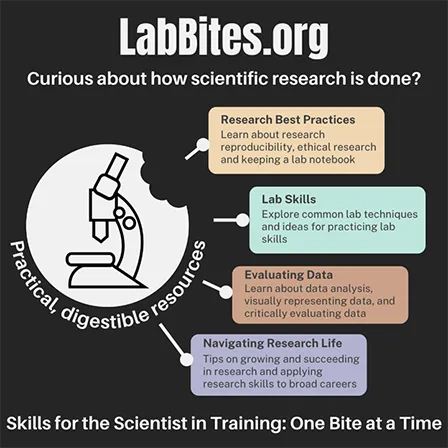
LabBites is a science communications website catered to undergraduate students and advanced high schoolers interested in learning about what it’s like to participate in a lab setting. Founded by Ashley Waldron, Riley St Clair, Sarah Emerson, Caroline Dumas, and Helaina Stergas, the mission of the site is to educate students about specific practices, techniques, and general skills that are critical to lab work. The website launched in 2022 and has since featured articles including data analysis, reproducibility, and locating reliable sources. LabBites is currently seeking early career scientists and graduate students to contribute content to their website—click here to apply!