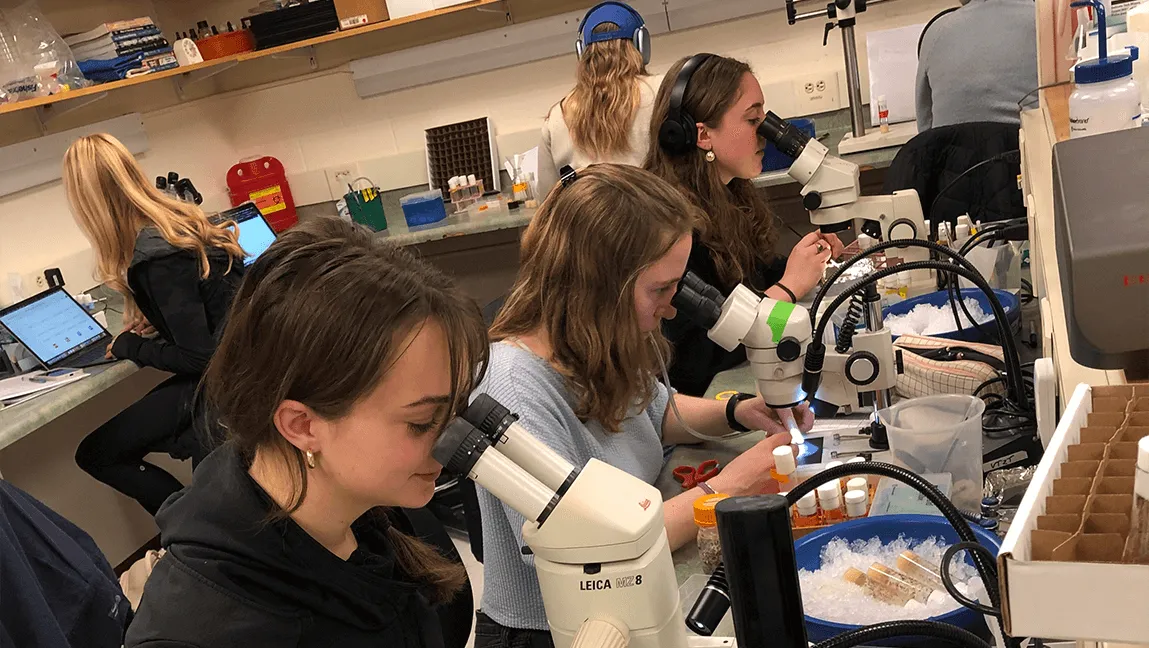
Course-based Undergraduate Research Experiences, known as CURE classes, are a unique feature of our Biology department curriculum. These classes give students a real research experience in a classroom setting, and each course is based around the professor’s personal research interests. Compared to traditional lab courses where the experimental results are known, CUREs investigate unknown questions and some CURE class results have been published in scientific journals. Not only do these classes give students undergraduate research experience, but they may also provide scientific journal publications to add to their CV. Chair of the department, Dr. Ballif says, “In recent years Biology has been developing more research opportunities for students using real research experiences in laboratory courses. These CURE courses can increase research capacity and can be highly successful for students to gain research experience, and to help further faculty research goals.”
The CURE classes offered each semester give a broad scope of different fields of study in biology. From proteomics and genetic tools to study molecular/cellular mechanisms of development and behavior, to soundscapes of marine mammals and understanding the impact of a warming climate, there is truly something of interest for any biology student.
Unanimously, students love these classes. CUREs by nature are small and create a group of tight knit young scholars working towards the same goal. Having a chance for real research experiences as an undergraduate fosters confidence, and flips the narrative on traditional classroom learning. Instead of memorizing specific protein pathways or scientific terms for an exam, students learn scientific methods by actually doing science. Calista Hanna, a senior in Dr. Lockwood’s class says, “Performing experiments and having lectures in the same room made the class feel cohesive, and a small class size meant we had access to strong professor-student interactions.” Hailey Rosenfield, a junior in Dr. Stanley’s class says, “This class is fun! Due to its small size, we all developed a good rapport which made working on an individual project not so lonely.”
In CURE classes, students undergo the full scientific process from start to finish. First, students must think like research scientists by understanding relevant background for their projects, constructing experimental protocols, and learning research techniques. Then, they work together and independently to troubleshoot experiments and collect data. Real data can be messy, and students become better scientists as they learn to adapt their technical skills and actively problem solve. Analysis is done using a variety of computer programs and may include graphical figure construction and complex statistical tests. Finally, students present their work in cumulative oral presentations, posters, or a written final paper.
Senior Marlana Winschel says that when compared to other lab classes she’s taken, “One of the best lessons I’ve learned in [Dr. Stanley’s class] is the importance of scientific resilience.” This is the idea that even when you have a sound protocol and hypothesis and think you will get perfect data, sometimes a negative result is still a result. Oftentimes, real scientific research is all about trying different approaches to see what works best. Students may not realize this until they join a lab outside of the traditional classroom setting. Hanna adds, “The independence and trust you are granted during this class are a refreshing experience compared to most undergraduate lab courses.” She strongly recommends that anyone interested in biological research should take a CURE class.
Recently, the 12 students from Dr. Ballif’s first CURE course in 2019 published their research, all as co-authors. The study was led by former graduate student, Anna Schmoker, and one of the students in the course, Caroline Dumas, is now a Ph.D. candidate with Dr. Ballif and Dr. Ebert. In the near future, Helaina Stergas, another graduate student in the Ebert lab will submit an article co-authored by the 12 students from the 2021 CURE class.
Dr. May-Collado has published four scientific papers since 2019 that include data generated in CURE courses, and 12 students are listed as co-authors alongside May-Collado lab members and international collaborators. Many of Dr. May-Collado’s students have also presented their CURE class results as posters at student research conferences. In Dr. Ebert’s new CURE lab, students presented posters of their work as final projects with the expectation that all data will be compiled and submitted to a peer-reviewed journal as co-authors. Similarly, Dr. Stanley plans to use the data compiled from this semester’s brand-new Advanced Genetics CURE class in future publications with students credited as co-authors.
In their own words, here are some brief descriptions of five of the CURE classes offered by professors within the department.
Advanced Genetics: Crispr/Cas9 gene editing in zebrafish eye development
“In this course, students use zebrafish as a model organism to test the expression and nervous system function of unknown genes of interest to the Ebert lab. Using data collected from BIOL 205 (Advanced Genetics and Proteomics), students use modules and publicly available databases to explore protein homology, structure, functional domains, and predicted mRNA expression in a variety of developmental model organisms. Along with these modules, students designed primers, performed PCR, and made RNA in situ hybridization probes to investigate mRNA expression of their gene of interest in developing zebrafish embryos. We have created expression profiles for 10 unknown genes of interest and students present their data to the class. The class voted on the top 5 to pursue for genetic knockdown. In pairs, students designed CRISPR guide RNAs, learned zebrafish microinjections and knocked down their genes in a variety of transgenic lines expressing fluorescent molecules in a variety of nervous system tissues. The students imaged their fish on brightfield and fluorescent microscopes and the results of this course led to some exciting genes that the Ebert lab will be following up on in the near future. Also, the data collected will be written up for publication with all students as co-authors for a special education edition of the peer-reviewed journal Zebrafish this summer.”
-Dr. Alicia Ebert
Advanced Genetics: Genetic tools to study feeding behavior in fruit flies
“In this course, students design and conduct experiments using genetic tools in fruit flies to identify molecular/cellular mechanisms that drive feeding behaviors. In the first semester of this class in spring 2023, we focused on the proboscis extension response which quantifies a taste-induced feeding behavior in flies. First, we found that a mix of amino acids reliably elicits this feeding response and that several physiological variables, such as biological sex and hunger, impacted this amino acid taste sensitivity. Then, each student designed experiments in genetically modified flies to silence a set of chemosensory neurons or mutate candidate receptors and evaluate the impact on taste sensitivity. Preliminary results indicate that ‘sweet’ taste neurons and neurons expressing a receptor gene called IR76b are required for this the amino acid taste-induced response to occur. Surprisingly, silencing of olfactory neurons to block the sense of smell during this behavior appears to increase this taste response. This data produced by this class contributes to the field of sensory neurobiology and advances our understanding of ‘umami’ taste. I plan to publish data from this class with students as co-authors.”
-Dr. Molly Stanley
Advanced Genetics and Proteomics Lab
“In this class students use hands-on protein biochemistry, proteomics, protein mass spectrometry, and bioinformatics. Of note, another Biology graduate student is using data from my 2021 CURE course in a more developed research article that will be submitted in the coming months. This fall I will be teaching the course again and will use data collected in my 2020 course as well as this fall’s course to generate another publication.”
-Dr. Bryan Ballif
Physiology of Global Change
“Physiology of Global Change” refers to the adverse effects of environmental change that organisms experience due to climate change, specifically global warming. We focus on the small things (i.e., proteins) that have big effects on physiology and investigate (1) how heat disrupts physiology and (2) how evolution has made organisms that live in hot places better able to tolerate heat. This semester, the students have gathered novel data that demonstrate a link between the evolution of heat tolerance and oxidative stress tolerance. What makes these data particularly exciting is that, while previous work has shown a connection between heat stress and oxidative stress, this is one of the first studies to show that heat-adapted populations have evolved enhanced oxidative stress tolerance. Their work has implications for the study of thermal physiology, as well as important predictions about the potential evolutionary outcomes of global climate change.”
-Dr. Brent Lockwood
Soundscapes and Behavior
“My goal is to engage undergraduate students in the application of remote technologies and machine learning tools to study marine communities and their inhabitants. This CURE consists of four components (1) learn basic knowledge on bioacoustics, animal behavior, and soundscapes; (2) work independently, in teams, and in collaboration with international scientists and students, (3) gain confidence in carrying out independent research projects; and (4) acquire skills in analytical analysis and scientific writing and communication. For this CURE, students will work on three core themes: vocal repertoire of marine mammals, impacts of human underwater noise on marine communities, and use unmanned aerial vehicles to study marine mammal behavior. Authentic research experiences and active learning are important components of a scientist’s development but is also equally important to develop good research practices. By the end of this CURE students will have developed good research and collaboration practices, computational and scientific communication skills needed to continue pursuing a career in science or transfer these skills to other career paths. Through this CURE student-mentor interactions, students will have the opportunity to reflect on their STEM interests, what does it mean to be a scientist, and develop a sense of belonging in science.”
-Dr. Laura May-Collado