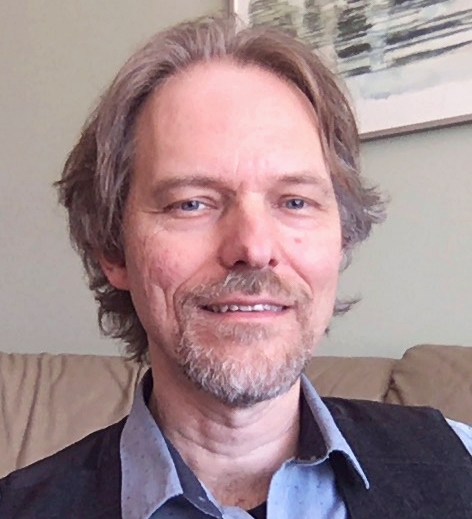
Ph.D., York University, 1997
Professor of
Environmental Thought and Culture
Environmental
Program / Rubenstein
School of Environment & Natural Resources
Adrian Ivakhiv
is a Professor of Environmental Thought and Culture at the
University of Vermont, with a joint appointment in the Environmental
Program and the Rubenstein
School of Environment & Natural Resources. He is
currently a UVM
University Scholar and Public Humanities Fellow, and
recently held the Steven
Rubenstein Professorship for Environment and Natural Resources
(2016-19). He heads the EcoCulture
Lab, which organizes collaborative engagements between
ecologically oriented artists, scientists, humanists, and the
broader community.
Prof. Ivakhiv is
a cultural theorist and ecophilosopher, whose research and
teaching are focused at the intersections of ecology, culture,
identity, religion, media, philosophy, and the creative arts. His
books include Claiming
Sacred
Ground:
Pilgrims
and
Politics at Glastonbury and Sedona (Indiana University
Press, 2001), Ecologies
of the Moving Image: Cinema, Affect, and Nature (Wilfrid
Laurier University Press, 2013), and Shadowing
the Anthropocene: Eco-Realism for Turbulent Times
(Punctum Books, 2018). With its historical breadth and theoretical
innovation, Ecologies of the Moving Image has been called
"capacious
and authoritative," "groundbreaking,"
a "landmark
contribution" to the growing field of ecological cultural
studies, and the first book of "eco-film-philosophy." Expanding
and deepening the eco-philosophy of the earlier book, Shadowing
the Anthropocene presents a process-relational
"philosophy of life," a philosophy that sees images as part of the
battleground in which humans contest the meanings of an
increasingly turbulent world. His current work includes projects
on the Chernobyl
Zone of Exclusion and the philosophy of time, "regimes of
the image," ecological themes and approaches across the arts, and
an anthology of writings on spiritual practice.
Prof. Ivakhiv
has served as president of the Environmental
Studies Association
of Canada, an executive editor of the Encyclopedia
of Religion and Nature (Thoemmes Continuum Press, 2005),
co-editor of the new international, open-access, peer-reviewed
journal Media+Environment,
and on the editorial boards of several journals including Journal
for the Study of Religion, Nature, and Culture, Green Letters, The Journal of
Ecocriticism, Environmental
Communication, and two book series in the
environmental humanities. He is a Fellow of the Gund Institute for
Environment and of the Rachel
Carson Center for Environment and Society.
His articles have been published across numerous disciplines
including film and media studies, cultural and literary studies,
religious and pilgrimage studies, human geography, and Ukrainian
studies. He has been interviewed by popular radio personality Krista
Tippett, profiled in a book of "post-Continental"
philosophers, and invited to speak on four continents and in
well over a dozen countries.
Adrian's
interdisciplinary background includes work in the humanities,
creative arts, and social sciences. Born and raised in Toronto,
Canada, his research on culture and environment has taken him to
late- and post-Soviet Ukraine (including a year in 1989-90 as
Canada-USSR Scholar studying the cultural impacts of the Chernobyl
nuclear accident), the Carpathian mountains of east central
Europe, Cape
Breton Island and Haida Gwaii off either coast of Canada,
and to other sites of cultural-ecological contestation in the U.S.
Southwest, southwest England, central and eastern Europe, and
elsewhere. In a previous life as a choral
conductor, experimental
composer, and ethno-psych-avant-garage-folk-thrash
musician, he performed at monasteries in Egypt, concert stages in
Ukraine, and at the Canadian Parliament Buildings in Ottawa
(honestly, once). When he isn't teaching, researching,
writing, or
attending committee meetings (aargh), he makes music,
hikes in the Green
Mountains, eats Vermont's artisanal
cheeses, and reads The
Nation, Grist, Spacing, and Ji
Magazine. He has lived in Burlington since 2003. From his
west-facing window he watches for Champ.
 Read
Prof. Ivakhiv's list of 33-1/3 Environmental Studies great books.
(Grad students preparing for their comps, take note!)
Read
Prof. Ivakhiv's list of 33-1/3 Environmental Studies great books.
(Grad students preparing for their comps, take note!)
 Read an interview in Society & Space --
discussing film, philosophy, the eco-humanities, the Anthropocene,
& more
Read an interview in Society & Space --
discussing film, philosophy, the eco-humanities, the Anthropocene,
& more Watch the Environmental
Humanities Book Chat on his book Ecologies
of the Moving Image
Watch the Environmental
Humanities Book Chat on his book Ecologies
of the Moving Image
 Listen
to an
interview
with
Adrian on Krista Tippett's NPR
program
"Speaking
of Faith" (now "On Being").
Or read
the transcript.
Listen
to an
interview
with
Adrian on Krista Tippett's NPR
program
"Speaking
of Faith" (now "On Being").
Or read
the transcript.
 Read & follow
Immanence, Adrian's environmental cultural theory blog
Read & follow
Immanence, Adrian's environmental cultural theory blog
25
And here are 25 other cool things about Adrian (that once
you've read you can't unread... but try!)
Professor
Ivakhiv's research and teaching interests constellate at the
intersections of ENVIRONMENTAL THOUGHT (environmental
ethics and philosophy) and CULTURAL STUDIES (issues
of cultural identity, ethnicity and regionalism, nationalism and
transnationalism, media studies, visual culture, social justice,
affect and mobilization). While he utilizes humanistic and social
scientific methods, his work falls comfortably within what has
come to be known as the "ENVIRONMENTAL HUMANITIES." You
might think of it as the "Culture of Nature."
Click on the following links for further information, a selection of readings/writings, etc.:
|
|
Green
Visual,
Cultural &
|
|
|
. . in Ukraine & Eastern Europe
|
Some other areas of interest include:


