| Standards of Practice Main Menu |  | Main Menu |
| Standards of Practice Main Menu | | Main Menu |
| Strengthening Community Collaborations: Essentials for Success |
|
As the challenges facing families change, so do the needs
and resources of collaboration. It is unrealistic to expect one
style of collaboration to be effective in all circumstances.
Each community, like any other large human organization,
has its own unique culture, and within that there typically
exist several subcultures, each with its own patterns of
process and communication. Users of this guide should
employ the standards of practice suggested here in ways
that respect the culture of their communities and their processes
of collaboration. The most-often-asked question about community collaborations is: “What will make our collaboration successful?” Through years of experience coupled with research, evaluation and development, we have learned that there is no single answer to this question. But there is an identifiable set of essential elements that form the basic ingredients for success. |
 99 KB |

| Essential: Knowing the Destination |
| An old Irish proverb sums it up best: “If you don ‘t
know where you’re going, any road will get you there.”
Collaboration is the process of gathering people and their
organizations together to help bring about a desired
condition in the community. But before the process can
work, the community must answer the question: What is the desired condition? Clearly defining the desired community condition is one of the single best investments that can be made to ensure successful collaboration. The desired condition will vary with each community and its problems. For example, a community threatened by youth gangs and violence may define its desired condition as “a safe and secure community for youth and families.” |

|
As a group, place an “X” on the scale to identify where you believe your community is today. Then place an “O” to indicate where you believe the community realistically can be in three years. 
|
Who is responsible? Defining the desired condition will help spark a community conversation about another important question: “Who is responsible for bringing about this condition in the community?” Citizens ultimately come to the conclusion: “We all are responsible, but let’s figure out what each of us will contribute.” Thus begins the community conversation about roles and responsibilities. |
| Levels | Purpose | Structure | Process |
| Networking | • Dialog and common
understanding • Clearinghouse for information • Create base of support | • Non–hierarchical • Loose/flexible link • Roles loosely defined • Community action is primary link among members | • Low key leadership • Minimal decision making • Little conflict • Informal communication |
| Cooperation or Alliance | • Match needs and provide coordination • Limit duplication of services • Ensure tasks are done |
• Central body of people as communication hub • Semi–formal links • Roles somewhat defined • Links are advisory • Group leverages/raises money |
• Facilitative leaders • Complex decision making • Some conflict • Formal communications within the central group |
| Coordination or Partnership | • Share resources to address common issues • Merge resource base to create something new |
• Central body of people consists of decision makers • Roles defined • Links formalized • Group develops new resources and joint budget |
• Autonomous leadership but focus in on issue • Group decision making in central and subgroups • Communication is frequent and clear |
| Coalition | • Share ideas and be willing to pull resources from existing systems • Develop commitment for a minimum of three years |
• All members involved in decision making • Roles and time defined • Links formal with written agreement • Group develops new resources and joint budget |
• Shared leadership • Decision making formal with all members • Communication is common and prioritized |
| Collaboration | • Accomplish shared vision and impact benchmarks Build interdependent system to address issues and opportunities |
• Consensus used in shared decision making • Roles, time and evaluation formalized • Links are formal and written in work assignments |
• Leadership high, trust level high, productivity high • Ideas and decisions equally shared • Highly developed communication |
As a group, place an “X” on the scale to identify where you believe your community is today. Then place an “O” to indicate where you believe the community realistically can be in three years.
|
Discussion — the conversation of decision-making — provides the basis for implementing practical solutions. While dialog brings out the options and in a sense prepares the “seedbed” for creative ideas, discussion lays the foundation for the implementation of solutions. |
Effective dialog and discussion help communities strengthen
their capacity to bring about positive change. In balance, dialog
and discussion improve the likelihood of:
|
 |
| Essential: Community-Based Participation |
| 8 CHECK THE ENVIRONMENT As a group, place an “X” on the scale to identify where you believe your community is today. Then place an “O” to indicate where you believe the community realistically can be in three years.
| While the catalysts driving a collaborative effort may be varied — a crisis, funding, interests, leadership, etc. — gaining participation from a wide range of individuals and groups is critical. Collaborative efforts that have successfully woven themselves into the fabric of the community are those that include a broad cross-section of people and organizations. This does not just happen; rather, it must be carefully planned as a core element of the collaborative effort. |
Standards of Practice | | Main Menu |
 |
Recently, a survey was conducted asking Oregonians about
their values and beliefs. Of 20 personal activities listed, “attending
public meetings” was least valued; however, at the top of the
list was “learning new skills for advancement.” The study also
indicated that the driving forces behind citizen participation is
twofold: First, people will participate in something that is meaningful
to others and will make a positive difference; second, they
will participate if their involvement helps them expand their
skills and expertise. When members of a collaboration were asked “What has kept you involved?” the answers typically fell into three categories: RESPECT AND VALUE: “The group respects my opinion and provides positive ways for me to contribute.” EFFICIENCY AND EFFECTIVENESS: “The roles and responsibilities are clearly mapped out and everyone does his or her job. Together this makes the whole collaboration valued among the participants and valued in the community.” ACCOMPLISHMENT: “The collection of people are really committed to their goals and work hard toward them. As time goes on people recognize the value of working together on common agendas rather than in competition.” |
As a group, place an “X” on the scale to identify where you believe your community is today. Then place an “O” to indicate where you believe the community realistically can be in three years. |
| Our community exhibits a low level of commitment | Our community exhibits a high level of commitment |
As a group, place an “X” on the scale to identify where you believe your community is today. Then place an “O” to indicate where you believe the community realistically can be in three years.
|
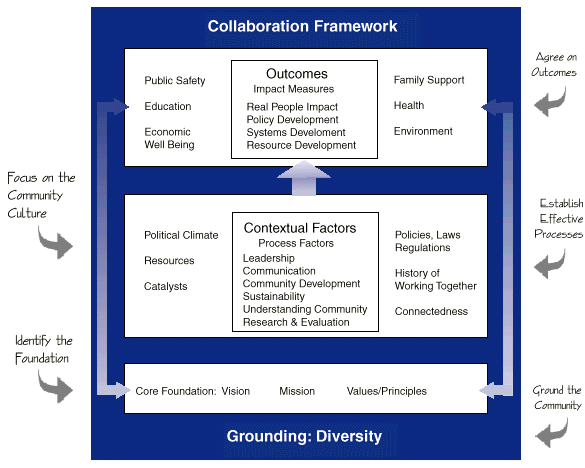
The COLLABORATION FRAMEWORK serves as a guide for communities in establishing or advancing their culture of collaboration. The standards of practice should be regarded as a tool to help the community, rather than a restriction. |