
|
| insuring successful collaborations |
 |
Time: |
45 minutes to 3 hours depending upon the number of people, the level of current knowledge, and the manner of facilitation. |
Audience: |
10-50 people interested in collaborating together. Overhead projector, paper, pencils, flip chart, felt pens, sticky dots (for voting), colored sticky notes. |
Unit 5
|
| taking measure along the way |
| • OUTCOMES: To assist the group in being able to evaluate its efforts and better understand its strengths and weaknesses. | ||
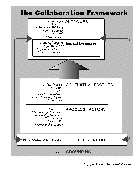 |
• DISCUSS: The Framework itself, is a good diagnostic
tool for identifying problems within a collaboration.
By using it as a template, the existing collaboration's
group dynamics can be seen clearly. One or more
elements may be causing underlying problems with
the group, and the Framework can often times
point these out easily. Use it at any time during a
collaborative effort to better understand how
effectively the group is meeting its goals. A highly functioning collaborative effort, at all times, focuses upon what condition(s) it seeks to achieve and how it goes about achieving that condition(s). If it doesn't feel right, if it's not going fast enough, or if it's not going smoothly enough, it may be time to take the measure of your collabora-tion. |
|
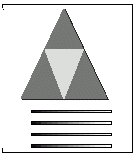 |
• ACTIVITY: This exercise combines the A-B-C model
of change we used in the 2nd Unit, with an "inverted
triangle of vision" to get a sense of where the
collaboration is now, and where it wants to be. Four
factors are considered: Leadership, Strategies,
Commitment, and Vision. Each is scored along a
continuum by group members, with an "A" for
where the collaboration seems to be right now, and
with a "B" for where the group wants to be in the
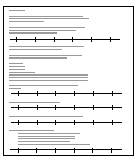
future. (1) Define the four factors with the group. Ask individuals to respond to the following question, rating the collaboration on separate continuum lines for the four factors: "How strong do you think we are?" Place an "A" for current conditions on top of each line and a "B" for future conditions under-neath each line, with arrows pointing toward the anticipated direction of movement. (2) Use the process factors from Unit 3 to rate the collaboration. The group should be able to define its own questions to best meet its goals, but questions identified in Unit 3 are a good starting point. Use the same lines of continuum in the back of this unit. Think about using the contextual factors in Unit 3 the same way. Look for system issues rather than individual ones. Avoid blaming people. Use "I" statements: When you ____, I feel ____. Assure a safe environment for all participants. Facilitate conversation as a dialogue, in which members brainstorm openly about issues, rather than jumping to conclusions and developing strategies or solutions right away. |
| systems thinking (from "What You Can Expect ... As You Practice Systems Thinking" by Charlotte Robert and Jennifer Kemeny in The Fifth Discipline Fieldbook) |
 |
• OUTCOMES: To develop the groups understanding of systems, and to better understand the benefits of thinking from a systems viewpoint. | |
 |
• DISCUSS: At its broadest level systems thinking is
about looking at the interrelatedness of forces and
seeing them as part of a common process. A system
is actually a number of elements that "hang together"
because they continually affect each other
over time and work toward a common purpose. The
word comes from the Greek verb sunistanai - "to
cause to stand together", and as this suggests, the
structure of a system includes the quality of perception
with which the observer causes it to stand
together. Systems are communities, families, teams,
biological organisms, the atmosphere, factories,
chemical reactions, politics, collaborations and
organizations of all kinds. One form of systems thinking is becoming particularly valuable to help achieve positive organizational change. It is "system dynamics" and was developed by Professor Jay Forrester and his colleagues at Massachusetts Institute of Technology. He uses links and loops, archetypes, and other models to understand complex feedback processes and problematic patterns of behavior within organizational systems. "There are no right answers. Because system dynamics illustrates the interdependencies within the current system, there is never a single right answer to any question. Instead, the discipline reveals a variety of potential actions you may take... Each of these actions will produce some desired results and (almost certainly) some unintended consequences somewhere else in the system. The art of systems thinking includes learning to recognize the ramifications and trade-offs of the action you choose... By its nature, systems thinking points out interdependencies and the need for collaboration. Thus, as the team continues its work, it may become necessary to bring in new members—particularly people who were once seen as enemies, but are now obviously players on the same side in the same game." p91-92. |
| understanding collaborative systems (adapted from Exploring Your Own Story by Michael Goodman, Rick Karash in The Fifth Discipline Fieldbook by Peter Senge) |
|
• OUTCOMES: To assist the group in discovering a coherent story from interrelationships of seemingly random events. This can be a powerful learning process for teams. | |
 |
DISCUSS: This question lies at the heart of systems
story telling: "How did we (through our internal
thinking, our processes, our practices, and our
procedures) contribute to or create the circumstances
(good and bad) we face now?" -p105.
Significant answers tend to come only after sustained
deliberation. The first step is to identify the problem. It should be an issue that's really important to the collaboration, not just an exercise. Focus on a situation which has troubled you repeatedly. Reduce the problem statement to one or two sentences and narrow your focus. Choose a problem whose history is known and describable. Do not sanitize your description of the issue - keep it as accurate as possible. Don't include any suggestions of solutions at this point. (The problem is: we just need a new computer.) Be non-judgemental. Example: The problem is: profits were steady for two years, but have been declining for the last six months. |
|
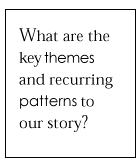 |
The second step is to tell the story. Bring the story
or stories underlying the problem to the surface.
Develop a theory that makes sense, is logically
consistent, and could—if accurate—explain why
the system is generating the problems you see. Then
test the story, in the spirit of the scientific method.
The team should purposely maintain as many
diverse, even contradictory, ideas for as long as
possible, rather than jump to the right solution. The
story won't be linear, instead you'll begin to see a
series of events from many vantage points, you'll
begin to identify key themes and recurring patterns,
and your understanding of the underlying structure
will deepen. • ACTIVITY: Identify the "characters" of the story— the key factors of the story—by using the Frame-works process and contextual factors. Example: One key factor is the national health care costs are out of control, or we spend far too much time in redun-dant paperwork. The point here, is not to settle on any statement as right or wrong, but to begin talking about the problem, establish the dimensions of the problem, bring to light the collaboration's varied perspectives, and lay the groundwork for selecting some key factors as variables. Questions that might help: (1) How would this issue look from a high level management position? A front line worker position? (2) How would our elected officials view this issue? Or informed citi-zens? (3) What factors would be most prominent from these different perspectives? (4) What factors has our collaboration created or contributed? |
|
 |
Another approach is to give participants paper and
pencil. Large sticky notes are great - 5 x 8 or larger.
As individuals, draw the most important issue as a
graph with time (months, years, whatever works)
along the bottom of the X axis, and the key factor
(number of clients per year, demand for technical
support, etc.) as the Y axis. These don't need to be
exact, just impressions. Accompany the graph with a
few words (spoken or written) describing its significance. Until this stage most people have only seen this situation in terms of the current moment. This exercise moves participants to a sensitivity for change over time, that it isn't a brand-new problem. When individual graphs are compared and discussed, suddenly a story is developed. You can notice common themes. If your graphs are on sticky notes you can begin to move them around on a wall, grouping them in patterns of behavior. Questions that might help: (1) What basic story combines these graphs? (2) Do we need to reconsider the original problem? |
| evaluating your efforts (adapted from the Community Leader's Guide) |
|
• OUTCOMES: To assist the group's understanding of evaluation and how it corresponds with the Frame-work. | |
 |
 |
• DISCUSS: Evaluation is not concerned with summarizing
your accomplishments, so much as understanding
if you accomplished what you said you'd
accomplish. It asks the questions, "Did we do what
we set out to do?" And "What was the impact of
our activity?" Two basic philosophies exist for evaluation: (1) The evaluator should be separate from the action and be as neutral as possible, or (2) Those that carry out the plan are in the best position to interpret the information and draw conclusions. Have the group reach consensus regarding this. Important aspects for a successful evaluation of the collaboration's efforts are already in place. The collaboration's outcomes and purpose and measur-able indicators have been identified in Units 2 & 3. The only aspects that might remain for the collabo-ration to consider are the following: (1) Who is responsible for collecting the information, (2) How will it be collected and when? (3) What does the information tell us? (4) Who will interpret the information and draw conclusions and recommendations? • ACTIVITY: If the group is comfortable in evaluating its own efforts, bring the group to consensus regarding the questions in the above paragraph, and break into small groups for discussion and follow through. The evaluation should make sense to the full collaboration, and help the group know whether or not they have reached their goal, or if they're on the right track. It should also be able to help the group justify what next steps may be needed. |
| hunting for root causes (adapted from The Five Whys by Rick Ross, in the Fifth Discipline Fieldbook by Peter Senge) |
 |
• OUTCOMES: To assist group members in solving current problems with their collaboration. | |
|
 |
• DISCUSS: Answers to "Why" questions should not
blame individuals, because then you'll end up only
able to punish the person and there won't be any
chance to change the system. Example - "Why is
there oil on the floor?" - because maintenance
didn't clean it up. "Why didn't they clean it?" -because
the supervisor didn't tell them. "Why
didn't he do that?" - because the crew didn't tell
him. "Why didn't they tell him?" - because he
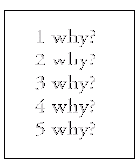
didn't ask... We need to learn to recognize the difference be-tween event-oriented explanations, and systemic explanations. Systemic explanations are the ones which lead to the reasons why they didn't clean it up, or he didn't tell them to, or they didn't ask -such as poor crew training. To avoid the distraction of event or blame-related answers, try asking, "Okay, is that the only reason?" • ACTIVITY: This activity is a way to hunt backward for the root cause(s) of difficult, recurring problem(s). It's about asking "Why," five times in a team setting with discussion. First, pick a symptom, an issue, or a problem -someplace to begin unraveling the mystery. Ask the 1st why: "Why is such-and-such taking place?" Try and get three or four answers to put on the wall for everyone to see. Leave plenty of space around each answer. Steps 2, 3, 4, and 5: Repeat this process for every statement on the wall. Ask "Why?" about each one, and write the answer next to the original statement. Follow up on likely answers. Look for convergences. Twelve different symptoms might be able to be traced back to two or three systemic sources. Trac-ing these paths you'll probably find issues that affect the whole system. |
|
• OUTCOMES: To assist individual members in identi-fying problem areas for the collaboration. | |
|
 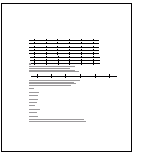 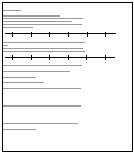 |
• ACTIVITY: These checklists are designed to identify
factors influencing the way people relate with each
other in collaborations. The information obtained
from this may help your group be more successful,
avoid pitfalls, or diagnose problems that keep you
from meeting your goals. These checklists may be used individually or in groups. They can be assigned as "homework" for team members to fill out and bring in at some future, specified date, at which time they can be compiled and a general overview of the group can be displayed. The idea is not to point out individuals to blame, but to gauge the groups strengths and weaknesses, in order to direct attention, time and energy to supporting the strengths and negating the weaknesses. |