|
 |
Time: |
45 minutes to 4 hours depending upon the number of people, the level of current knowledge, and the manner of facilitation. |
Audience: |
10-50 people interested in collaborating together. Overhead projector, paper, pencils, flip chart, felt pens, sticky dots, sticky notes, masking tape or push pins. |
Unit 4
|
| Defining relationships |
| self-fulfilling prophecies (from Leadership and the New Science - Learning About Organization from an Orderly Universe, by Margaret J. Wheatley.) |
| • OUTCOMES: To increase participants understanding about our expectations, and how our perceptions of others affects how we interact in a collaboration. | ||
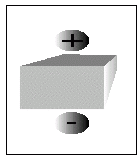 |
• DISCUSS: "Schroedinger's cat is a classic thought
problem in quantum physics. Physicist Erwin
Schroedinger constructed the problem in 1935 to
illustrate that in the quantum world nothing is real.
We cannot know anything about what is happening
to something if we are not looking at it, and,
stranger yet, nothing has happened to it until we
observe it... The problem of the cat has not yet been
resolved, but it is constructed as follows: A live cat is
placed in a box. The box has solid walls, so no one
outside the box can see into it. This is a crucial
factor, since the problem centers on the role of the
observer in evoking reality. A device will trigger the
release of either poison or food; the probability of
either occurrence is 50/50. Time passes. The trigger
goes off. The cat meets its fate. Or does it? Just as an
electron is both a wave and a particle until our
observation causes it to collapse as either a particle
or wave, Schroedinger argues that the cat is both
alive and dead until the moment we observe it.
Inside the box, unobserved, the cat exists only as a
probability wave. It is possible to calculate mathematically
(as a Schroedinger wave function) all of
the cat's possible states. But it is impossible to say
that the cat is living or dead until we observe it. It is
the act of observation that determines the collapse
of the cat's wave function and makes it either dead
or alive. Before we peer in, the cat exists as prob-abilities.
Our nosiness determines its fate." -p60. Not all things that are important can be observed and measured. What is our relationship to the cat? Why is the cat important? Try to understand Schroedinger's cat in light of self-fulfilling prophecies and the impact they have on the people with whom we interact. This is a concept that has been discussed at length in management theory and education. If a teacher believes her student to be gifted, it is a well known fact that that particular student will excel. If a manager believes a new employee to be especially smart, she will hear words of wisdom every time the new hire speaks. If we think someone is stupid or gifted, they appear stupid or gifted to us. Our beliefs about others color their actions in our eyes and it affects the way we interact. If we're in a position of authority, we may give choice assignments to an employee, expecting them to succeed, and observing them in a way that confirms our own beliefs. Our powers of observation can bring Schroedinger's cat to life. Our willingness to let others care for the cat may keep it alive, too. Think about this as it relates to diversity and your world view. Where do you stand? What experiences do you bring to the observation? The lenses we see through are different for different people. • ACTIVITY: In small groups have participants share their feelings about the information that has been presented. How does this affect the way we work collaboratively? What beliefs do we have that get in the way of working together effectively? How can we best surface our beliefs? Clarify our beliefs? Reach a new understanding about them? |
|
| the 6 process factors |
| community linkages |
 |
• OUTCOMES: To develop participant's understanding of community relationships and communnity linkages. | |
  |
 |
• One of the first steps in defining existing
and potential relationships is developing an under-standing
of the linkages within your community.
They generally fall into five levels—Networking,
Cooperation or Alliance, Coordination or Partnership,
Coalition, and Collaboration. Each level can
be evaluated in terms of its own purpose, structure,
and process. Developing a matrix of "community
linkages" provides focus and clarity as your collabo-ration
supports new relationships. By recognizing
the interrelatedness of relationships within your
collaboration you will strengthen your infrastructure
and help your efforts to be successful. • ACTIVITY: Using the chart of community linkages have participants identify current linkages within their community. This may best be done in small teams analyzing and recomposing to present back to the large group. Have the group reach consensus on the linkage(s) they are now in, and where they want to be in a specific time period. These results tie directly to the next section, Merging Community Linkages with the Framework. What examples of Networking are occurring in your communities now? Of Cooperation or Alliance? Of Coordination or Partnership? Of Coalition? Of Collaboration? |
| merging community linkages with the Framework |

|
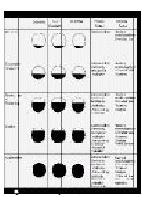 |
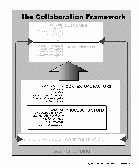
• OUTCOMES: To build a workplan correlating the
group's linkages with the Framework. • DISCUSS: Oftentimes a visual representation of our collaborative efforts helps us understand where we are now, and where we hope to be. Now that we've identified current linkages (and future linkages) we can relate these linkages with all five aspects of the Collaboration Framework: (1) Grounding, (2) Core Foundation, (3) Process Factors, (4) Contextual Factors, and (5) Outcomes. • ACTIVITY: Using the chart, Merging Linkages with the Framework, have participants identify the parts of the Framework and their levels of influence on the different linkages. What does this mean for the group's collaborative effort now, and in the future? On the chart, Grounding refers to how extensive the diversity of the people are that are involved; Core Foundation relates to how well the vision, mission, etc. have been designed and established by all members; and Outcomes correspond to how well clearly defined outcomes and impacts are owned by the whole group. Process and Contextual Factors are those factors that influence the linkage the most. |
| how things appear (from Leadership and the New Science -Learning About Organization form an Orderly Universe, by Margaret J. Wheatley.) |
| • OUTCOMES: To develop an understanding of how our perceptions of people and events shape our realities. | ||
 |
• DISCUSS: Physicists such as John Archibald Wheeler
believe in a participatory universe, in which the act
of looking for information evokes the information
we go looking for. The double-slit experiment in
which electrons behave as if they know we're
watching them—patterning as a wave with two slits
open or as a particle with one slit open, and acting
differently if the recording apparatus is on or off—
has become the basic question upon which quantum
physics rests. The correlation in this for collaborators
is the mystery of observation and the role
of the observer, and how our perceptions of people
and events shape our realities. "It is difficult to develop a new sensitivity to the fact that no form of measurement is neutral. Physicists call this awareness contextualism, a sensitivity to the interdependency between how things appear and the environment which causes them to appear. Contextualism raises some very important questions. How can we trust that we get the information we need to make intelligent decisions? How can we know what is the right information to look for?" -p63. |
|
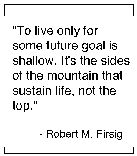 |
What this suggests is that we should be less worried
about the data we collect and organize and the
information we sift in hopes of finding the right
answer, and more concerned with the nature of our
participatory experience together. Bringing all
participants to the table, enjoying the diverse
richness of many different interpretations and
observations, generating information, thinking
about who we are and what we want to be together—
that's collaboration. It's also the best way to build ownership! People support what they create. Quantum physics suggests that it's impossible for any idea, plan, strategy or collaboration to be successful if the participants don't personally interact with it! "Reality emerges from our process of observation, from decisions we the observers make about what we will see. It does not exist independent of those activities. Therefore, we cannot talk people into reality because there truly is no reality to describe if they haven't been there. People can only become aware of the reality of the plan by interacting with it, by creating different possibilities through their personal processes of observation." |
|
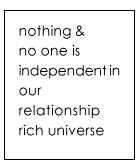 |
"A quantum universe is enacted only in an environment
rich in relationships. Nothing happens in the
quantum world without something encountering
something else. Nothing is independent of the
relationships that occur. I am constantly creating the
world—evoking it, not discovering it—as I participate
in all its many interactions. This is a world of
process, not a world of things." -p68. • ACTIVITY: Ask participants to turn to the person next to them and discuss how they feel about this. Or break into small groups for a more in-depth discussion if time allows: Have participants (1) Observe - "What do you see?", (2) Reflect - "How are you responding?", (3) Interpret - "What does this mean?", and (4) Decide - "What will you do?".
How does this knowledge affect us? How might our
collaboration affect some one or some thing that we
haven't discussed? How have our perceptions
colored the way we've done business in the past? |