Training Manual Menu |  | Main Menu |
Training Manual Menu | | Main Menu |
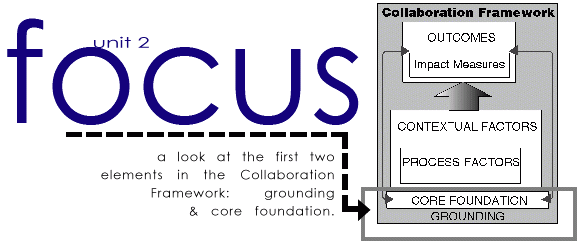
| • Catalysts That Initiate Collaborative Efforts. • The Importance of Grounding. • Great Teams & Common Purpose.
|
 |
Time: |
45 minutes to 4 hours depending upon the number of people, the level of current knowledge, and the manner of facilitation. |
Audience: |
10-50 people interested in collaborating together. Overhead projector, paper, pencils, flip chart, felt pens, post-it notes, tape, push pins. |
| Unit 2 initiating & advancing collaborations |
| catalysts that initiate collaborative efforts |
 |
• OUTCOMES: To assist the group in identifying existing or potential catalysts that may enhance or inhibit the collaboration. | |
 |
 |
• DISCUSS: What has brought you together? Is there a commonly held issue, problem, shared vision, crisis or outcome that is driving this collaborative effort? In the beginning, as your collaboration is initiated, it is critical for all existing and potential members to understand the forces bringing you together - the catalysts for your collaboration. |
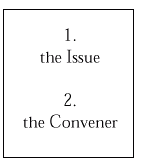
| Catalysts get your collaboration started. But for a successful collaborative effort two types of catalysts are needed: (1) A community-wide issue. The reason(s) or predicating factor(s) must be viewed by your community as a situation requiring a compre-hensive response; and (2) A convener or conveners. The convener(s) calls an initial meeting, draws folks into dialoguing about the issue, and helps bring people towards developing solutions to the situa-tion. This person acts as a catalyst within the community, and should be respected and viewed as a legitimate player. They must carry out their role with passion and respect, and have good organiza-tional and interpersonal skills. The idea of catalysts is so important that it comes into play in two parts of the Framework: (1) In this Unit - Initiating Collaborations, and (2) as one of the six Contextual Factors related to the effectiveness of a collaboration as discussed in Unit 4. | ||
 |
Equally as important as the idea of a catalyst, is the notion that a fully thought out plan brought to a group for their implementation has much less chance of moving forward than a plan or idea brought to the group and worked out with the group for implementation. • EXAMPLE: Before the prevention of youth violence can be an issue to collaborate around, a community must view youth as having the skills that can en-hance the quality of life in the community. |
| problem solving behavior (as developed in the Community Leader's Guide). |
| • OUTCOMES: To understand the need for a representative group effort and to assist participants in identifying their strengths and weaknesses when helping the group through planning or problem-solving processes. | ||
 |
• DISCUSSION: We've all been embroiled in problems,
sometimes unwittingly, and occasionally by the
circumstances we find ourselves in. As we move
towards collaborating in our communities to solve
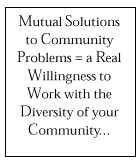
priority issues several things are important. It's crucial to have a representative and diverse group involved in your efforts. To help form this type of group ask the following questions: "Who is affected by the problem?" "Who might be affected by the plan?" "Who will be responsible to support the plan?" "Whose opinion needs to be changed or altered to become an advocate for the collaboration?" Seek young and old, male and female, wealthy and low-income, college and self-educated, and diverse ethnic viewpoints. Seek people from various geographic areas and representatives from different agencies. You need a cross-section of your entire community. Planning for solutions to issues involves a number of steps. After getting a diverse and representative group together, members need to develop a way in which to plan and work together. To do this they will have to reach agreement as to why they have formed a group and what process and timetable they will follow. To move in this direction ask the following questions: "who needs to be involved in establishing the overall purpose of the planning effort (vision, mission, values and principles) and how long will this take?" "Who needs to be involved in setting the goals and objectives?" "How long will we allow for action planning?" "Who will be responsible for specific activities and outcomes, and what will the timetable be?" |
|
 |
• ACTIVITY: How do you behave as a member of a group that is struggling with an issue? This exercise will help you better understand your strengths and weaknesses in helping your group through a plan-ning or problem-solving process, and rethink your possible leadership role and personal development goals. | |
| • OPTIONS: (1) Make handouts of Problem Solving Behavior and have individuals fill it out, and discuss it in small groups. (2) With a flip chart, poll the group after the exercise to get a read on where the group is as a whole, and mark the flip chart for everyone to see where the groups strengths and weaknesses are. (If you think members of the group may be threatened or unwilling to raise their hands in front of others do this anonymously by having members write on sticky notes and pass them in.) |
| shifting our thinking (from "A Whack on the Side of the Head - How You Can Be More Creative", by Roger von Oech). |
|
• OUTCOMES: To help participants understand creativity is important to collaborations. | |
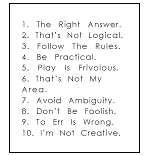 |
• DISCUSS: In order to be successful collaborators we need to be able to shift our thinking: from being driven by problems to working towards our visions, from muddled roles to defined relationships, and from being activity driven to focusing upon outcomes. According to Roger von Oech there are several reasons why we don't "think something different" or act creatively: (1) we don't need to be creative for most of what we do, (2) we are creatures of habit and routine, and (3) we haven't been taught to be creative by our educational system. Moving into a collaborative venture, however, requires you to be creative and to generate new ways to accomplish your objectives. When you do, your own belief system may stop you, and that's another reason why we don't "think something different": (4) most of us have certain attitudes that keep our thinking on the straight and narrow, doing the same thing we've always done. By opening up to a creative outlook you allow new possibilities and are more amenable to change. • EXAMPLES: (1) One day Pablo Picasso went outside his house and found an old bicycle. He looked at it and took off the seat and handle bars. Then he went inside, welded them together and created the head of a bull. (2) In the winter of 333 B.C., the Macedonian general Alexander and his army arrived in the Asian city of Gordium to take up winter quarters. While there, Alexander heard about the legend surrounding the town's famous "Gordian Knot", for which a prophecy stated that whoever was able to untie this amazingly complicated knot would become king of Asia. Alexander studied the knot at length, tried a number of times to unravel its mystery, but ended up stymied. And then he got an idea to make up his own rule for untying the knot, took out his sword, and sliced the knot in half. Asia was fated to him. | |
 |
• ACTIVITY: Three exercises give participants a chance
to "think something different"and can be handed
out individually, in small groups, or simply dis-cussed
in a large group setting. There are no "right" answers to these exercises, but if folks are stymied here are some answers: (1.) Switch Horses. (2.) Try putting the newspaper in a doorway - door closed - with the two people standing on each side. (3.) VII = VIII, Here are three different answers to turn IX into 6: (a) put a line through the middle of the Roman number IX, turn it upside down and cover the bottom half, (b) SIX, (c) IX6 or 1 times 6 = 6. |
| the importance of grounding |
|
• OUTCOMES: To create an understanding of ground-ing and the value of diversity in participants. | |
|
• DISCUSS: Grounding is the bedrock or earth upon which we build the foundation and structure of the Collaboration Framework. Think of it this way: Before we build a foundation, we need to know if the soil can support the foundation's weight. If the earth is too sandy, too moist, or too hard we have two choices: (1) We can add ingredients to the earth to bring it to more of a balance in order to support the foundation more securely; and/or (2) We can consider different requirements for our foundation – perhaps we'll use a slab foundation, or drive piles deep into the earth to support a structure built upon a swamp. So it is with building collaborations. The ground for collaborative efforts is diversity. Before we can develop a foundation of vision, mission and values, we must assure that our collaborative effort honors the unique gifts and talents of each person, group and organization we bring to the collaboration, and for those persons and groups who may benefit from our efforts. Diversity provides a critical balance to all levels of collaborative efforts. | |
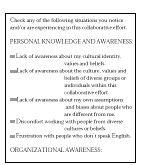  |
• ACTIVITY: This is a checklist, adapted from Manag-ing
Diversity, by Gardenscwartz and Rowe, that
participants may fill out individually, discuss in
small groups, or participate with in the full group.
This is designed to raise awareness, identify issues
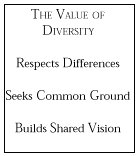
and provide beginning steps for taking action. • DISCUSS: Honoring diversity is a value each mem-ber of the collaboration must hold in order for your effort to be successful. Individuals must respect each other for who they are in order to be able to trust and become productive, functioning members. This type of thinking leads us to an understanding that all current and future members of our collabo-ration are interconnected in a diverse pattern. And with this we may begin to think of the collaboration in terms of a living system (which we'll look at closer in Unit 4), seeing interrelationships rather than things, seeing patterns of change rather than a static snapshot. This, in turn, allows us to shed old attitudes of blame and guilt, and naturally develop more compassion and empathy. When a real diversity of people and opinion exists in your group, a shared vision often takes hold. Understanding each other's perspective, listening to other's ideas, and mutual agreement is more likely to occur. Appreciation and respect for diversity includes our personal and professional behaviors, attitudes and values, and policies. These must come together in a way that allows the full collaboration to work effectively, respectfully, appreciatively in cross-cultural situations, or with minority populations, or with any persons different from the "norm" in our community – whether recognized for their color, religion, sexual orientation, inability to walk up stairs, or their need for sign language interpretation. A system respectful of diversity acknowledges and makes an effort to include in all that it does the importance of diverse cultures of racial, ethnic, religious or social groups. We must be proactive in meeting diverse needs, respect our differences, seek common ground, build on shared vision, and allow variation as we implement solutions. |
| great teams & a common purpose (from "The Essence of the Learning Organization" and Rick Ross' "Backing into a Vision", from The Fifth Discipline Fieldbook) |
| • OUTCOMES: To develop collaborative goals, and surface participants feelings about their level of commitment. | ||
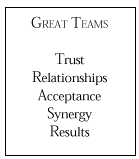 |
• DISCUSS: "At some time or another, most of us have been a member of a "great team." It might have been in sports, or the performing arts, or perhaps in our work. Regardless of the setting, we probably remember the trust, the relationships, the accep-tance, the synergy—and the results that we achieved. But we often forget that great teams rarely start off as great. Usually, they start as a group of individuals. It takes time to develop the knowledge of working as a whole, just as it takes time to develop knowledge of walking or riding a bicycle. In other words, great teams are learning organizations— groups of people who, over time, enhance their capacity to create what they truly desire to create. | |
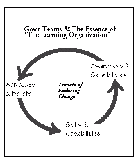 |
"Looking more closely at the development of such a team, you see that people are changed, often pro-foundly. There is a deep learning cycle. Team members develop new skills and capabilities which alter what they can do and understand. As new capabilities develop, so too do new awarenesses and sensibilities. Over time, as people start to see and experience the world differently, new beliefs and assumptions begin to form, which enables further development of skills and capabilities. This deep learning cycle constitutes the essence of a learning organization—the development not just of new capacities, but of fundamental shifts of mind, individually and collectively." -p17. | |
| • ACTIVITY: This is a warm-up exercise, helpful for talking about common goals in concrete terms, without mentioning "vision". It surfaces people's feelings about their own levels of commitment. Go through the following four questions one at a time, putting the answers up on flip chart paper: 1 WHAT ARE THE CHARACTERISTICS OF A GREAT TEAM TO WHICH YOU HAVE BEEN A MEMBER? Have participants answer individu-ally, speaking to the group. Define the team any way you like but it should be a team where you felt personally committed – where the team achieved extraordinary results. 2 WHAT WAS DIFFERENT ABOUT THIS TEAM? Discuss what felt truly special. It might be "I felt powerful", "I felt excited", "I believed in what we were doing", "We pulled together", "Together, we made a difference", "I felt like I owned it", "There was passion and commitment", "There was a clear challenge". A recorder for the group should write significant comments on a flip chart where everyone can see it, and post each completed page on the wall. 3 HOW CAN WE, AS A TEAM, CREATE THOSE KINDS OF FEELINGS HERE? Have participants ask each other: "What could we do, accomplish, or create together that would rekindle how we felt when we were members of "really great teams"? Brainstorm ideas, and have the group reach consensus around one that "fits" for everyone. 4 WHAT WOULD WE COMMIT OURSELVES TO? You may reach this point in an hour, or it may require more. When you reach this stage, the group commits to one or more initiatives, which may or may not include individual commitments for parts of the task. At this point the group has a shared set of priorities, and a new way of thinking about them – even though no one has used the word "vision". (Correlate this information with the information generated in the last activity of Unit 1: Understanding Collaborative Goals.) |
Training Manual Menu | | Main Menu |