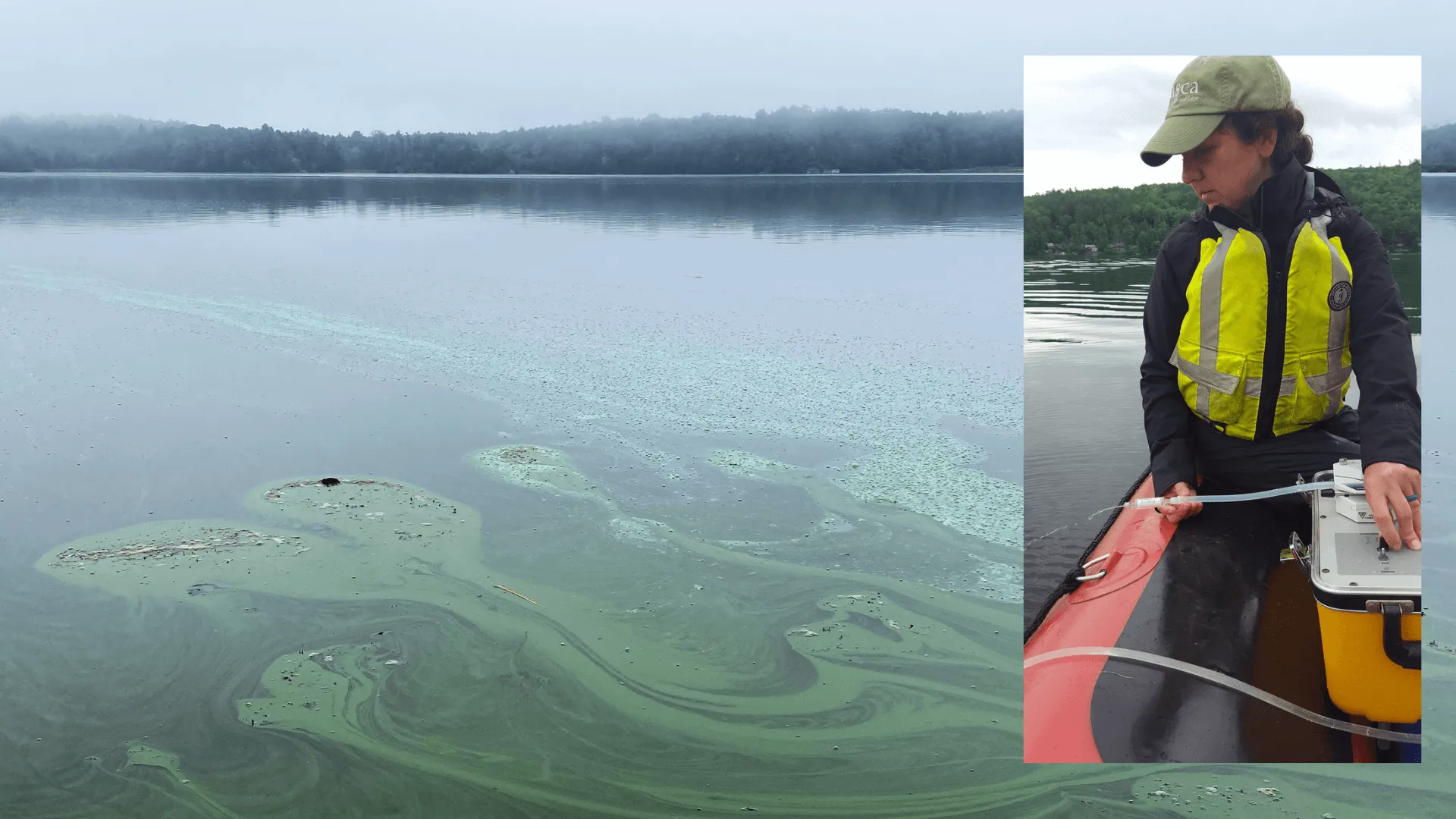
Up in Alburgh, Vermont, The Shiner, an 18-foot aluminum Henley, embarks onto Lake Champlain. Katelynn Warner, a postdoctoral researcher at the University of Vermont, steers the boat towards one of her northernmost research sites.
Warner is out on the lake to investigate the genetics of cyanobacteria blooms, seeking to answer three fundamental questions: Who is producing cyanotoxins? When do they produce them? And why?
Funded by the Lake Champlain Basin Program, her current research builds on questions that emerged during her time as a Ph.D. student at UVM's Rubenstein School of Environment and Natural Resources, where she studied the ecological mechanisms driving toxic cyanobacteria blooms.
Warner’s doctoral research utilized high frequency sensor data, weekly water samples, and metagenomic sequencing to investigate bloom dynamics. By sampling in Missisquoi Bay and St. Albans Bay, she examined how differences between the two systems influenced bloom development. The study, published in 2025, found that although both systems produced similarly low concentrations of toxins during blooms, the blooms themselves differed in biomass and severity. The findings highlighted the complex interplay between nutrient cycling and environmental conditions, raising new questions about blooms and their toxicity.
Now, Warner is returning to Lake Champlain with a three-pronged approach.
She is sampling four bloom-prone areas of the lake— Alburgh, Missisquoi Bay, St. Albans Bay, and Burlington Bay—every two weeks to determine which cyanobacteria are present, which are producing toxins, and under what environmental conditions.
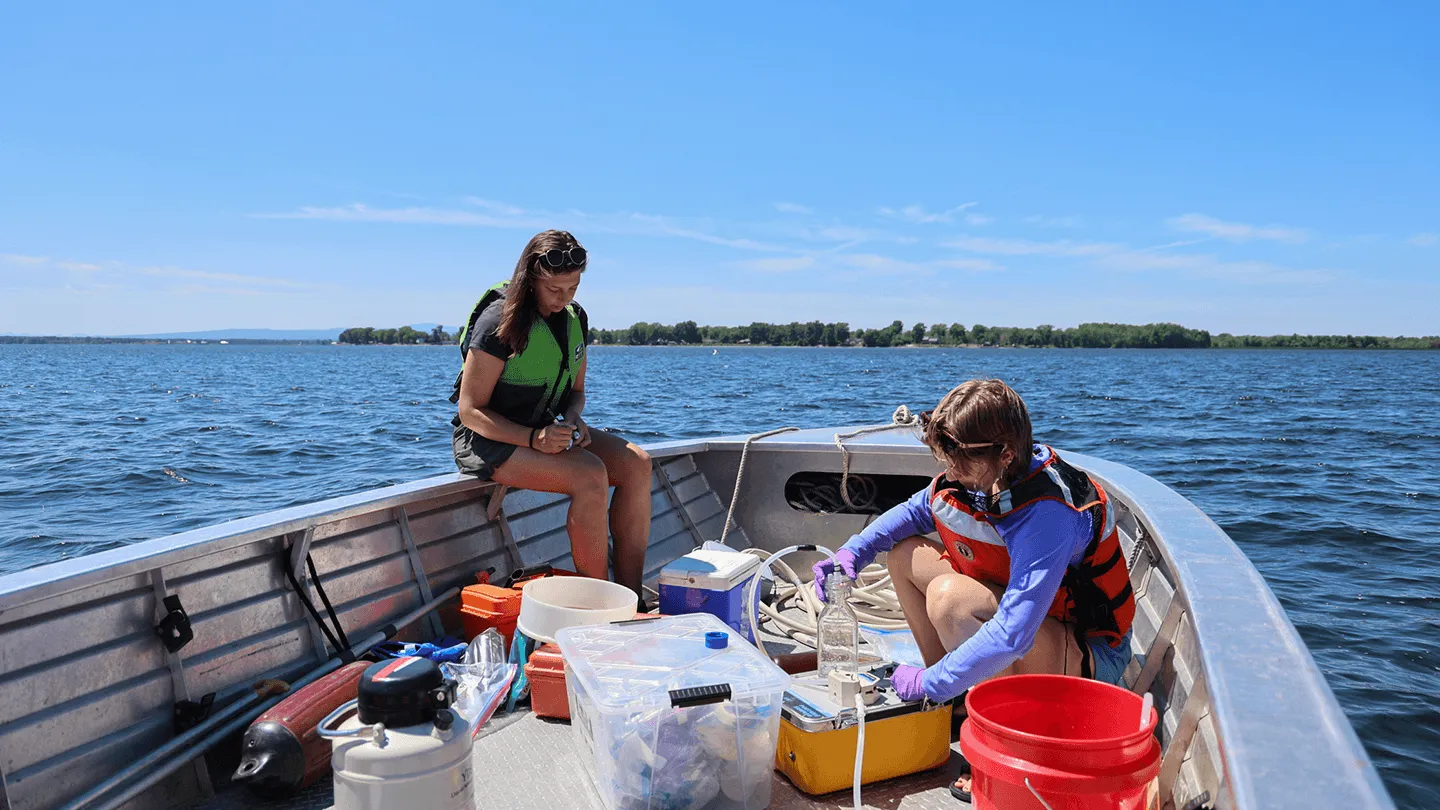
Kaelyn Langlois, a rising senior studying environmental science, joins Warner on the boat. When The Shiner reaches the designated coordinates, the pair gets to work.
Langlois begins by lowering a Secchi disk from the side of the boat on a calibrated rope. She records two depths: the depth where the disk disappears from view and the depth where it reappears as it is raised. Together, these measurements provide an estimate of water clarity, a simple, but useful indicator of the lake’s conditions. More algae generally mean murkier water and Secchi depth can serve as a indicator for chlorophyll levels.
Next, Warner immerses a sonde, a cylindrical instrument equipped with multiple sensors, into the water. The sonde profiles the water column, collecting parameters such as temperature, pH, dissolved oxygen, and chlorophyll levels—measurements that help researchers track the environmental conditions associated with cyanobacteria.
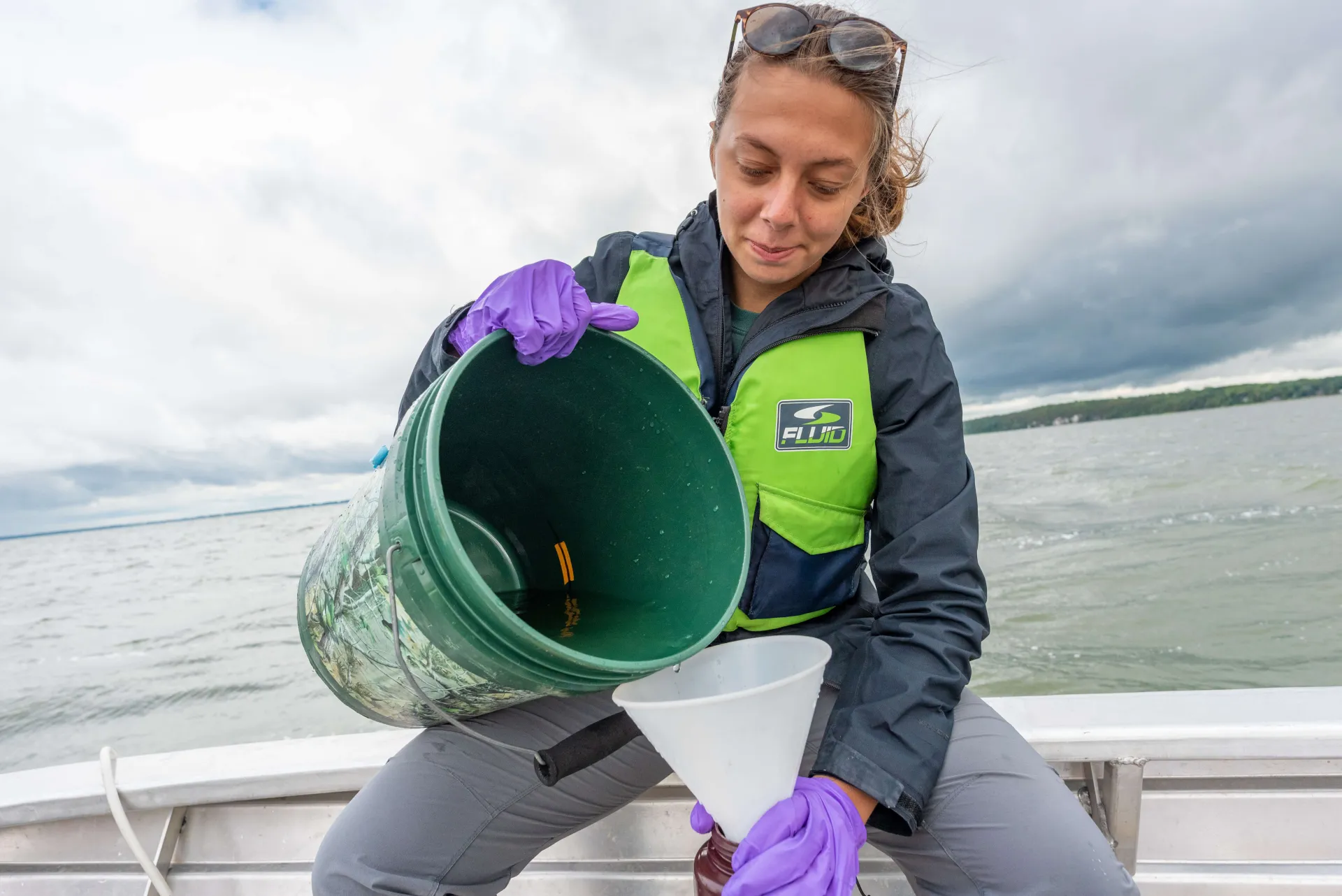
Langlois then begins the repetitive work of collecting samples. She fills a bucket of lake water from the site, then filters it to collect multiple DNA and RNA samples. Warner immediately places the samples into liquid nitrogen to preserve their integrity. Additional water samples are collected for analysis back in the laboratory, where other nutrients and toxins, as well as phytoplankton, will be measured.
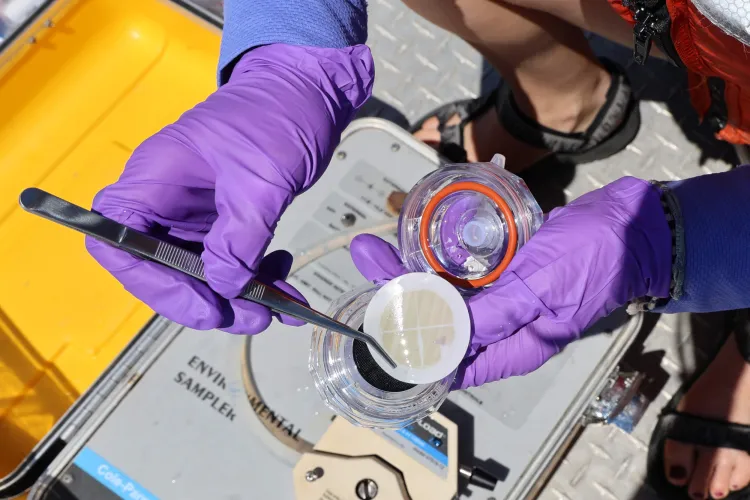
The team is also examining the relationship between the cyanobacteria’s genetic makeup and toxicity. “The biweekly approach is essentially trying to answer what cyanobacteria are present, and then we dive deeper and do DNA and RNA work with it,” explains Warner. Two strains of cyanobacteria may belong from the same species and be nearly identical, yet one may be able to produce toxins, and one may not.
This phenomenon is taking the team to beaches along Lake Champlain for blitz sampling. There, they can investigate the differences in biomass and toxicity from one location to another along the shoreline.
The second aspect of the research is looking at the connection, or lack thereof, between toxin production and the blooms. Warner hypothesizes that changes in toxin production may be driven by fluctuations in nutrient availability. Heatwaves may also play a role. To test these possibilities, the team is conducting controlled nutrient and temperature experiments.
One challenge is that toxin production can change tenfold in a six-hour window, far faster than researchers can feasibly manually sample. The third component of the project addresses this gap.
The team is deploying an ISCO, or an autosampler, to collect samples at a much higher frequency. Paired with an existing monitoring buoy, the system will present new data every 15 minutes. Together, these instruments will provide a detailed water column profile, while capturing high-frequency changes in toxin concentrations. The combination of this data will help researchers determine physical water column characteristics associated with peak toxicity, such as temperature, pH, and chlorophyll levels.
Ultimately, this data improves the ability to forecast when a bloom reaches toxic levels.
The team will be sharing their work with local stakeholders through a project advisory committee comprised of members from UVM, the New York and Vermont Departments of Conservation, and the Vermont Department of Health. Knowing when and why blooms become toxic could help communities make more informed decisions about water management and public health across Lake Champlain, bringing the research impacts well beyond the laboratory.