Water Workforce Faculty Collaborative
Safe drinking water and wastewater treatment are essential to public health, environmental protection, economic development, schools, and healthcare facilities. However, Vermont and communities across the country face ongoing workforce shortages, threatening the ability to provide these essential services.
In 2025, The Water Resources Institute (WRI) and the Vermont Rural Water Association (VRWA) received a capacity partnership grant from the UVM Leahy Institute for Rural Partnerships to explore ways to strengthen Vermont’s water workforce pipeline.
As part of this effort, 233 water operators in Vermont were surveyed about their career pathways, work experiences, challenges, and demographics. The respondents revealed that succession planning and recruiting new employees were their greatest concerns.
At the same time, 65 UVM students and four faculty members participated in visits to drinking water and wastewater facilities, giving students firsthand exposure to water operations and potential career opportunities.
Students were surveyed before and after the visits to gauge awareness and attitudes on this workforce sector. Fewer than one-third of the students had ever visited a drinking water or wastewater facility, fewer than 20% knew someone who had worked at one, and less than half knew whether their families used water services provided by a community facility.
This lack of exposure extended to career opportunities. Before the visits, just 19% of the students considered a career in water treatment. Afterwards, 55% said that the facility visit influenced their interest in a career in water treatment, while 61% said the visit inspired them to consider working in a rural community setting.
Among faculty teaching the participating courses, only one had previously exposed students directly to drinking water or wastewater treatment facilities. These findings highlight the lack of awareness of the water operations sector and the opportunity to build Vermont’s water workforce pipeline by integrating water workforce experiences and content into existing college curricula.
Alison Smith, Training Administrator at VRWA, noted that "through this work together, VRWA has gained a better sense of the type of experiences that are meaningful and impactful to students in promoting career opportunities in water as we seek to solve the workforce shortage in this sector."
This summer, WRI and VRWA expanded upon their efforts. The concept: build a faculty collaborative to raise awareness of water workforce needs and explore opportunities to integrate awareness across the curriculum.
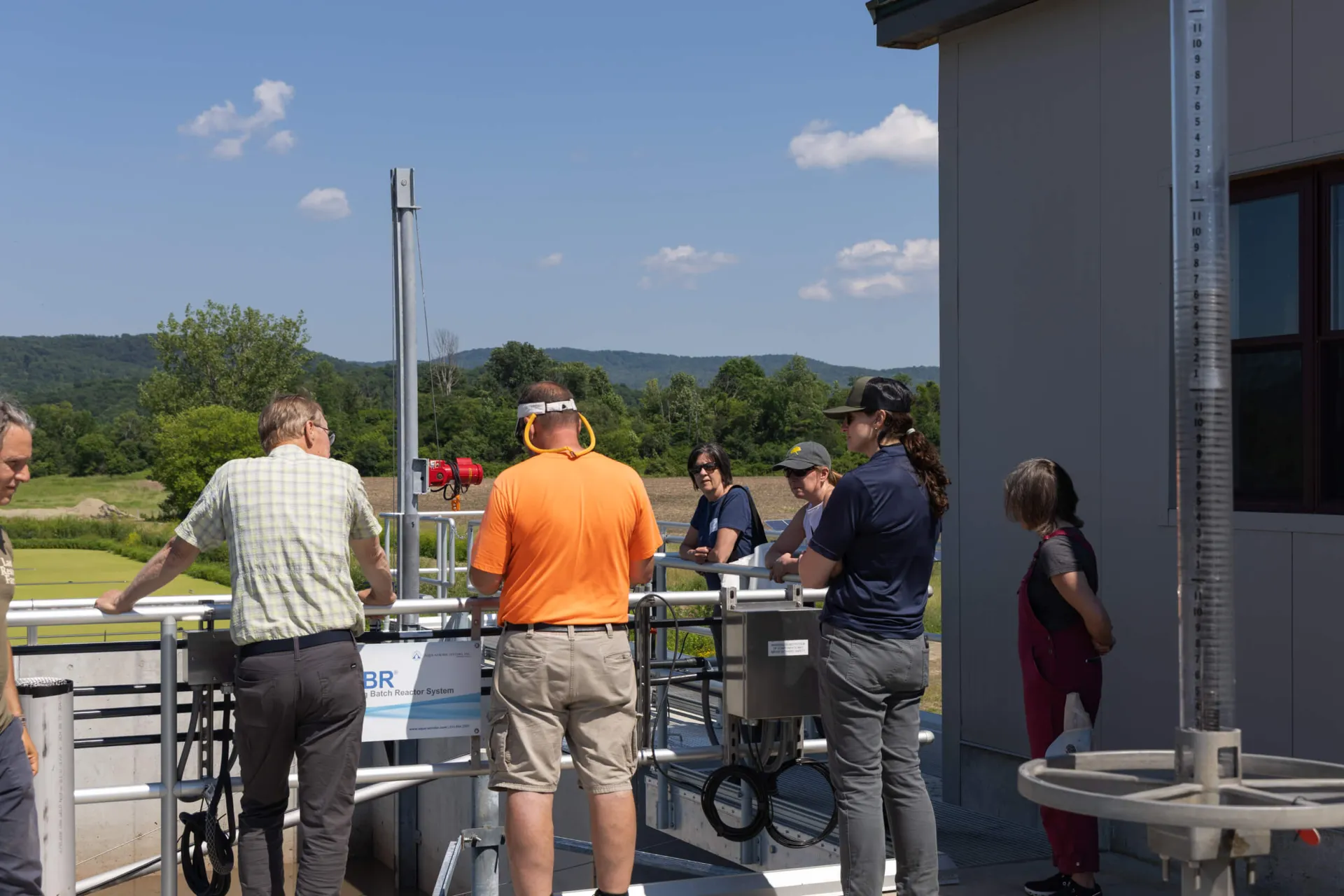
In June, eight UVM faculty members joined VRWA for a field tour of rural water systems facing a range of operational challenges. The group visited Waterbury’s Edward Farrar Utility District, the Richmond Water Department, and Hinesburg’s Wastewater Treatment Facility. Water operators and educators shared their experiences and discussed how the facilities could serve as learning environments. Together, the participants considered the potential barriers and solutions to creating experiential learning opportunities for students, from field visits to integrating water operations into existing courses.
In August, the group reconvened to reflect on the field tour, reconnect with VRWA leadership, and chart pathways to program development, professional credentialing, and fundraising for new educational initiatives that meet this future workforce challenge. Liz Royer and Allison Smith of VRWA joined the discussion, sharing their perspectives on the workforce needs facing Vermont’s rural water systems.
Faculty brainstormed ways to collaborate across academic units to advance training and workforce development, including opportunities that could complement existing programs and coursework.
"Through this experience we feel confident that we have established VRWA as a resource for UVM faculty in helping to illustrate concepts taught in the classroom as they are applied in water operations across Vermont," reflects Smith. "In connecting faculty and students with water operations, we learn more about how to be a useful resource to the University by creating opportunities in the field that pique their curiosity for research and career exploration."
Moving forward, it's imperative to have a strategic perspective on continuing education and workforce needs. "Vermont’s rural water workforce has a capacity problem as much as a headcount problem," explains Maureen Hebbert. As the Director of Strategic Initiatives and Employer Partnerships in UVM’s Professional and Continuing Education program (PACE), Hebbert joined the group to share her experiences with workforce development and professional credentialing programs in Vermont.
"Rural systems need people who can operate infrastructure, meet increasingly complex regulations, respond to emergencies, and preserve institutional knowledge—often with very limited budgets and an aging workforce," she says. "The underlying issue is that Vermont doesn't just need 'more water operators.' It needs a sustainable rural water workforce ecosystem—one that continuously recruits, trains, certifies, retains, researches new ideas and policies and builds new collaborative partnerships with municipalities, educational institutions, industries and state government."
The workshop concluded with an afternoon session focusing on securing support for new initiatives. Jeannine Valcour and Brady Liss of UVM’s Research Development team and Emily Lappat from the UVM Foundation shared their experience in fundraising.
These efforts are connecting Vermont’s water sector with higher education, creating new pathways for students to engage in the field. By increasing awareness and developing stronger connections between educators and water operators, WRI is cultivating a new generation of diverse, skilled water professionals.
UVM Faculty Participants:
Cheryl Morse, College of Arts & Sciences; Julia Perdrial, College of Arts & Sciences; Harlan Morehouse, College of Arts & Sciences; Vic Izzo, College of Agriculture & Life Sciences; Anne Jefferson, Rubenstein School of Environment & Natural Resources; John Lens, College of Engineering & Mathematical Sciences; Laura Webb, College of Arts & Sciences; Beverley Wemple, College of Arts & Sciences; Matthew Scarborough, College of Engineering & Mathematical Sciences; Kyle Wittinghill, Rubenstein School of Environment & Natural Resources.