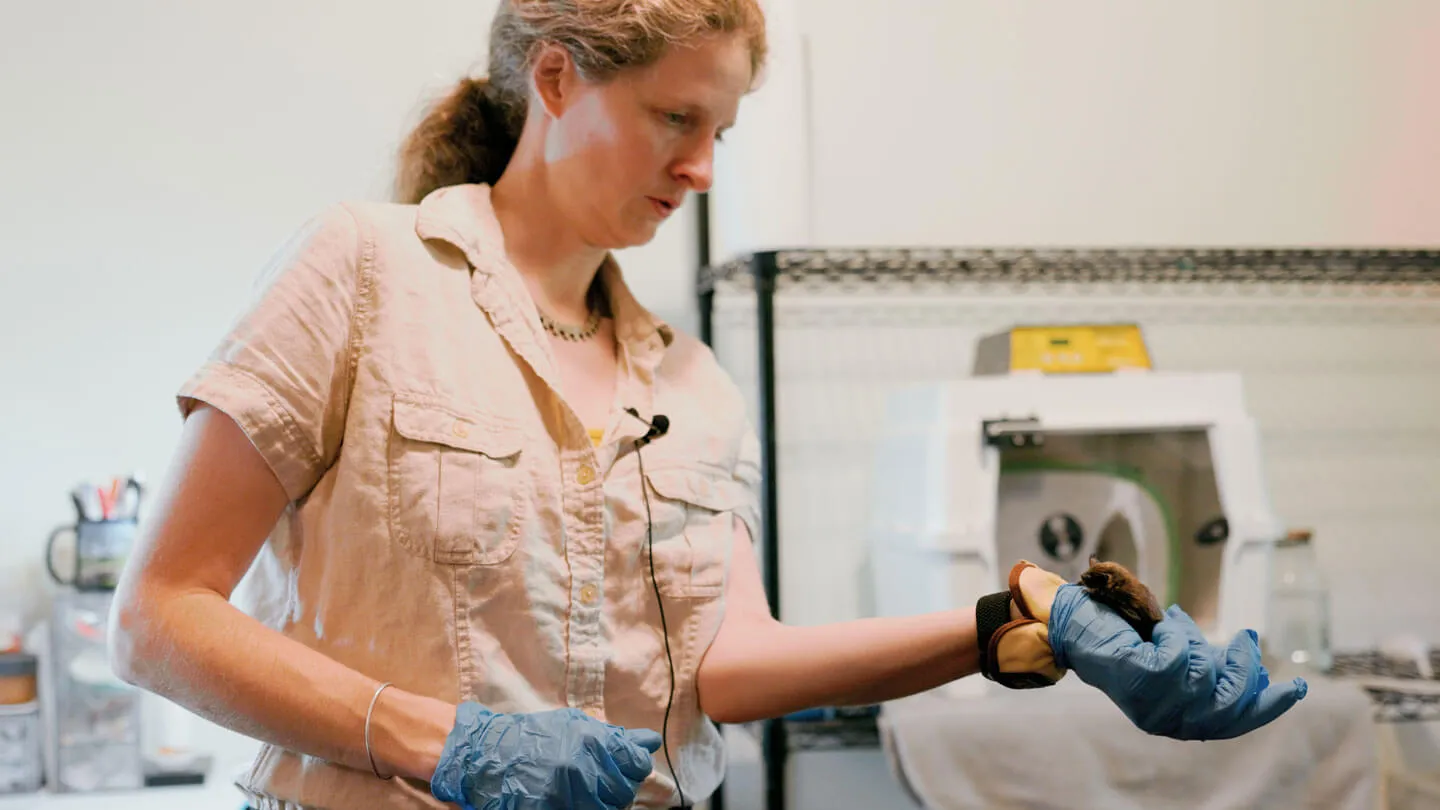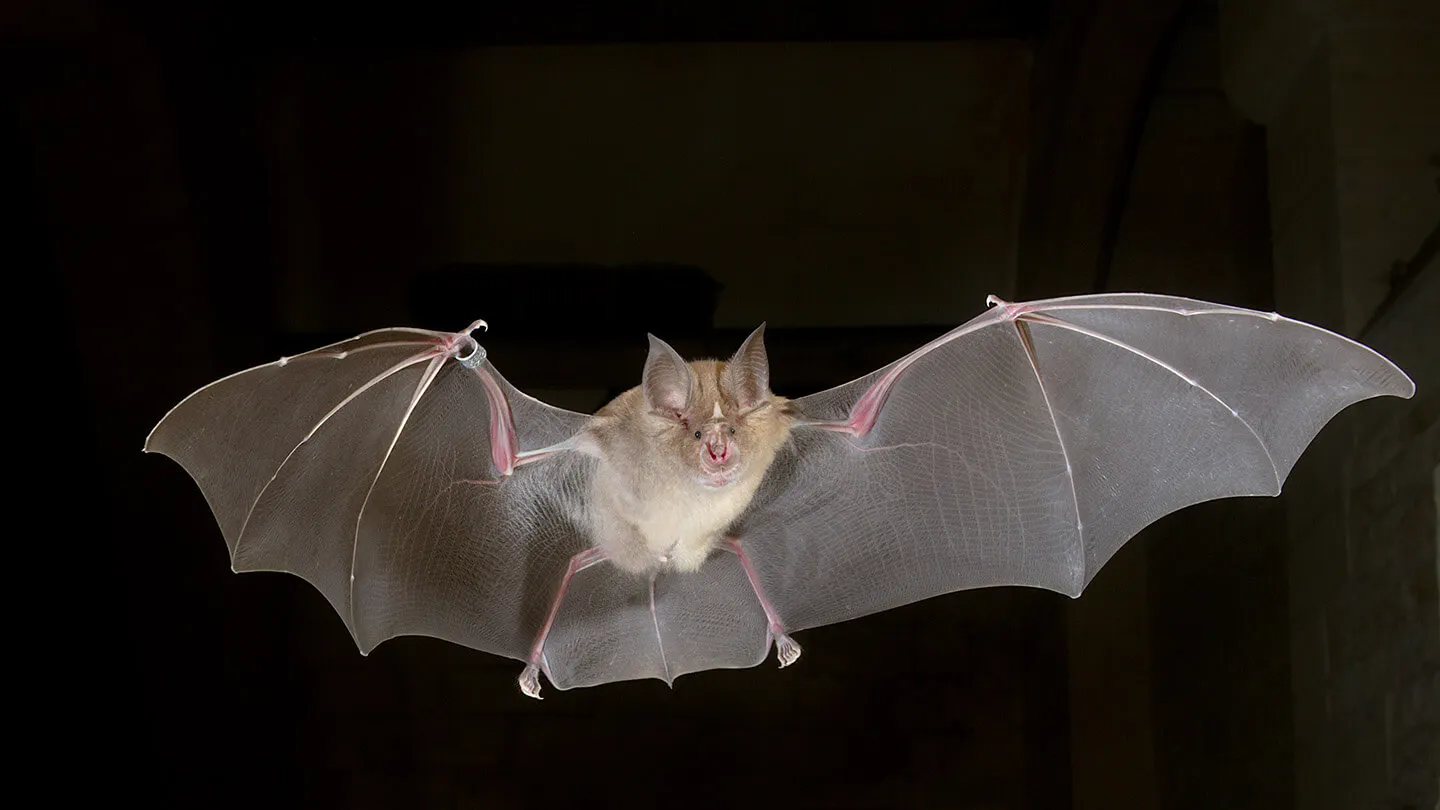
Some bats consume only fruit and nectar. Some bats hunt over the open ocean like flying fishing trawlers. There are bats that mate in swarms and others that eat other bats. Then there is the Honduran white bat—fluffy cotton balls with wings that eat only figs and will steal your heart forever. At least, that is the impression given by UVM Assistant Professor of Biology Dr. Elise Lauterbur and a researcher involved in a landmark study on the evolutionary history of bats.
She and 136 researchers from around the world conducted the largest investigation into the bat genome and fossil history to date as part of the Bat1k initiative’s effort to sequence the genomes of all living bats. The team parsed the genomes of more than 100 bat species across all 21 bat families and developed the first-ever reconstruction of the ancestor of all living bats. The team’s findings were published in Nature today.
Q. This study took a deep dive into evolutionary history and rearranged the bat family tree. Historically, why was it so tricky to pin down?
Bats are extraordinarily diverse, with over 1,500 described species (and counting). They range in size from the bumblebee bat, which weighs about the same as a penny, to the giant golden-crowned flying fox with a wingspan of nearly 6 ft. They also have a huge variety of diets, with some specializing in insects, others fruit, some nectar, or fish, or even blood. What that means is that we can't rely just on physical characteristics to figure out how bat families are related to each other across their broad family tree, because many species have evolved to fill similar ecological roles and look similar. Smaller genetic datasets have also given conflicting answers because some of the genes that contribute to the evolution of those diverse traits may look alike despite the species being only distantly related.
Another part of the challenge is that bats diversified extremely rapidly after they first evolved. The first fossil identified of a bat ancestor has what appears to be fully functional wings. After that, we see bats spread across the globe and diversify in the blink of an eye. When many groups split from one another over short periods of evolutionary time, it is much harder to reconstruct the exact branching order millions of years later. By analyzing so many high-quality genomes from representatives of every living bat family, we were able to compare vastly more genetic information than ever before and resolve relationships that had remained uncertain for decades.

Q. This study used both genomics and fossil records to determine how various bat families related to each other. What was so special about the methodology used in this investigation and what was your role in it?
One of the things that makes this study unique is its scale and completeness. We generated and analyzed 103 high-quality bat genomes, including at least one representative from every living bat family. But it's difficult to tell when species diverged using only genomes, and fossils provide both an anchor point for dating divergences and additional information about skeletal traits. This includes being able to determine when specific bat families or ancestors arrived or evolved on specific continents. By combining these lines of evidence, we were able to build a detailed family tree and a timeline of both bat evolution and global diversification.
I provided eight of the reference genomes used in the study—the same genomes from the Myotis paper recently published in Nature, did a deep dive into the relationships among virus adaptation, longevity, and cancer resistance in one of the most diverse groups of bats, the genus Myotis." My collaborators and I sequenced, assembled, and analyzed these genomes before providing them to the broader collaborative effort as a foundational resource that can be used to answer many different biological questions.
Q. Bats have crazy superpowers. They are the only mammals that can truly fly. They can echolocate prey. And bats have impressive immune systems allowing them to live exceptionally long lives for their size. Does it matter which trait evolved first?
One of the most exciting questions in bat biology is how these remarkable traits evolved and whether they are connected. Our study suggests that the common ancestor of living bats already had powered flight and echolocation. That means these abilities probably evolved very early in bat history, before the major bat lineages diversified into the groups we see today. We are still working to understand exactly how traits such as exceptional longevity and unique immune responses evolved. What is becoming increasingly clear is that many of these traits are linked, providing both major insights into bat biology as well as issues of medical concern to humans. Understanding the sequence of evolutionary events matters because it helps us identify possible cause-and-effect relationships. If one adaptation arose before another, it may have created the conditions that allowed subsequent innovations to evolve. But in the case of bats, this is still a puzzle hidden deep in history.

Q. This study reconstructed the common ancestor of all living bats. What can you tell us about it?
The common ancestor could do two very unusual things: fly and echolocate. These two traits do not define bats, but we show in this study that they were fundamental to their evolution and diversification. I say that these traits do not define all bats because there are some bats that have lost the ability to echolocate, and we can now say with confidence that this ability was lost in certain species rather than having evolved multiple times after the origin of bats. Some bats, such as the lesser short-tailed bat of New Zealand, even seem to be on their way to losing the ability to fly. It's remarkable that by combining genomes and fossils, we can make surprisingly detailed inferences about an animal that lived more than 60 million years ago. What we don't know about the ancestral bat was how long it lived or whether it was able to tolerate viruses in the same way that makes modern bats special. Further genomic analyses may shed light on these questions in the future.
Q. Is there a particular finding from this study that you are the most excited about?
What excites me most is that we've moved from debating parts of the bat family tree to having a framework we can use to ask much bigger questions: How did flight evolve? How did echolocation evolve? How did bats become one of the most diverse and widespread groups of mammals on the planet? How did bats develop their unique relationship with some types of viruses? This unparalleled resource provides for future research into how bats sense the world. For instance, a former UVM undergraduate Iris Lawson-Ryan studied the evolution of echolocation within bats; a current master's student in my lab is exploring how bats deal with different diets, and Nasreen Broomand, an NSF Postdoctoral Research Fellow in my lab, is examining what traits are associated with conservation risks in bats. I suspect one of the most important outcomes of this study will be questions we haven't even thought to ask yet.
Q. You recently co-authored another bat study in Nature that showed genes in Myotis bats seem to have multiple jobs in adaption to viruses, cancer resistance and increased lifespan. How does this study relate to your previous work on bats?
My research focuses on understanding some of the traits that make bats exceptional. This study provides the evolutionary roadmap that helps us determine when and where those traits evolved. So, these two studies complement one another. Our Myotis study focused on understanding some of the genetic changes that may contribute to exceptional longevity, cancer resistance, and resilience to viral infections in one particularly successful (and adorable) group of bats. This new study takes a much broader view by examining bat evolution across the entire order and asking more general questions—how did bats evolve, when, and where? Studies like these help us identify the genetic and evolutionary mechanisms that contribute to those remarkable abilities and understand how they evolved in the first place.