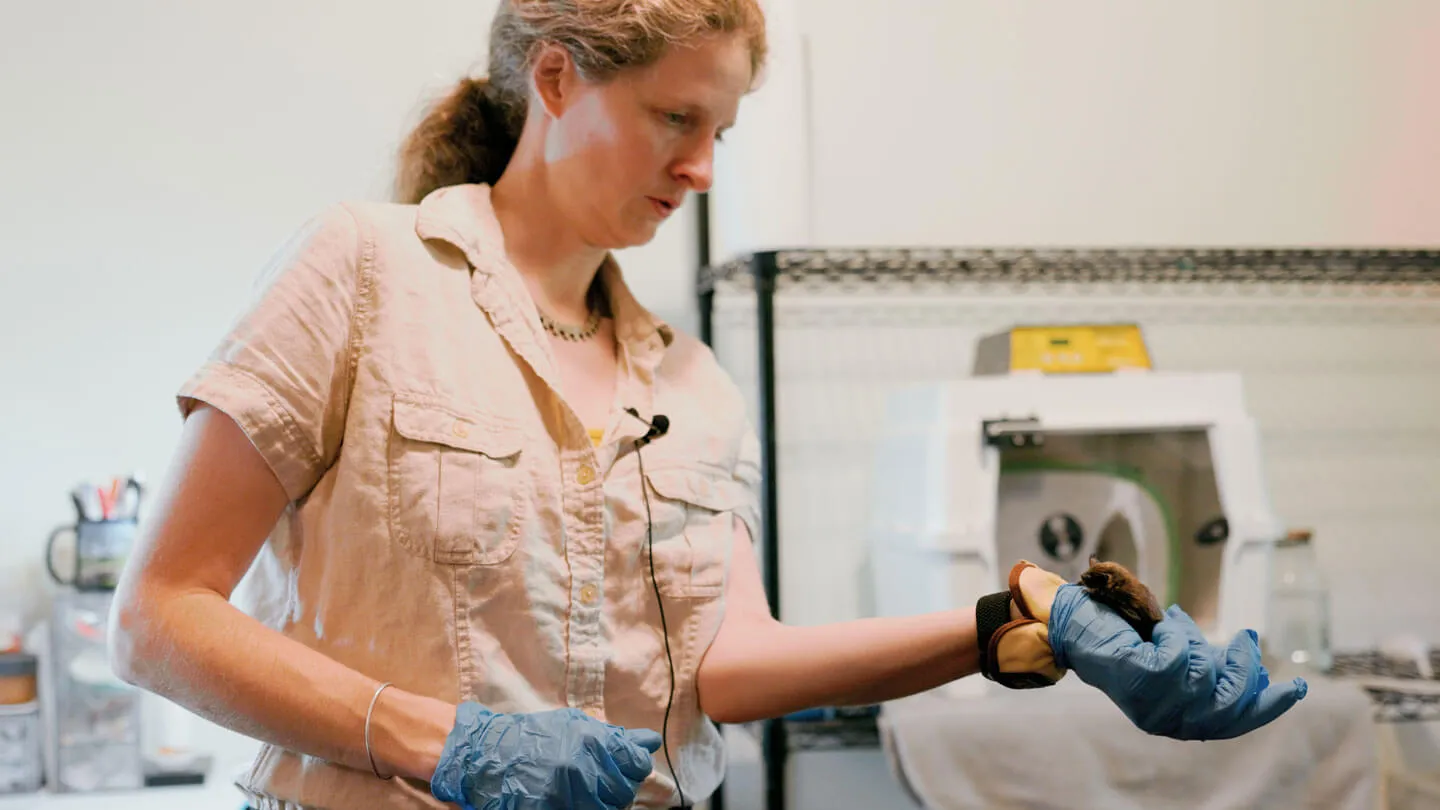
Bats are anomalies in the mammalian world—they fly, have long lifespans, and rarely get cancer. Scientists now suspect the bat immune system enables them to live longer without disease, according to a new study published today in Nature.
An international team led by researchers from the University of Vermont and Penn State University found that the key to the impressive lifespan of bats and their ability to resist cancer is embedded in their DNA––specifically, the way in which bats code genomic changes after exposure to pathogens in their environment.
“Pathogen adaption, longevity, and cancer resistance—they are fundamentally linked,” says Elise Lauterbur, an assistant professor of evolutionary biology at the University of Vermont and co-lead author of the study. “Many of the genes that have adapted to viruses in bats are genes that are also involved in longevity and cancer resistance.”
By analyzing the bat genome and experimenting on cultivated cells to mimic their response to disease, the researchers identified where in the distant past eight species of Myotis—one of the largest groups of bats and found nearly everywhere except Antarctica—encountered pathogens and how it influenced their evolution. The team screened the genome for positive selection, in this case, adaptation to viruses, to pinpoint structural changes such as gene duplication or deletion, and found key differences in the way bats have adapted to DNA and RNA viruses from humans and other primates.
“Pathogen adaption, longevity, and cancer resistance—they are fundamentally linked. Many of the genes that have adapted to viruses in bats are genes that are also involved in longevity and cancer resistance - Elise Lauterbur
While humans show positive selection for proteins that interact with RNA viruses such as SARS-CoV-2 and Influenza, bats have an outsized selection for proteins that react to DNA viruses such hepatitis B and herpes viruses. This suggests a mismatch between humans and bats that can leave both species vulnerable to potential spillover of disease. Curiously, the team also discovered that bats exhibit a unique gene copy mechanism for DNA-repair—a process essential for longevity and resistance to age-related diseases such as cancer.
“One of the things that copy number variation allows is for diversification of the function of the gene,” Lauterbur explains.
Most of the time when coding changes occur it breaks rather than shifting to a new function. Copy number variation allows you to diversify, says Lauterbur. “So potentially, you now have two things you are good at instead of one.”
Assembling the bat genomes
This boosted immune defense strategy may allow bats to respond to multiple viruses or promote longevity using new pathways. The researchers built the first near-complete genomes for eight different Myotis bats to look for clues into how disease resistance played a role.
They collected tissue from Myotis bats in the American West using a novel sampling approach developed by biologist Juan Manuel “Manny” Vazquez, an assistant professor at Penn State University and co-lead author of the study. Instead of harvesting organ tissue, the scientists biopsied tiny circular patches from the wings akin to an ear piercing. Vazquez then used the tissue to grow cell lines and build genomes for the eight species. The approach unlocks new methods for scientists to study animals across their lifespan.
“Here is a way to do science for any animal on earth that doesn’t require killing the animal and is in fact compatible with better science,” Vazquez says.
This was especially important given the sample population includes Myotis lucifugus or little brown bats—North America’s longest living bat species and the one affected most by a deadly fungal infection called white nose syndrome.
Why examine bats in the first place?
Bats are among the most diverse mammalian species—second only to rodents—and live nearly everywhere and eat nearly everything. Bats can also live an extremely long time for their size—think decades rather than years.
“If you look at two bats, the same size, one lives 3 years the other lives 30 years and they are very closely related, like humans and Neanderthals, you can essentially find a very small number of genetic changes that leads to a very big change in their lifespan,” Vazquez explains. “And that is kind of the Holy Grail for evolutionary medicine.”
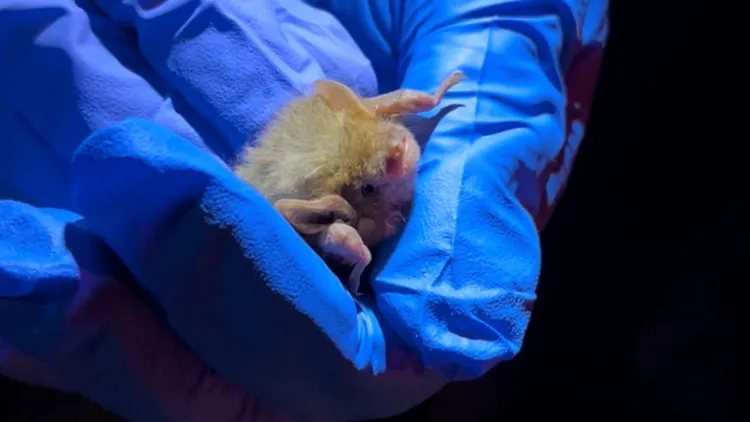
While scientists have long studied rodents, bats receive less attention. The authors wondered what if bats could provide new insights for human health because they have already evolved longer lifespans? Could the development of flight have propelled the diversity of bats around the world and shifted the evolutionary trade-offs from escaping predators to escaping disease?
Lauterbur studies how species evolve to environmental threats such as pathogens and focuses on disease resistance. Vazquez sequences genomes for insights into aging and age-related diseases. When they both pored over the results they marveled over the genetic changes—one seeing aging genes, the other seeing genes associated with disease.
“These are often studied as separate biological problems, Lauterbur says. “But our results suggest that evolution may be shaping them together.”
Potential pathways for cancer resistance
The research team homed in on a specific immune gene called protein kinease r (PRK) found in every mammal to understand what made the Myotis bats antiviral response so different.
“In every single other mammal that has been looked at, there is one copy of this gene,” Lauterbur explains. “That means there is some important pressure keeping it at one copy. In our very special Myotis bats, there are two copies—or so we thought.”
When she teased apart the genome, Lauterbur found some Myotis bats had one, two, or even three copies of PKR, suggesting additional copies have a protective effect that promote longevity. Collaborators conducted experiments on the various cell lines, splicing copies of PKR into different species and then introduced the cells with a pox virus to gauge their reaction and dosed the cells with chemotherapeutic drug to test how they tolerate and repair damage. The team found little brown bats—the longest living bats of the group—responded differently at high doses where cell damage would most likely occur.
"The bats seen to be really good at repairing and killing off the damaged cells." - Manny Vazquez
“The little brown bats start committing to kill off cells,” Vazquez says. “Our hypothesis is it’s dumping the cells that can’t be salvaged.”
This adaptation could be critical for curbing the spread of cancer. As organisms age and cellular processes decline, some particularly long-lived species have developed specialized responses from repairing damaged cells, isolating the damage, to throwing cells out upon damage detection.
“The bats seen to be really good at repairing and killing off the damaged cells,” Vazquez says.
While it may be too early to use the unique immune adaptations of bats to solve human pathology, some lessons may be particularly valuable.
“Everything is connected,” Vazquez says. “Everything uses the same shared set of biology. … We don’t have to treat all of these different problems as silos. We can now start focusing on systems like bats to understand how we can solve multiple human age-related diseases.”
Moving forward, Lauterbur wants to explore underappreciated adaptations such as changes in gene copy number, she says. “Those kinds of changes can give evolution additional ways to generate diversity and respond to changing environments, and I think we're only beginning to understand their importance.”
This study was funded by the National Science Foundation and the National Institutes of Health. Additional senior co-authors of the paper include Peter H Sudmant of the University of California, Berkeley; Lucie Etienne of the École Normale Supérieure in Lyon, France, and David Enard of the University of Arizona, Tucson.