University of Vermont athletes are no strangers to the Olympic podium. Since Albert Gutterson won a gold medal in the long jump at the 1912 Olympic Games, more than a dozen Catamounts have followed in his footsteps. But until the 2026 Olympic Winter Games, the most medals earned in a single Games by athletes who have attended UVM was two.
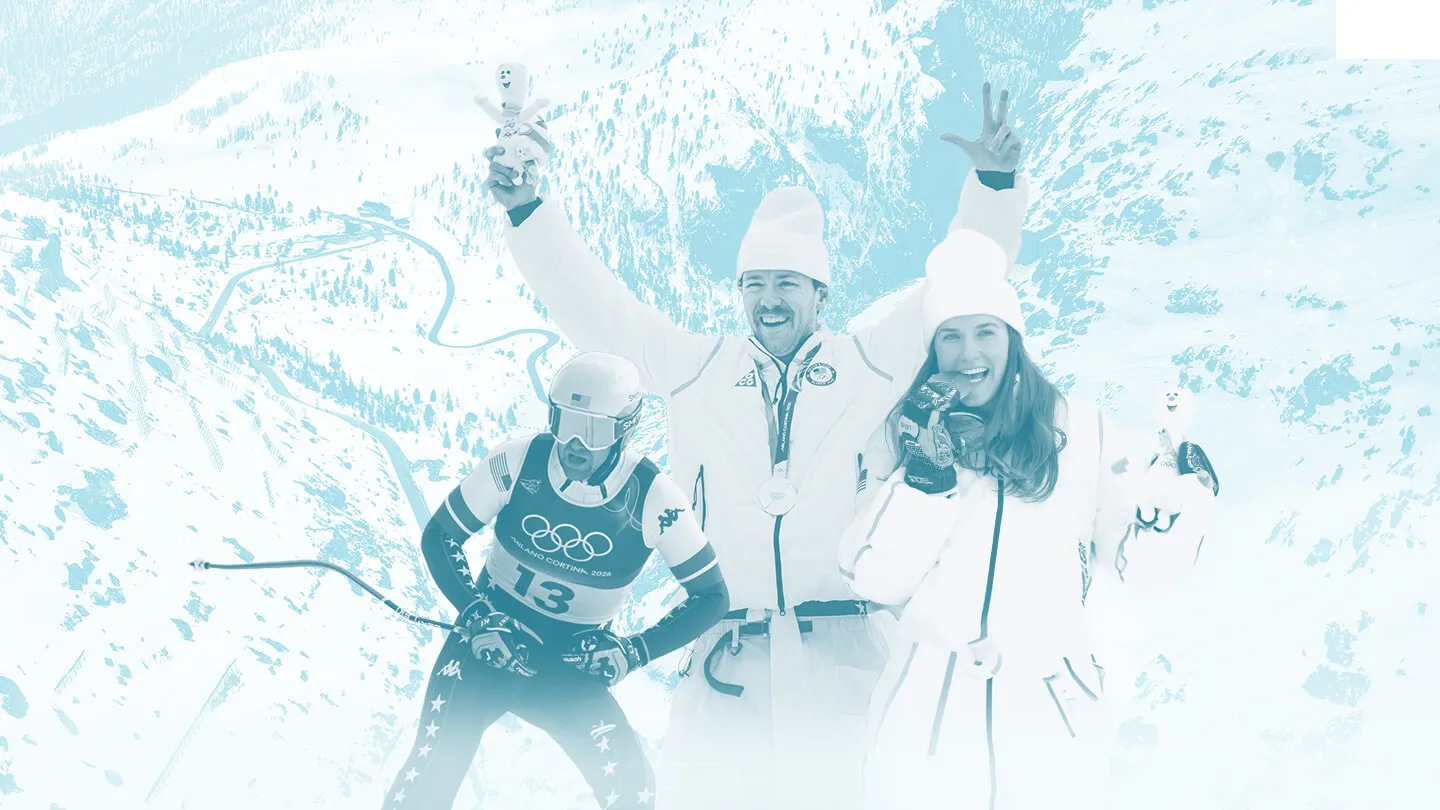
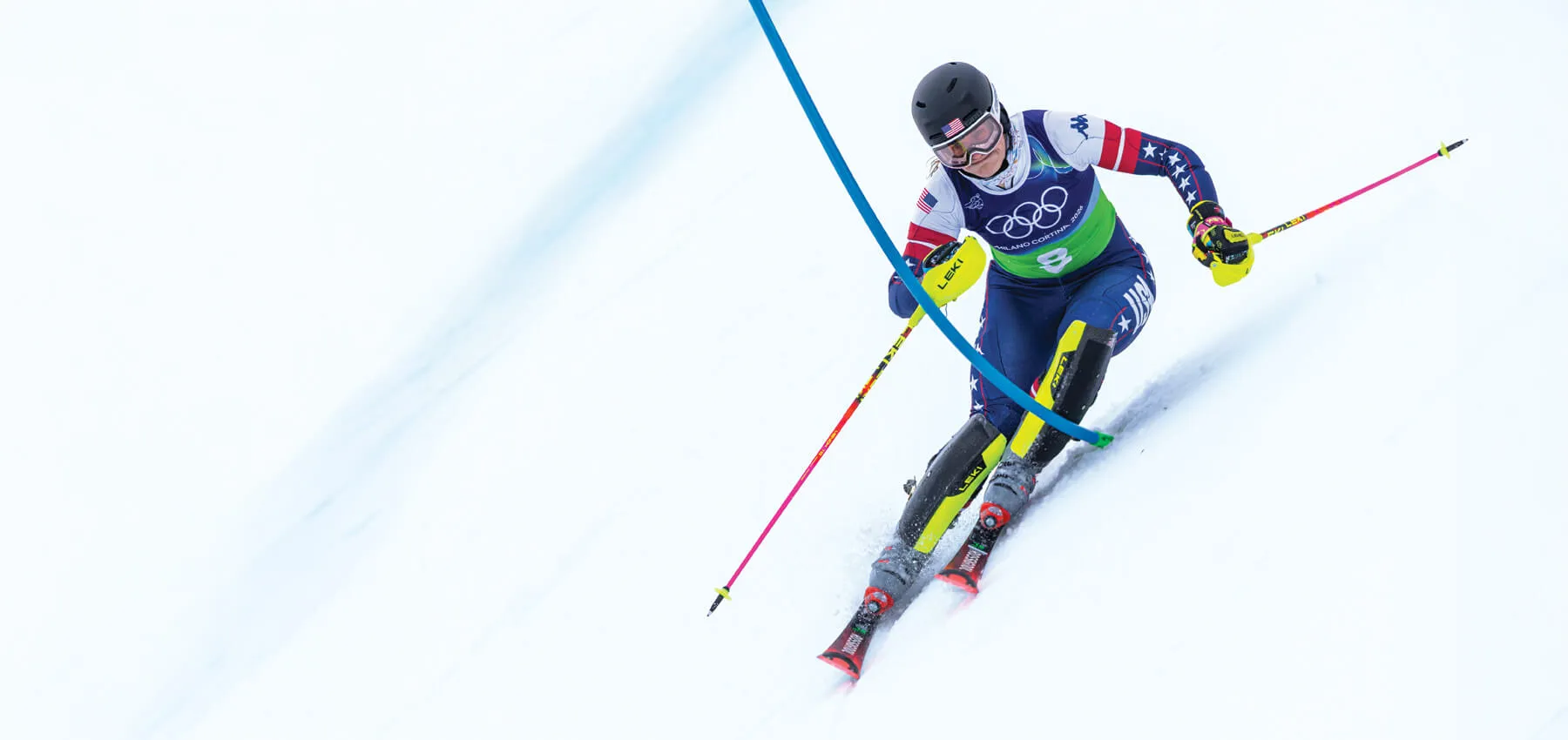
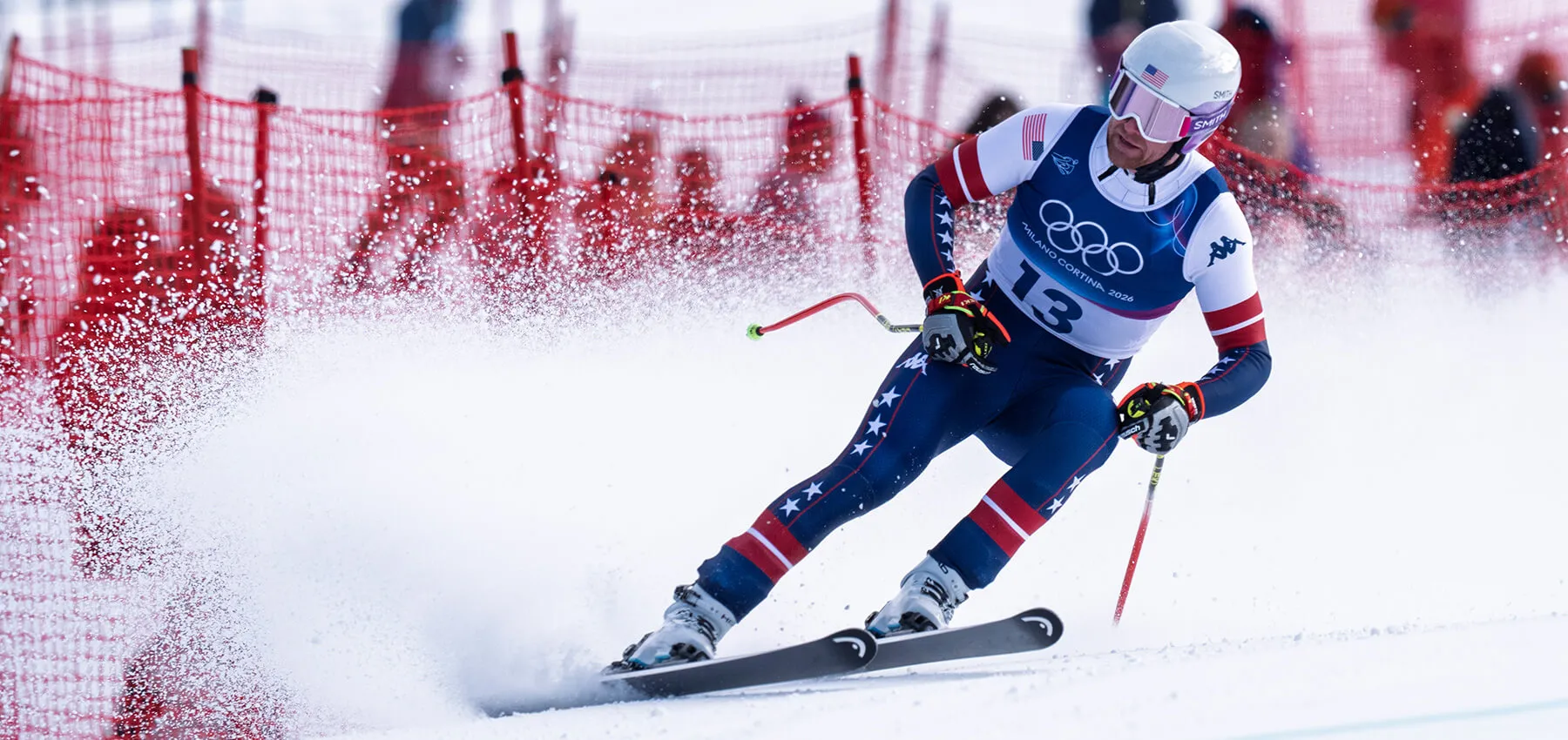
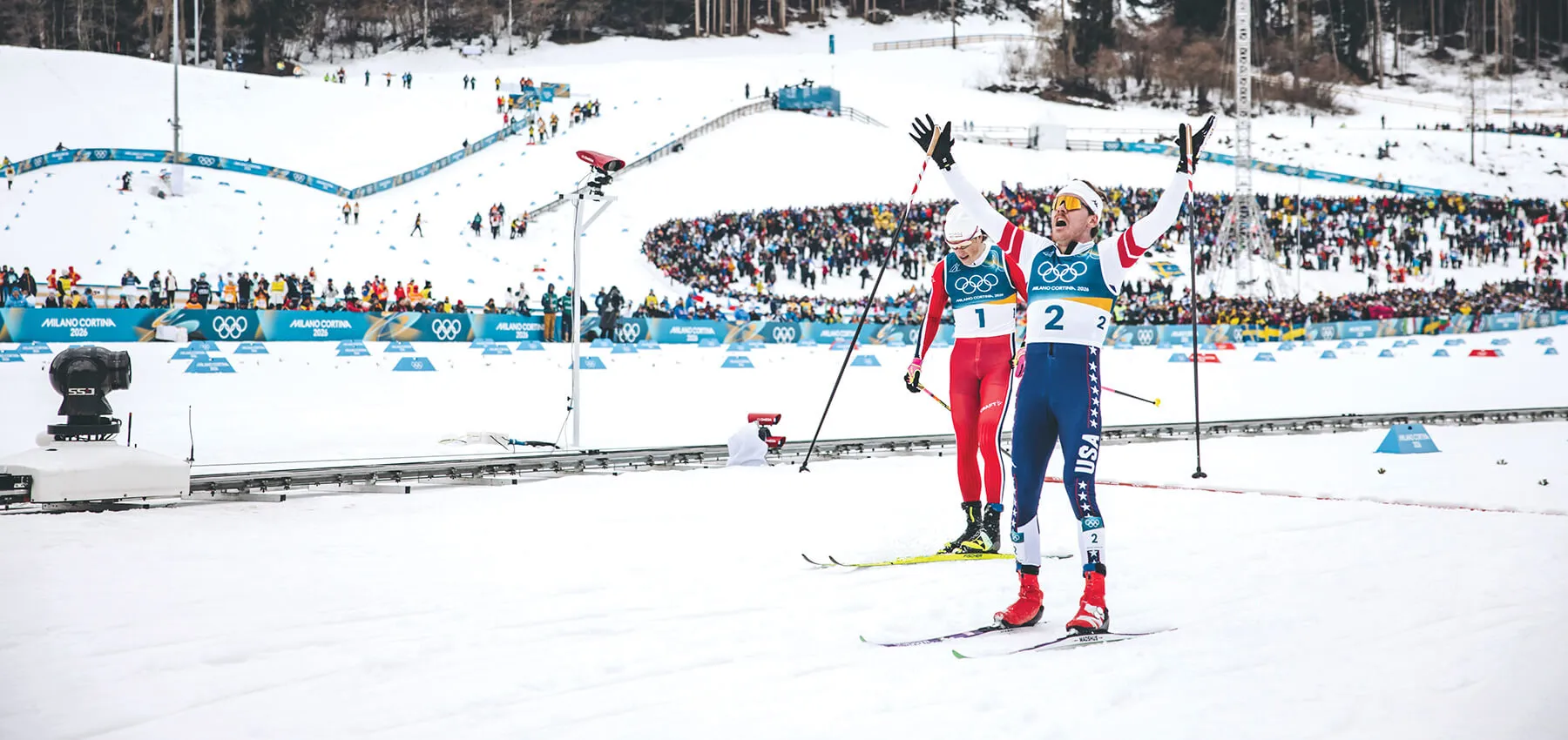
Then, at the Milano Cortina Games, three skiers with UVM ties claimed four medals in four separate events. First, Ben Ogden ’22 earned silver in the men’s cross-country sprint—the first Olympic medal for the U.S. men in 50 years. About an hour later, Paula Moltzan, who won the 2017 NCAA slalom title for the Catamounts, captured bronze in the alpine team combined. The next day, Ryan Cochran-Siegle, who studied mechanical engineering at UVM, won his second Olympic silver medal in men’s super-G. Six days later, Ogden added another silver, this one in the team sprint.
“I wanted to bring it home for my family and bring it home for Vermont,” said Ogden, a lifelong Vermonter, after winning his first silver medal.
While Cochran-Siegle—known as RCS—never competed for the Catamounts, both Ogden and Moltzan did, and their college experi-ences played a role in their Olympic success.
Why UVM?
Moltzan, 32, grew up in Minnesota and was a top junior racer who first made the U.S. Ski Team in 2012 when she was still in high school. By 2015, she was excelling—competing in her first senior world championships and becoming the first American woman to win slalom gold at the junior world championships.
But the 2016 season was less kind to Moltzan. Although she scored her first World Cup points (by finishing in the top 30), she did not do well enough to meet U.S. Ski Team criteria. Moltzan was devastated. Her ski racing dream was over. Or so she thought.
College was the obvious next step. But “when it’s April and school starts in August, to find a school to go to is kind of tough,” she said.
Ogden, 26, had a more traditional path to UVM. A fourth-generation Vermonter, he grew up in Landgrove and before graduating from the Stratton Mountain School in 2018, sought out a top NCAA Division 1 ski program. Several schools fit that bill; his older sister at-tended Dartmouth, and his dad graduated from Middlebury. But Ogden was drawn to UVM. He liked that UVM Nordic coach Patrick Weaver prioritized recruiting top Vermont skiers.
“From his talents, I knew he was going to help us make the team competitive. But after meeting him, I knew that he could bring a lot more to the team, just as the person,” says Weaver.
At the time, Jimmy Cochran, a two-time Olympian and former UVM All-American, was an assistant coach for the Catamount ski team. After speaking with him, Moltzan received an offer from UVM and quickly proved her worth. A biochemistry major, she reached the podium in six regular-season races as a freshman and won the 2017 NCAA slalom title.
Her favorite memories from college? The team lifts and workouts.
“There’s so much camaraderie and support that it almost makes the pain cave fun,” she says.
Ogden, 26, had a more traditional path to UVM. A fourth-generation Vermonter, he grew up in Landgrove and before graduating from the Stratton Mountain School in 2018, sought out a top NCAA Division 1 ski program. Several schools fit that bill; his older sister at-tended Dartmouth, and his dad graduated from Middlebury. But Ogden was drawn to UVM. He liked that UVM Nordic coach Patrick Weaver prioritized recruiting top Vermont skiers.
“I wanted to bring it home for my family and bring it home for Vermont”
“From his talents, I knew he was going to help us make the team competitive. But after meeting him, I knew that he could bring a lot more to the team, just as the person,” says Weaver.
Weaver noticed that Ogden was a good listener. He also liked how committed Ogden was to Vermont.
“He wanted to represent Vermont, that was very important to him,” says Weaver. “That’s refreshing to hear from an 18-year-old.”
Ogden also liked UVM’s engineering program. He could take mechanical engineering classes from day one “rather than having to take French,” he jokes.
“I wish I could speak French,” he continues, “but for my goals, it made more sense to take engineering classes from day one. It was a little bit less of a load for the rest of my time there.”
His favorite memory skiing for the Catamounts came at the 2019 Dartmouth Carnival, when UVM swept the podium in the 3 x 5-kilometer relay, with Ogden’s team finishing first.
“All nine of us on the team got to stand on the podium,” remembers Odgen. “Success in relays is more fun than success in individual events because you’ve got your friends there. This was the ultimate version of that.”
“If you get two skiers on a podium, that’s a pretty good day,” comments Weaver. “When we got three, it was almost surreal.”
Although Cochran-Siegle never skied for the Catamounts, attending the university was a natural choice. His grandparents, Mickey and Ginny Cochran, met at UVM, with Mickey graduating in 1948 and Ginny two years later. Mickey and Ginny’s four children—known as the famed “Skiing Cochrans”—also attended UVM. Cochran-Siegle’s mom, Barbara Ann Cochran, had won Olympic gold in 1972, then graduated from UVM in 1978. His aunts Marilyn and Lindy—also Olympians—graduated in 1979 and 1982, respectively, and his Uncle Bobby was a 1972 Olympian, 1976 UVM graduate, and 1973 NCAA downhill champion. Many of the Cochran offspring who competed for UVM in the 1970s were trained by Mickey himself, who was an alpine coach for the team for most of the decade.
“I still recognize so many of the qualities that draw me back to UVM...One of the most meaningful is the chance to contribute to my family’s legacy at the university. It’s safe to say my connection to UVM runs deep—my blood truly runs green and gold.
Several cousins also attended and raced for UVM, including Jimmy and Amy Cochran (Bobby’s kids) and Tim and Robby Kelley (Lindy’s kids). All four earned All-American honors, and Tim won NCAA slalom titles in 2011 and 2012.
“When I began applying to colleges in the fall of 2009, the only schools I seriously considered were UVM and the University of New Hampshire, largely because my sister was enrolled [at UNH] at the time,” says Cochran-Siegle. “UVM stood out to me for a number of reasons. My family’s deep connection to the university was certainly a major factor, along with its historically strong alpine ski program, the quality of its academics, the familiarity of the student body and setting, and the affordability of in-state tuition.”
Cochran-Siegle’s blossoming ski career pulled him away from college. While his cousins were claiming NCAA honors, he was winning world junior medals: gold in downhill and combined in the 2012 junior world championships. But his heart has remained close to the school. His fiancée, Jessie Lucas, recently graduated from UVM’s Larner College of Medicine and is currently a resident in emergency medicine there.
“I still recognize so many of the qualities that draw me back to UVM,” he says. “One of the most meaningful is the chance to contribute to my family’s legacy at the university. It’s safe to say my connection to UVM runs deep—my blood truly runs green and gold.”
From UVM to the U.S. Ski Team
Moltzan’s return to the U.S. Ski Team came unexpectedly—and quickly. In the fall of her junior year, while training in Colorado with her UVM teammates, she won a time trial that earned her a start in the Killington World Cup slalom.
At Killington, in front of thousands of cheering fans, including her UVM teammates, Moltzan stunned everyone—including herself—by finishing 17th (with the fourth-fastest second run). She soon received more World Cup starts.
“Never in a million years would I have expected that result,” she said at the time.
Her success continued in Europe, where she finished as high as 12th in a World Cup slalom. She was offered more World Cup starts and a world championship berth. She adjusted her spring semester—taking only electives with no labs—and kept racing.
Then in early March that year, back home at Stowe for the 2019 NCAA Ski Championships, she traded her USA speed suit for Cata-mount colors and placed third in slalom and fifth in giant slalom—helping UVM finish as runner-up, the team’s best finish in five years.
At season’s end, Moltzan was named back to the U.S. Ski Team. Her final year of classes would have to wait.
Ogden was also named to the U.S. Ski Team while at UVM, balancing academics with international competition. He maintained a full course load while traveling to Europe for world juniors and World Cups every winter—trips that lasted for several weeks. Three times, he helped the U.S. men earn relay medals at world juniors (the first-time he U.S. men had ever done so).
Back home, competing for the Catamounts, Ogden was consistently on the podium. In 2020, shortly before the Covid-19 shutdown, he won his first NCAA individual title in the men’s 10-kilometer freestyle. In 2022, he swept both the classic and freestyle NCAA titles.
After those victories—held at Utah’s Soldier Hollow Nordic Center, site of the 2002 Olympics—his Olympic dreams felt closer than ev-er.
“I’ve spent many a training session and race envisioning success at the Olympics,” he says. “I don’t know if I ever expected it or not.”
A two-time Olympian, Weaver knows how hard it is to win an Olympic medal—or even get near the podium. But he sensed something in Ogden.
“He’s a very determined athlete with a lot of talent, and he just wanted to get better and wanted to learn,” says Weaver. “If anyone, I felt he could make it happen.”
College Racing Leads to World-Class Success
Moltzan credits her three years at UVM for elevating her ski racing. She grew up too, she says, and learned to take responsibility for her life. She also thrived in a team environment.
“When it comes to race day, it’s not just for you anymore,” she explains. “It’s for an entire team, and I’ve kept almost the same mind-set.”
She also learned to manage pressure. At NCAA races, team scores depend on both alpine and Nordic results, placing weight on every performance. Moltzan recalls standing in the start gate at her first NCAA slalom, knowing her team was counting on her.
“I can’t even compare the feeling to a World Cup because your team is riding on your back, and it’s not just the alpine team, it’s the Nordic team as well,” she said after that race. “You have six alpine athletes and six Nordic athletes all on your shoulders.”
One of the few moments that rivaled that pressure came at the 2025 world championships, where she and teammate Lauren Macuga (who had raced the downhill portion of the team combined) narrowly missed the podium.
At the 2026 Olympics, she made sure history did not repeat itself. After teammate Jackie Wiles put them in fourth after the downhill, Moltzan delivered a strong slalom run to secure bronze.
As her husband, Ryan Mooney ’20, reminded her, “pressure is a privilege.”
Moltzan has two semesters remaining to finish her degree—both “fully loaded with major classes and labs”—which she plans to com-plete after retiring from ski racing.
“I’m a biochem major,” she says, “and I’m not interested in teaching those classes to myself online.”
Ogden’s time at UVM also deepened his love for the sport. In college, he matured as both an athlete and person—and learned that success does not always require perfect conditions. Not every race has to go as planned. He also learned resilience. In the van with his UVM teammates after tough races, “we’d maybe laugh about the rage.”
“When it comes to race day, it’s not just for you anymore,” she explains. “It’s for an entire team, and I’ve kept almost the same mindset.”
At the 2026 Olympics, however, everything did go as planned. In the men’s classic sprint, Ogden moved himself into silver-medal posi-tion early in the race and crossed the finish line just behind Norway’s Johannes Høsflot Klæbo. It marked the first Olympic medal for
U.S. men’s cross-country skiing since Vermonter Bill Koch won silver in 1976.
Weaver still works with Ogden and every year since his UVM graduation, has watched him improve.
“This year, when we got into this season, in the back of my mind, I really did think he had a shot of doing something very special at the Olympics,” says Weaver, who watched the Olympic races from home with his family.
Winning that first silver medal carried personal meaning for Ogden. Koch had helped inspire Ogden—and often let him and his sisters mess around in the cross-country skiing terrain park that Koch had built in his backyard in Peru, Vt., a few miles from Landgrove.
Later in the 2026 Olympics, Ogden and teammate Gus Schumacher won another silver, this one in the team sprint. That medal was special too, shared between best friends who believed in each other.
“It’s something I’ll never forget,” says Ogden.
Since the Olympics, Ogden has reflected on the many people who supported him over the years—from family, coaches, and mentors, to professors and classmates at UVM. He took exams on the road and befriended classmates who shared notes from the classes he missed.
“I never received pushback, people were always happy to help,” he says. “It’s a testament to the culture at UVM. It felt like collabora-tive learning … like professors wanted to help me become the best version of myself.”
“I feel really proud to have had some real success in the sport,” he adds, “and hopefully my professors and classmates know they had a hand in it.”