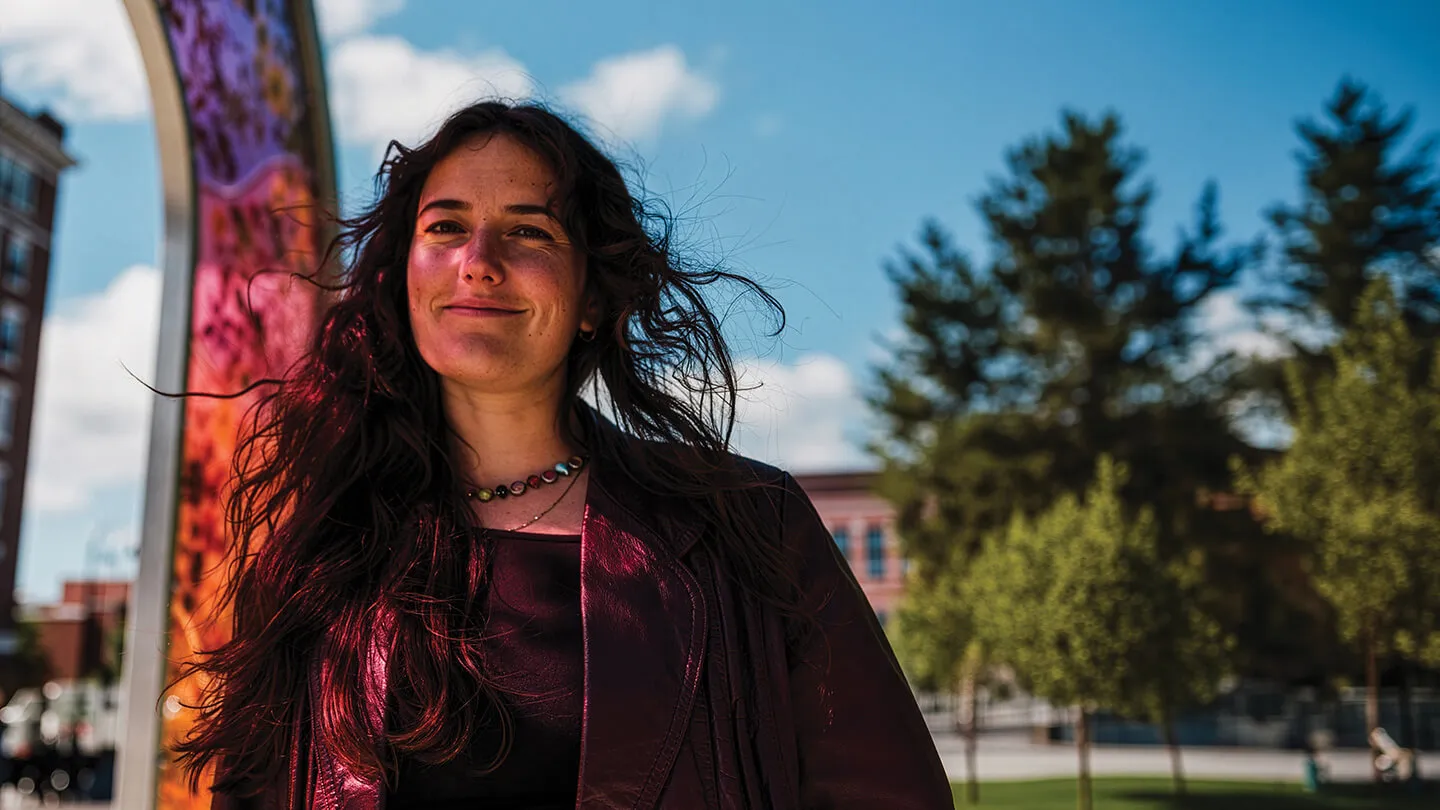
Lydia Kern ‘15 has always been a gatherer. As a child, she collected objects and found materials, not to house but to transform.
When she arrived at UVM, she was intent on social work. The joy of gathering resources and relationships into strong community felt natural.
The semester before her graduation, her sister passed away. This untimely loss reoriented Kern’s life towards art, a passion she had by then developed for years. Braced by her Burlington community as she navigated grief and artmaking, Kern stayed for a decade after graduation.
Now she is a full-time artist with a freshly unfurling life in New York City, with a studio in Queens.
She finds meaningful overlap between her background and training in social work. They “utilize similar skill sets—creative problem solving, meaning-making, acquiring material resources to meet specific needs, supporting processes of transformation, and navigating the unknown,” she reflects.
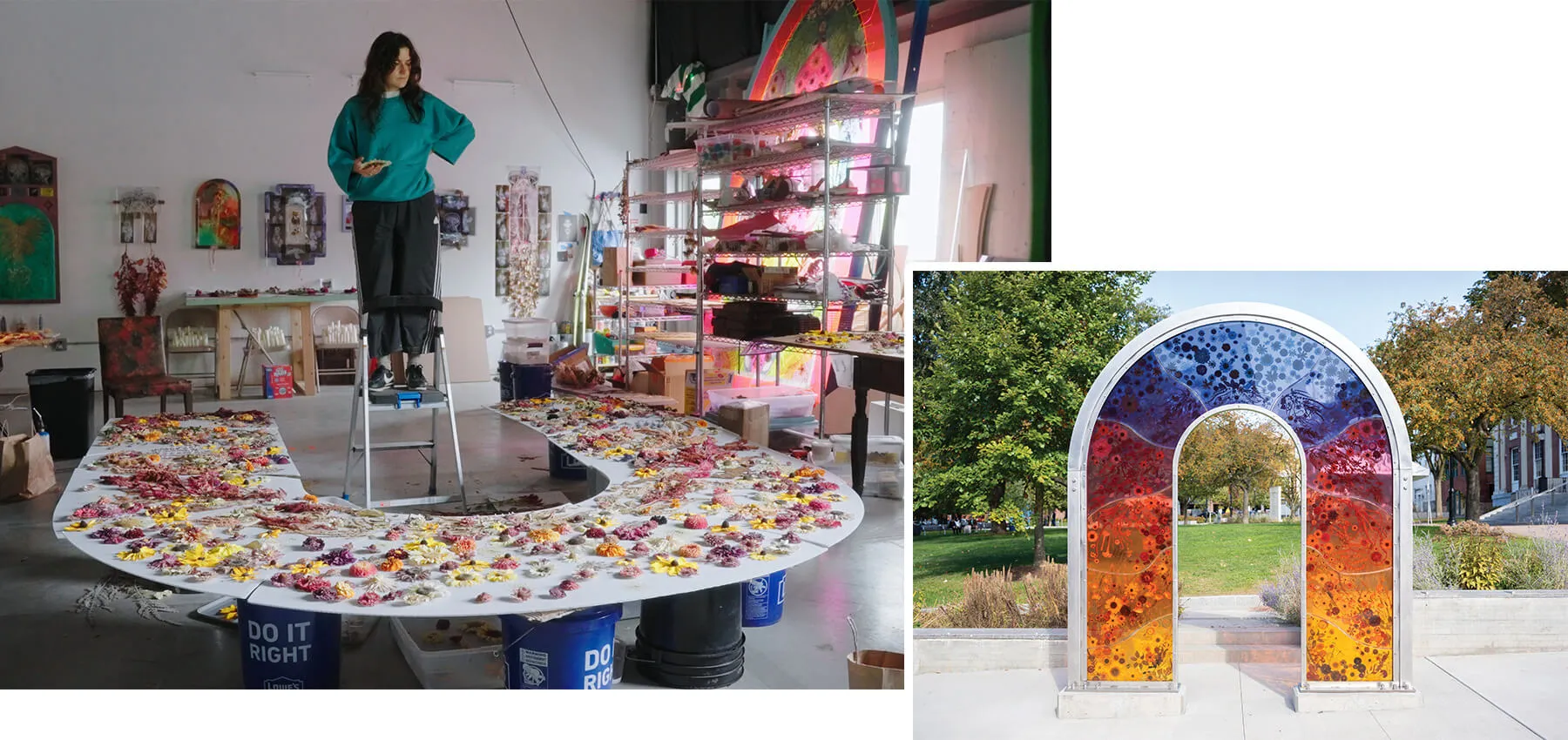
Kern found a way to transform grief into beauty, loss into connection, and refuse into art. It is befitting that the last piece before her depar-ture from the city that showed her such tenderness during an impossible time should be her largest to date, Anthology. It embodies “what is fleeting yet enduring—the persistence of beauty and the certainty of change.”
Anthology, translated as ‘collection of flowers’ from the Greek anthologia, is aptly titled: “composed of hundreds of preserved flowers gath-ered by neighbors across Burlington.” The sculpture forms a passable archway at the edge of City Hall Park and was commissioned by Burlington City Arts.
“I’m inspired,” she says, “by the poetic meaning flowers often hold for us—used to celebrate joy and commemorate loss. This feels appropri-ate for its proximity to City Hall, a space where so many ‘threshold’ life moments occur—birth and death certificates, marriages, gen-der-affirming name changes, and protests. These moments (personally, or as a species) are not meant to be passed through alone; they re-quire collective participation and support.”
All of the resin ‘stones’ were made to support and hold one another in place. The work itself was made “possible by a web of Vermont fabri-cators” as well as the community members who gathered the flowers used in the piece. In this way, Kern notes, Anthology “echoes collectivity, both in structure and in the creation process” and “belongs to everyone.”
Experience Anthology by visiting City Hall Park in downtown Burlington.