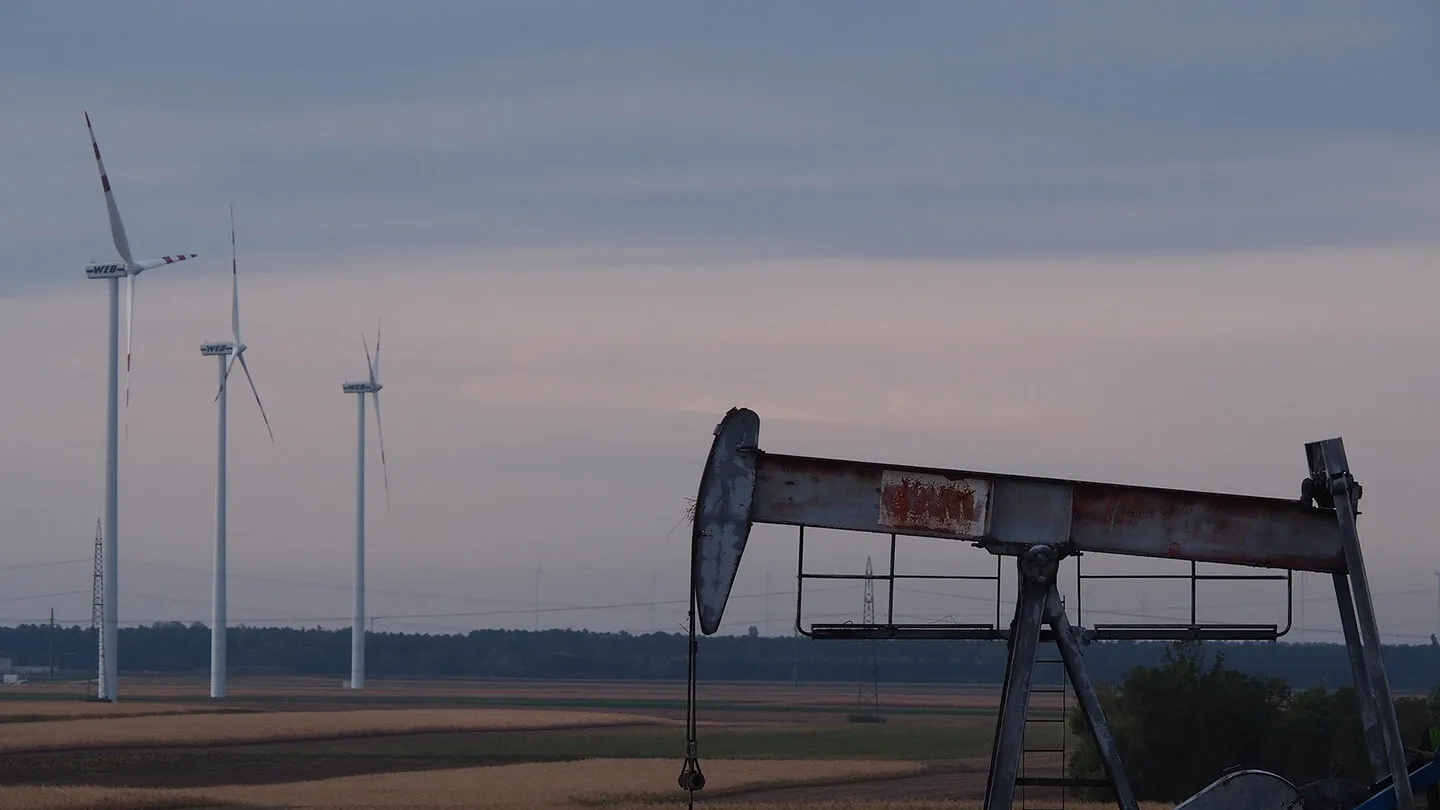
A month into war with Iran, the U.S. government has opened its strategic oil reserve and temporarily lifted sanctions against Russian (and Iranian) oil and gas to combat rising fuel prices and calm financial markets. Even if the conflict ended today, energy experts estimate a ripple effect could last months or even years. Could a fossil fuel crunch catalyze a global pivot toward greener, more sustainable, energy practices?
Meet the experts:
Leigh Raymond, professor of political science and the Gordon and Llura Gund Chair in Liberal Arts. He studies emissions trading, renewable fuels, and energy conservation and his book, Reclaiming the Atmospheric Commons The Regional Greenhouse Gas Initiative and a New Model of Emissions Trading, examined a 10-state cooperative effort established in 2005 to reduce carbon emissions in the Northeast.
Patrick Callery, assistant professor of management at the Grossman School of Business and faculty fellow of the Gund Institute for Environment. He researches corporate innovation and sustainability and recently described how corporate disclosure of carbon targets can be exploited by firms under financial pressure by investors.
Donna Ramirez-Harrington, professor of economics who studies environmental economics and policy. She examines voluntary adoption of environmental practices and green technology adoption, and was part of UVM team that found people who experience extreme weather events are more likely to support climate change mitigation strategies.
The conversation has been lightly edited for length and clarity.
Q. With volatile oil and gas prices, do you see this as a moment for transformative shifts in energy policies?
LR: I think that's already happening and I think the war will accelerate that. One of the main points that came from the Regional Greenhouse Gas Initiative’s (RGGI) cap-and-trade policy I studied is the incredible importance of consumer protection from energy prices. RGGI was able to succeed politically, in part, because they were very careful about finding ways to manage any increase in consumer energy costs. That was back in 2008. And now we are seeing a larger affordability discussion happening nationally. So, I think there's clearly a lesson there. We know that renewable prices are competitive or even lower than a lot of the traditional right fossil fuel prices, especially when you talk about electricity generation. We also know that the Iran war is having a catastrophic effect on energy prices, which shows the challenges facing fossil fuel energy production. There is a much larger global economic trend away from fossil fuels and towards renewables that is not occurring in the U.S. in part because of the extreme hostility the Trump Administration seems to have against renewable energy. Missing that trend is almost certainly undermining our ability to provide more affordable electricity and energy costs.
PC: We tend to see things from U.S-centric perspective and don't always have visibility of what's going on internationally where there is continuing growth in electrical vehicle (EV) adoption and renewable energy, perhaps not as aggressive as people would like to see if we're trying to decarbonize the economy, but certainly trending in the right direction. When you have oil shocks, it definitely pushes people to revisit their reliance on oil and gasoline and toward buying EVs, for example. But when you think outside the transportation sector, I think that's going to require something different than oil prices to shift. While there is a psychological aspect of ‘What else is going to drop?’ I don't think you're going to see companies rushing out to embrace sustainability again. I hate to say it, but you might even see more greenwashing like ‘Oil is a problem, but look at what we're doing with our solar panel investment’—things like that.
DRH: For environmental economists like me, we like the carrot and the stick. You want to raise the prices of the undesirable—the stick—and lower the price of the desirable through a subsidy—the carrot. A regional program like RGGI has both. The only national program is the Inflation Reduction Act of 2022 (IRA), and it only provides carrots. What you're seeing in Iran might be perceived as the stick but it's only temporary. And it’s not targeting carbon; it’s causing entire supply chain disruptions, including the transition to clean energy because a lot of our inputs such as lithium-ion battery cells are still sourced from China. Higher fuel prices can lead to inflation and higher interest rates, which may put large-scale green energy projects at risk because they require large upfront costs. The good news is that we are now the number three producer of solar in the world because of the IRA and the CHIPS and Science Act. They were designed to create a green supply chain to prepare for the energy transition to renewable energy and rival China. However, the Trump Administration has weakened or rolled back IRA funding disbursements and subsidies, slowing things down and adding uncertainty into the minds of investors.
After the 1973 oil embargo, the U.S. required automakers to improve fuel efficiency standards. Are there certain factors needed to prompt big changes?
LR: For utilities, it's basically the bottom line. Government policies around taxes and subsidies can be very important. The production tax credit in the U.S. has been critical to developing the wind energy industry. We also have tremendously large subsidies for fossil fuel extraction and production that tend to get overlooked and are a major obstacle for utilities to shift over to renewables. Public opinion also matters, especially when you look at consumer prices, so I think that's a major issue for officials, especially today as affordability is becoming much more salient political issue. But there are great ways to make the shift to renewables while saving money for consumers or at least without raising their net energy costs.
PC:A major shock to the system is often required. The lessons of recent decades have shown us that a big shock can kick a lot of things into action. For example, take the financial crisis in 2008. But if the threat passes and the shock wasn’t experienced for a long period it's easy to slip back to where we were before. So, I think these external shocks to the system can promote change but whether they really facilitate an overhaul in institutions and systems requires that those shocks be experienced for a long time. One thing that worries me is the potential convergence of climate problems, escalated geopolitical tensions, and the rise of artificial intelligence that could tilt the world into another crisis. What we're seeing right now with $100 barrels of oil I wouldn't really call a crisis.
DRH: It really is incentives. For consumers, we need costs to be low, so we subsidize changes to systems. If something is more expensive to generate or to develop investors are not going to do it and that's why the IRA’s investment tax credits are important. Public opinion works too. It seems like a fluffy term, but public opinion gets reflected in the way we vote with our pocketbooks. If we boycott a company that is very unsustainable or we purchase shares or products of a company whose goods are sustainable, it’s really an incentive. It hits them on their bottom line. Public opinion gets reflected through things you can record in the goods market, labor market and stock market.
Are you hopeful that this will spur a green energy transition?
LR: There's no question that the world is shifting rapidly towards renewables so I'm optimistic about that. I'm pessimistic about how the U.S. continues to not only slow that transition down but also put ourselves at a tremendous disadvantage by looking backwards. That's a terrible mistake for the environment; it's also a terrible mistake for the country to really lose out on cutting edge on leadership in green energy. China is already becoming the global leader in that area. And that's a huge mistake that we're making with no grounding in real research or actual data that I can see.
PC: Most people realize the futility of continuing down a fossil fuel-based economy over the long term, but it’s hard to move away from that path dependence and short-term disruptions that prevent that shift from happening. I’d really like to be hopeful, but I've been very discouraged by the way things are going. It seems like sustainable business practices just get pushed to the back burner because there are bigger fires to fight right now. A core area of my research is corporate climate disclosure and the extent to which it can be leveraged to improve emissions reductions. I was optimistic when I began studying this, but through my analysis I have come away discouraged with the ineffectiveness of voluntary emissions targets. Now, I am focused on trying to identify loopholes that need to be closed because if you actually hold firms accountable for their climate commitments then you might see some real change.
DRH: Climate change is a global issue and it’s important to not just focus on impacts of the Iran war on the energy sector in the U.S. For instance, much of Europe is already transitioning toward renewables since the invasion of Ukraine by Russia because they have the resources to do so. Many Southeast Asian countries get most of their oil and gas from the Gulf region and countries there are already rationing supplies and moved to shorter work and school weeks. In the short term, some Asian countries are shifting back to using coal. And while China is the biggest emitter of greenhouse gases overall, they are also the largest producer of green energy. They dominate production of every physical input that the green energy transition requires such as lithium-ion battery cells. Overall, we are in a much better position than in the 1970s because green technology exists. In the U.S. additional barriers come from the political side. That said, the biggest pushback to weakening the IRA has been from red states who received about 75 percent of clean energy investment. Maybe there is hope that support for climate action will start coming from those that have traditionally opposed it.

With erosion of the IRA, is it up to individuals to adopt sustainable practices or is there still potential for structural change?
LR: I think it's both, but without the structural change, we're not going to solve the problem. So that's a real frustration with what's happening in the last 18 months. I'm hopeful that that policy regression will not be long-lived, but there's already been a lot of damage done. And that's a sign of the real problems that we have in our political system right now with the abdication of any real authority by Congress and a partisan condemnation of anything that related to climate. That has definitely cost us time, which is an important issue for addressing climate change.
PC: Not long ago, the federal government was proactively driving major investment through legislation like the Chips Act, which provided funding for semiconductor manufacturing in the country, and the IRA, and the Infrastructure Investment and Jobs Act. There tends to be bipartisan support for investment in infrastructure and in key industries that are relevant to national security. Our own US military considers climate change a threat. I am hopeful that we are at the peak [of fossil fuel reliance], but it seems we are at peak irrationality.
DRH: Once climate change becomes personal is when it becomes actionable. Information disclosure can only get you so far. But I don’t know the frequency or the magnitude of the experience people need to change because they have different thresholds for pain. I am increasingly interested in political economy to study climate change because we need to pay attention to whether it is the benefit or cost side that is holding back support. In the United States, support for climate action is mostly on the East Coast and West Coast because it's coming from the cost side, not the benefit side. In the Northeast we are less reliant on coal and use more hydro, more nuclear, more natural gas. But the South is mostly coal country. This is why subsidies from the IRA and the CHIPS act can help lower those costs to help move more states to support transition towards renewables. Essentially, the underlying economic structure has to exist for individuals to support energy transition.
It can feel like climate change is an intractable problem. What can be done now to fuel more sustainable energy practices?
LR: While there may be roadblocks at the federal level, there is remarkable action happening on this issue at the state and local level. There are models out there for having good climate and renewable energy policy that is attentive to local needs. That's an important thing to keep an eye on and not to just be overwhelmed by frustrations at the federal level. Here in New England, look at RGGI. It came out of nowhere, nobody expected it to be a political success or to have real durability, and here it is now almost 20 years later still having a pretty big impact. It has survived democratic and republican administrations and proven to be pretty robust. The point I would make is the majority of states have fairly ambitious renewable energy policies—stated commitments with consequences—to transform their energy over to renewables.
PC: A big one is that there's no one out there holding companies accountable for climate pledges. If you look at the financial markets, every quarter companies get on a conference call with analysts and investors and explain their earnings. If a quarter goes by and things don't look as rosy as they did last quarter, your stock price takes a beating. There might be some pressure to change leadership. But when climate commitments aren’t met no one notices. Some of my research shows that we never know whether climate commitments are met because we keep changing our targets. When you change your earnings target, everybody notices but if you change your climate target, nobody notices.
DRH: Most of my work is on approaches for environmental protection from firms that voluntarily undertake practices to appease investors, regulators, or consumers and whether these efforts are sufficient. I have mostly found that there has to be a bigger regulatory climate otherwise those voluntary approaches don’t go far enough. They worked for toxic chemicals and the traditional types of pollutants because by the time we got to the voluntary approaches there were already regulations, taxes, subsidies, and pollution controls in place from the 1970s that voluntary approaches and information disclosure became an additional strengthening of the existing marketing channels. The problem with climate change and green energy is we did not have political will early on so we opted for voluntary action. Some studies have found, including some of my own, that voluntarily approaches can be counterproductive or a form of greenwashing. Voluntary carbon disclosure projects can make industries look good even when they don’t make big changes.