UVM’s Leahy Public Policy Forum, hosted by the Patrick Leahy Honors College, highlighted researchers, innovators and thinkers in the climate space. The two-day event engaged the university community with ideas about major U.S. public policy issues of the 20th and 21st century, especially those in which Senator Patrick Leahy was closely involved during his 48-year career in the U.S. Senate.
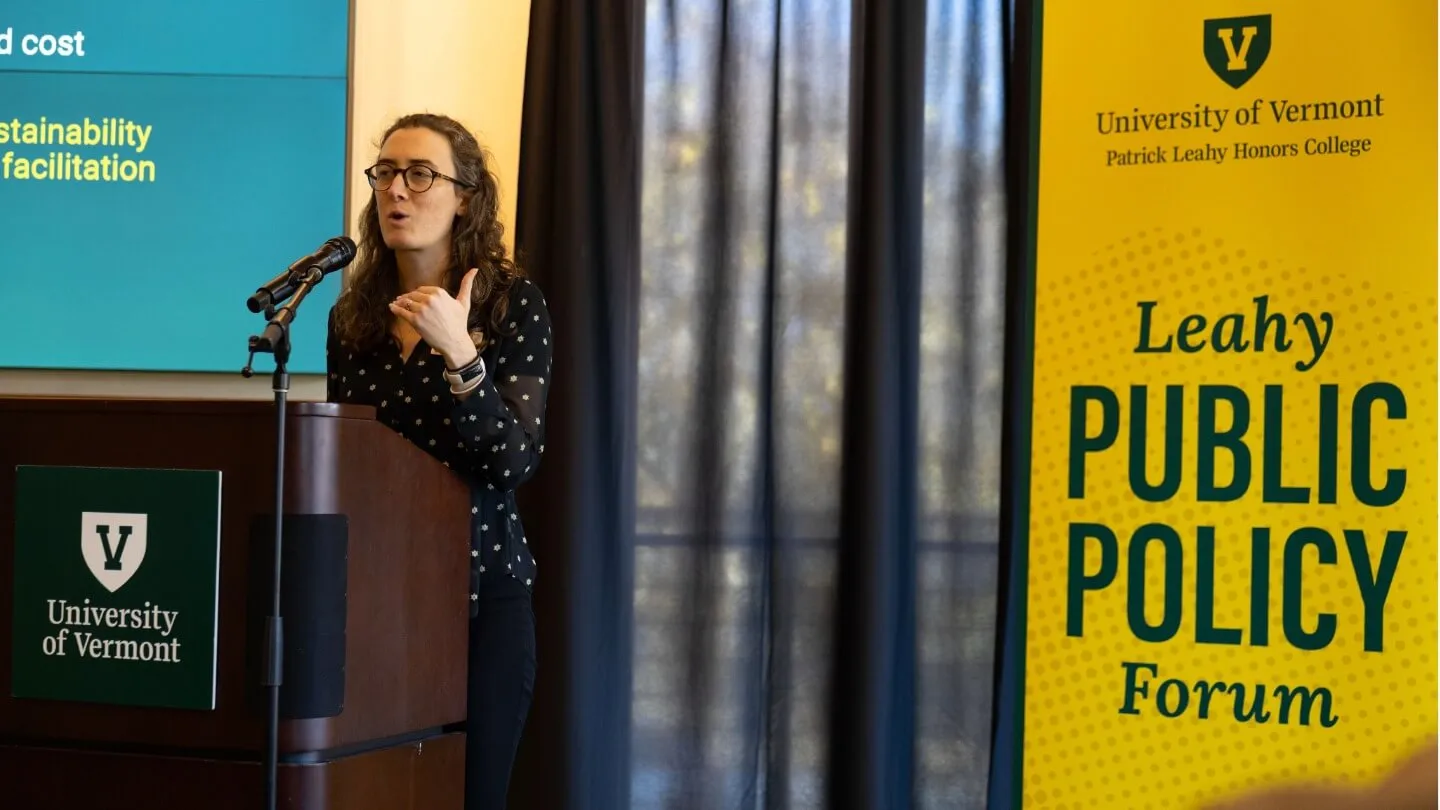
The Leahy Institute for Rural Partnerships hosted a midday session that brought together seven local researchers and entrepreneurs who are working to solve the climate crisis in Vermont. The Institute’s session was fast-paced and featured a quick talk from each speaker for no more than five minutes.
Developing the Next Generation of Solar Technology
A common theme between all seven speakers was their passion for the industry. Chad Miller, president and CTO of Verde Technologies said, “Something I love about working in solar [technology] is that I never have to justify why I’m doing it; everyone knows.”
Verde Technologies is developing next-generation solar panels from a material called perovskite. This material is lightweight, flexible, and very efficient at turning sunlight into electricity, said Miller. This technology is innovative because most homes in Vermont cannot deploy traditional solar panels due to their weight.
As a postdoctoral researcher at UVM in 2018, Verde’s origin story happened right here on campus. Miller worked with Randall Headrick, professor of physics in the College of Engineering and Mathematical Sciences (CEMS), who worked on thin film deposition methods as part of his research. The pair worked together to invent this lightweight, solar technology and to get Verde off the ground.
Integrating Students into Climate Work on Campus
UVM’s Office of Sustainability is working to solve climate challenges right here on campus and provide experiential learning opportunities all the while by “putting students right in the middle of the work,” said Director Caylin McCamp.
In 2023, McCamp’s office developed a comprehensive sustainability plan that included a goal of increasing pollinator gardens across the university’s campus. Following this plan, UVM grounds crew were left with many questions about how they should define a pollinator planting and how many plantings are enough to make up a pollinator garden.
The office brought a UVM student, Erin Camire, into the mix to answer these questions. Camire worked with professors in the Department of Agriculture, Landscape, and Environment to develop a research-backed definition of the term pollinator planting. Once the baseline definition was established, they developed a list of standard pollinator plants that should be used when grounds staff complete landscaping projects.
Camire’s project also included assessing and tagging all trees across campus. Because of this work, grounds staff can access critical information such as each tree’s health status and species type. This mapping is vital to UVM staff working on landscaping as they track the life cycle of plants on campus.
Camire’s work to assess and track university pollinator plantings will have ripple effects for years to come, said McCamp.
Quick Talks on Climate Efforts
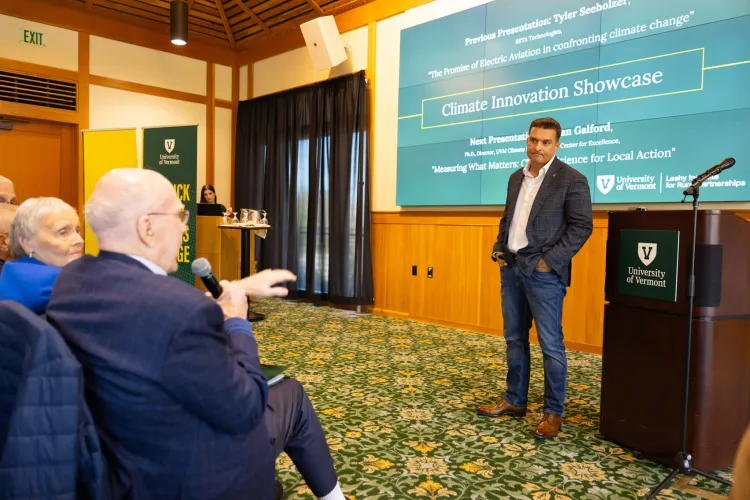
Thursday’s event filled UVM’s Silver Pavilion with many passionate thinkers. Amritanshu Pandey, assistant professor of electrical and biomedical engineering, discussed his work to develop algorithms that ensure safe agentic-AI use. Joshua Beneš, associate director of UVM’s Water Resources Institute, told audience members about the Vermont Mesonet, a weather monitoring tool that provides data around high-impact weather events.
Eric Roy, director of UVM’s Casella Center on the Circular Economy and Sustainability, discussed the climate benefits that coincide with food waste recycling. Tyler Seeholzer, training developer for BETA Technologies, discussed the benefits of electric aviation in confronting climate change. Director of UVM’s Climate Measurement Center for Excellence Gillian Galford shared her office’s work to assess Vermont’s climate and “make climate science usable, not just useful.”
Though their work spans different fields, from aviation to artificial intelligence, the speakers shared a common goal: integrate healthy climate practices into everyday life to watch as positive change compounds over time.