UVM students are big on changemaking. From local community service efforts to state-wide aid initiatives, it’s no wonder that, per the Princeton Review, the University of Vermont is ranked the top public institution for making an impact. Our students are involved in work related to sustainability research, medical advancements, and agricultural innovation. And now, they’re supporting research on the very policies that guide planning and decision making in Vermont.
Started in 2024 by members of Vermont’s Lawrence Debate Union, the Vermont Policy Institute (VPI), is a student-run, nonpartisan think-tank that provides policy research to organizations across Vermont.
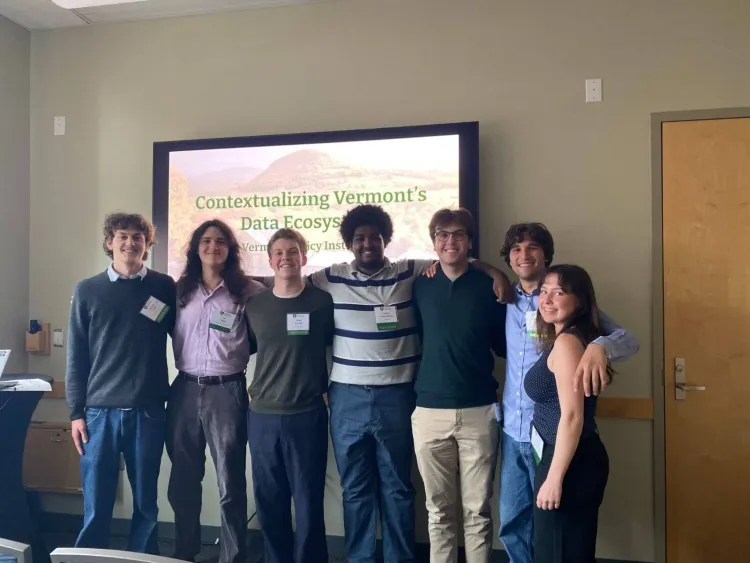
“I found myself wanting to branch out,” said Gavin Alberts, a third-year student studying Political Science and Economics, and a cofounder of VPI. “I began to look for places on campus to get involved in policy work, which led me to ask my friends if they’d be interested in starting a club. We wanted to do work that would bridge the gap between the university and the state to research problems that policymakers and the broader Vermont community face.”
The Vermont Policy Institute has already clocked multiple wins on behalf of Vermont. Last year, they established a recyclable container initiative across campus. The program, supported by the UVM Sustainable Campus Fund, created opportunities for more recycling containers on campus. Serena Buono, a senior studying Sustainability, Ecology, and Policy and another founding member, is excited about the way the initiative has grown, noting that, “We were able to get the funding and now have two interns running the recyclable program every week on campus.” This initiative has already diverted hundreds of pounds of waste from landfills, all through student-led policymaking.
The VPI has also made an important connection with another campus outreach organization. Both Buono and the Braden Lynn, a club cofounder and third-year Political Science and Philosophy double major, cite the Leahy Institute as an important campus partner.
“The Leahy Institute has been instrumental to VPI’s success. They have given us the projects that have engaged our members and given them the outlook for making an impact on the larger Vermont community.” — Braden Lynn, cofounder of the VPI
Last year, the Leahy Institute team connected VPI with the Windham Regional Commission, a regional planning commission located in southern Vermont, who were interested in conducting research on regional governance models that might alleviate some of Vermont’s capacity challenges. The VPI plugged in to the project to do preliminary research on one specific model: Council of Governments (COGs). Their research was then provided to the UVM’s Master of Public Administration (MPA) capstone course, where this preliminary work will be used to develop surveys and make recommendations to government.
The utility of COGs lies in the scale of collaboration - they can coordinate amongst smaller municipalities. Per VPI’s research, “COGs derive their capacity mainly from sustained, institutionalized modes of coordination such as elected governing boards, professional technical staff, and statutory mandates for funding or services (Wolf & Bryan 2009). These structural features would allow COGs to supersede the current capacity of Vermont’s RPCs, allowing them to administer services and fund projects at a greater scale. (Wolf & Bryan 2009; Feiock 2013)”
In only its third year, VPI is contributing to policy conversations at the state and local level; providing research capacity to students and leaders alike. That may be enough for many student organizations, but VPI’s ambitions do not end here. Braden Lynn sees the group’s future “as a leading organization for student participation at UVM and connecting students to the greater Vermont community. We seek to expand our workflow and professional connection to the Leahy Institute, along with developing closer connections in Montpelier.”
For more information on VPI’s work, visit their Instagram and LinkedIn.