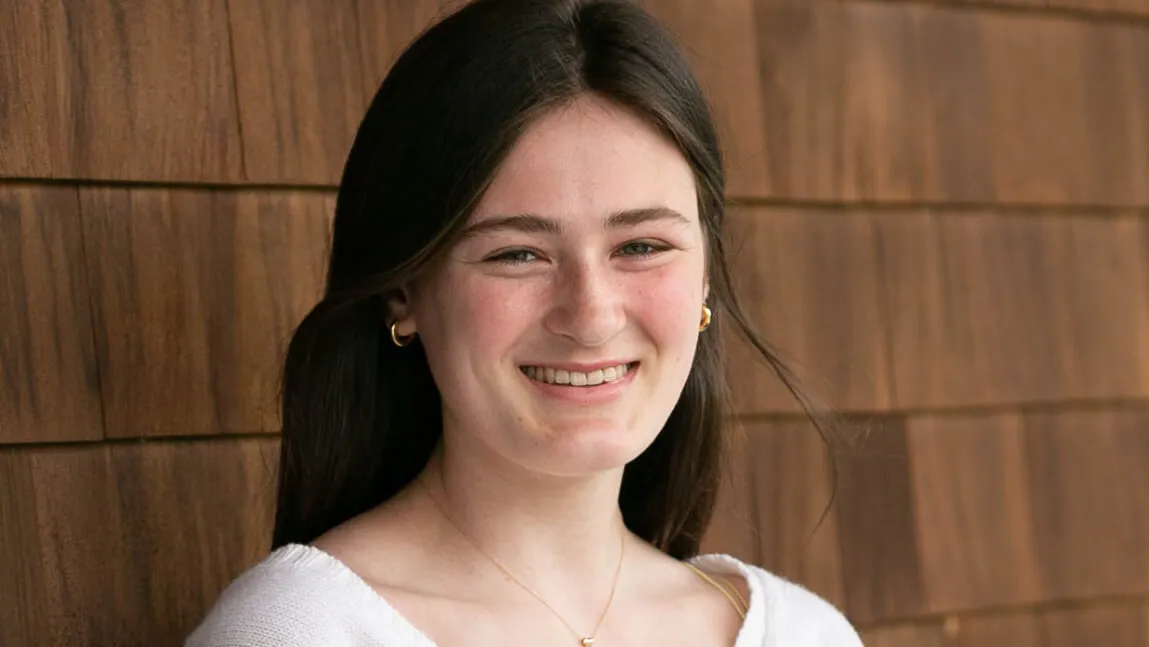
Hayden deCamp ’23 is an idea person. Perhaps more accurately, she’s an idea person with the creative courage to turn ideas into action.
A rising junior from Nyack, N.Y., deCamp is applying her creativity through Community-Centered Design, a new major at UVM that helps students learn how to practice community resilience and positive change. She recently completed a six-week project working with Community Development and Applied Economics Assistant Professor Steven Kostell, an artist and designer who explores traditional and experimental techniques in material production. His latest project seeks to turn hemp by-products into paper that could be used as a potential alternative to single-use plastic packaging.
“It’s meant to be packaging that is biodegradable, so any waste in the paper-making process can be reused as fertilizer,” deCamp explains. “It’s a completely regenerative process.”
deCamp spent the first six weeks of the summer helping Kostell and graduate student Ceres Rafiq make hemp paper with a bio-hydrophobic coating for use as watertight packaging for shipping food products. She’s also testing the paper as a potential material for an internship funded by UVM’s Office of Engagement.
In a separate project, deCamp is working with UVM lecturer Dave Hohenschau and fellow intern Madison Perry to design a mobile “pop-up park” that will be showing up in public spaces in communities around the state next year.
“The word ‘park’ is a little misleading because this is not about slides and swings—it’s more of a mobile interactive art installation that will encourage Vermonters to gather and share a common experience,” deCamp said.
The design parameters are challenging. The final product needs to fit into a five by eight-foot trailer that can be hauled by a pickup truck and delivered to clients interested in hosting the installation for a local event or “pop-up” attraction, from farmer’s markets to high school graduation parties.
The installations—deCamp is designing two different prototypes so clients have a choice on which setup they want to use—must be made of cheap and easy-to-obtain materials. The installations should be easy to set up and break down; deCamp envisions a kind of Ikea furniture assembly guide to give to clients.
It’s the kind of creative challenge she loves to grapple with.
“I’m envisioning something like a rainbow path lit by LED lights. Another idea is using corrugated plastic roofing standing upright, which can be back-lit to create interesting visual patterns.”
deCamp says she’s especially pumped that her two summer experiences provide her hands-on opportunities to work with people who bring different perspectives to the creative process.
“In CDAE (Community Development and Applied Design), you have classes with journalists, entrepreneurs, and community development students. In these jobs I’m working with scientists, economic planners, journalists, and other designers. I love the interdisciplinary aspect.”