The Challenge
Soil compaction is a concerning, though often invisible effect of climate change. Soil compaction is common on farms, especially in cool, humid regions like Vermont. Timeliness of field operations and grazing is critical in these areas, and fields are often entered before soils are adequately dry. This causes compaction, which can persist for years, and which can decrease yield by up to 50%. Soil compaction also contributes to water quality degradation through decreased soil health and increased sediment and nutrient runoff. Compact soils contribute to increased runoff volumes which threaten flooding in downstream areas during extreme rain events.
Farmers have not been able to measure soil compaction to determine what practices or tools are effective.
The Proposed Solution
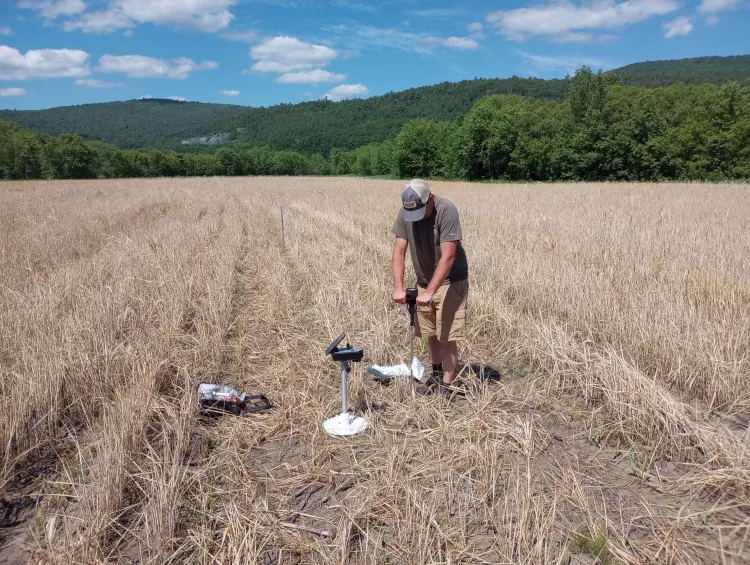
This project will evaluate two novel methods for measuring compaction, one that is currently being developed in the UVM Department of Electrical and Mechanical Engineering that utilizes Ground Penetrating Radar, and another approach that uses new gamma wave technology in a portable sensing system.
Research will occur on farms in the Connecticut River Watershed. In addition to fieldwork evaluating compaction measurement, the partners will also form a Soil Compaction Working Group with stakeholders and hold a compaction workshop, among other ways of disseminating findings and informing and supporting future research and outreach.
The Partnership
Faculty and staff from UVM Extension and the College of Engineering and Mathematical Sciences (CEMS) are partnering with the Connecticut River Watershed Farmers’ Alliance (CRWFA) to address soil health and compaction in the relatively underserved farming communities of the Connecticut River Valley of Vermont.
These farms are meaningful contributors to the Vermont local food system yet have received less resources and attention in the past two decades due to concerns over water quality in the Lake Champlain basin.
Project Details
| Community Partner: | Connecticut River Watershed Farmers’ Alliance (CRWFA) |
| UVM Partner: | UVM Extension, College of Engineering & Mathematical Sciences (CEMS) |
| Amount: | $106,157 |
| Primary Region: | Statewide |
| Focus Areas: | Regenerative Agriculture, Resilient Energy Systems |