College of Engineering and Mathematical Sciences

Type of Degree

Undergraduate Certificate

School or College

College of Engineering and Mathematical Sciences

Area of Study

Science, technology, engineering and mathematics

Program Format

On-campus

Credit hours to graduate

A minimum of 15 credit hours

Autonomy and robotics are transformative technologies driving innovation across many industries, fostering economic growth and enhancing quality of life.

Program Information:

Program Overview

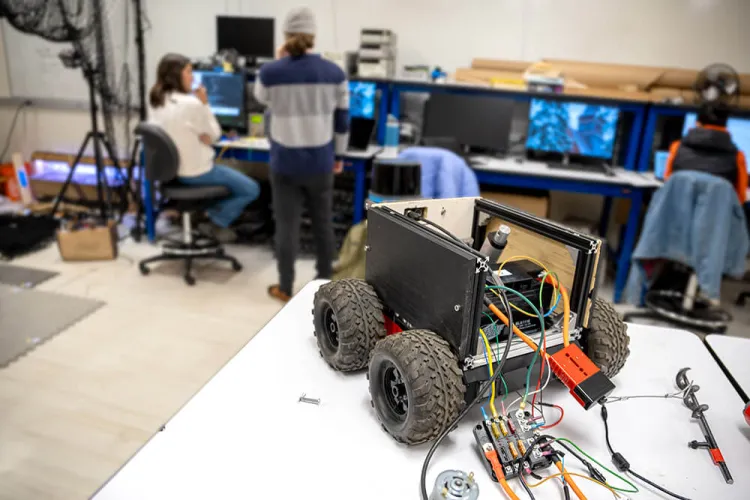
A wheeled robot sits in the foreground of an electrical engineering lab

The Undergraduate Certificate in Autonomy and Robotics (UCAR) provides you with a strong foundation in autonomous systems, robotics, and/or artificial intelligence. You will complement your coursework in these areas with experiential learning in our teaching labs. Completion of the program certifies to employers your readiness to begin your career in engineering positions focused on autonomous systems and robotics. 

Key technology sectors include manufacturing (e.g. enhanced production processes and improved precision), transportation (e.g. autonomous vehicles and enhanced traffic control), healthcare (e.g. robotic surgeries and patient care), agriculture (e.g. precision farming and agricultural robotics), defense (e.g. swarms and guidance systems), and energy (e.g. autonomous power systems). In this context, “autonomy” refers to the capability of an engineered system to operate autonomously. Achieving this involves algorithm and software design, which in turn involves concepts from signals and systems, control theory, and artificial intelligence. “Robotics” in this context refers to the design, construction, and operation of robots and machinery to perform tasks, and involves mechanical design, actuator/sensor design, mathematical modeling, and embedded programming.

Local companies with expanding needs in these areas include: Beta Technologies, GlobalFoundries, Green Mountain Power, Dynapower, Hazelett, Husky, and Rigorous Technology.
 

Curriculum

The Undergraduate Certificate in Autonomy and Robotics (UCAR) provides students with a strong foundation in autonomous systems, robotics, embedded systems programming, and artificial intelligence. Students will complete 2 required core courses, 6 credits of elective coursework, and 3 credits of experiential learning coursework as approved by the UCAR faculty coordinator. Completion of the program certifies to employers preparation for entry-level engineering positions in autonomous systems and robotics.

Core Requirements

Students complete 2 required core courses

Course Number

Title

Credits

EE 2845Digital Control w/Embedded Sys3-4
    or CMPE 3815Microcontroller Systems
EE 3515Control Systems4
    or ME 3320Control Systems
ME 2990Mechatronics4

Preapproved Electives

Choose 2 of the following (6 Credits)

Course Number

Title

Credits

EE 3530Digital Signal Processing3
EE 5540Real-Time Control Systems3
EE 5550Autonomy: Control & Planning3
EE 5560Autonomy: Robot Perception3
CS 3060Evolutionary Robotics3
CS 3540Machine Learning3
    or CS 5540Advanced Machine Learning
    or CMPE 5611Machine Learning for Engineers

Credit Bearing Experience

Choose 1 of the following (3 Credits) 1

Course Number

Title

Credits

EE 3991Internship3
    or ME 3991Internship
    or CS 3991Internship
EE 3995Undergraduate Research3
    or ME 2995Undergraduate Research
    or CS 3995Undergraduate Research
EE 4200Capstone Design II 23
    or ME 4020Capstone Design II
EE 2996College Honors3
    or ME 2996College Honors
    or CS 4996Undergraduate Honors Thesis

1 Topic must be relevant to the field of Autonomy and Robotics.

2 By petition only.


Admissions

Pre- or Co-Required Courses (NOT officially part of the certificate)

Discipline

Course Number (Current)

Title

Fundamental Math

Math 1234

Math 1248

Math 3201

Calculus 1

Calculus 2

Advanced Engineering math

Computer Programming

CS 1210

Computer Programming

Electrical Engineering

EE 2145 or 2175 or 2125 or equivalent

Electrical Engineering Concepts/Circuits

Participating faculty

Hamid Ossareh

Associate Professor, Department of Electrical and Biomedical Engineering

hossareh@uvm.edu

Luis Duffaut Espinosa

Assistant Professor, Department of Electrical and Biomedical Engineering

lduffaut@uvm.edu

Laura Treers

Assistant Professor, Department of Mechanical Engineering

laura.treers@uvm.edu

Jason Hibbeler

Senior Lecturer, Department of Computer Science Vice Chair

jason.hibbeler@uvm.edu

Outcomes

The learning objectives of the Undergraduate Certificate in Autonomy and Robotics (UCAR) are as follows:

  • Design and assemble circuits with sensors, actuators, and microcontrollers to build, program, and test autonomous systems, including robots.

  • Explain and classify robots and robotic systems.

  • Mathematically model, and design autonomy algorithms for, a wide range of practical systems including DC motors, smart grids, ground and aerial vehicles, and robot manipulators.

  • Use programming languages (e.g., Python, MATLAB) and simulation tools (e.g., ROS, Gazebo) to model, control, and simulate the behavior of autonomous systems.

  • Program microcontrollers to implement and deploy autonomy algorithms.

Completion of the UCAR program will equip students with the best practices and actionable knowledge and experience needed:

  • To make a powerful impact on their current or future employer's innovation, design, and automation efforts

  • To pursue graduate studies in the fields relevant to autonomy and robotics