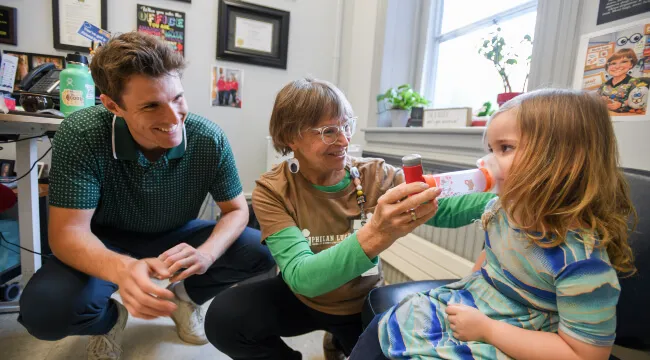
Asthma is the most common chronic disease in childhood and adolescence. It causes lung inflammation, mucous buildup, blocked airways, shortness of breath, chest pain, and difficulty sleeping. The American Lung Association estimates that almost half of school-age children in the U.S. miss one or more days of school because of asthma symptoms. In Vermont, nearly 10 percent of people under age 18 have asthma, and more than half of them have severe symptoms—multiple emergency room visits and significant fatigue from disrupted sleep—making learning and school activities difficult.
Asthma is controllable with inhaled corticosteroids, but there’s a catch: The medication must be used daily, sometimes two or three times per day, and managing that schedule can be difficult. Administering the medication also requires a specific technique to hold the inhaler properly, which can be tricky for young children and their parents.
Dr. Teach assembled a team to employ an untapped resource: school nurses.
“Mom and Dad may be working, dealing with several children, and struggling to get out the door in the morning. They may have long commutes to jobs and school. And if their child isn’t sleeping well, parents aren’t sleeping well, so they are all tired,” says Stephen Teach, M.D., M.P.H., professor of emergency medicine and pediatrics and a pediatric emergency medicine physician at the University of Vermont Medical Center. Not taking asthma medication consistently can lead to uncontrolled symptoms and a higher risk of severe attacks.
To address the issue, Dr. Teach has assembled a team to employ what he calls “an untapped resource: school nurses.” With support from UVM’s Leahy Institute for Rural Partnerships, Teach is piloting a new asthma treatment protocol that empowers nurses in 10 Vermont schools to provide daily medications to students with persistent asthma to improve health outcomes, boost attendance, and develop a scalable model for rural pediatric care.
The regimen, called School Based Asthma Therapy (SBAT), significantly reduced the impact of persistent asthma in young children in U.S. cities, including Washington, D.C., where Teach previously launched a similar program with great success. “It’s been documented that this improves health and education outcomes. Kids cough less, sleep better, and are better prepared to succeed in school,” Teach says. Parents or caregivers will continue giving the children their medication on weekends and school breaks, but even if they miss some doses, Teach says, “We know the children will have improved outcomes because they are getting their medication during the school day.”
Medical student Jack Dolak ’28 and doctor of nursing practice student Mallory Staskus ’28 are assisting the project by talking with school nurses, teachers, administrators, and primary care providers in the children’s towns. Before launching SBAT in schools, Dolak and Staskus conducted interviews to identify hurdles and paths for school-based asthma therapy. With Teach, they have created partnerships necessary to support protocol changes.
“School nurses agree this is a good idea, and a way for them to connect with students’ families and providers,” says Dolak. “The primary care doctors who prescribe the medications know the children will get it. The children’s families, teachers, and administrators are happy that the kids will be in school and not get sick.”
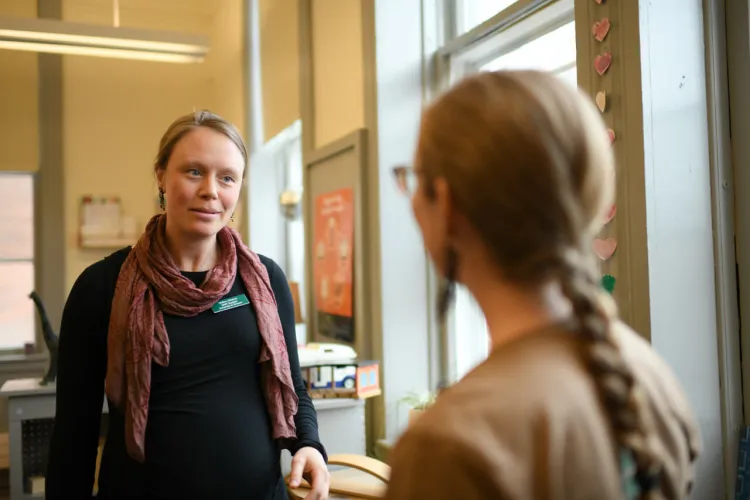
For Sophia Hall, D.N.P., M.Ed., RN, a nurse at Brookside Primary School in Waterbury, the benefits are clear. “We know students are getting their medication consistently, which they need to control their asthma. Exacerbations of asthma can happen for various reasons. For kids who don’t get their medication regularly it’s worse, because there’s no baseline,” Hall says. Relationshipbuilding is also extremely valuable. “Students who come in regularly for their medication get to know us and trust us, so if there is an emergency, they won’t be afraid to come in for a rescue inhaler.”
Dolak and Staskus help with troubleshooting as problems arise. They may reach out to a child’s pediatrician for an asthma care action plan, arrange for a pharmacy to deliver medication to the school, and help create plans for administering medications when a nurse is unavailable. “In some towns, the school nurse is in a different building each day. Making sure other staff have access to the medication is important,” says Staskus.
As the project progresses this spring and next fall, the team will document changes in absenteeism, health and education outcomes, and increases of feasibility and acceptability. Once under way, the regimen will sustain itself, Teach says. “The infrastructure exists— school nurses, teachers, physicians, insurance companies. We just need to get people working together in this innovative way, and it will sustain itself.”