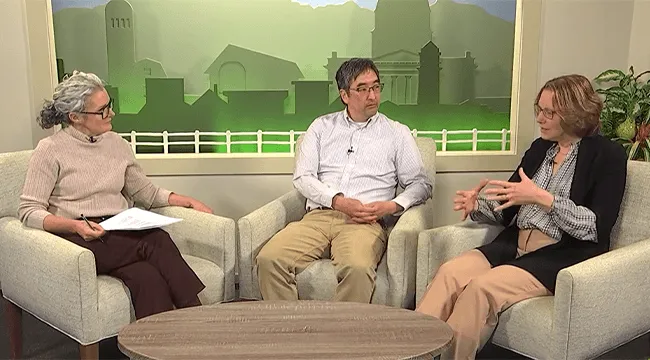
A recent episode of UVM’s Across the Fence program featured Larner College of Medicine infectious disease experts Benjamin Lee, M.D., and Beth Kirkpatrick, M.D., speaking with program host Amy Finley to clarify fact vs. fiction and provide expert guidance on how vaccines protect us and our families. This Q&A is an edited excerpt from that episode, which aired on March 2, 2026. To watch this interview in its entirety, visit Across the Fence.
Dr. Lee, an associate professor of pediatrics at the UVM Larner College of Medicine, is a pediatric infectious disease physician at Golisano Children’s Hospital at UVM Health. Dr. Kirkpatrick is a professor of microbiology and molecular genetics at Larner and a researcher with the UVM Vaccine Testing Center, which she founded in 2001. She also leads the National Institutes of Health–funded Translational Global Infectious Diseases Research Center at UVM.
“In the 20th century, vaccines were thought to be the most important public health advance—and that’s still true. Vaccines in general are a fantastic and impactful way to keep individuals and populations healthy, and the evidence has not changed.” — Beth Kirkpatrick, M.D.
Have the facts about vaccines changed?
BK: No. The scientific evidence supporting vaccines has not changed. Vaccines remain one of the most important public health advances, protecting both individuals and communities from serious disease.
Are Vaccines Safe?
BL: Yes. We can definitively say that vaccines are safe and have been extensively tested before being made available for public use.

The Centers for Disease Control and Prevention recently narrowed the childhood vaccination schedule, reducing the number of the universally recommended vaccines from 17 to 11. The six primary shots affected are those for hepatitis A, hepatitis B, rotavirus, COVID-19, influenza, and meningococcal disease. Some reports also include RSV. What health implications does this have?
BL: These are diseases that public health experts have agreed every child should be protected against through vaccination. Now, some are suggesting those vaccines may not be as essential. Even if this doesn’t immediately change access to the vaccines, it introduces uncertainty and confusion about their safety and importance. If fewer people choose to vaccinate, we could see these diseases return and start circulating again, as we have seen with measles. As fewer and fewer people get vaccinated, the number of cases of vaccine-preventable illnesses will continue to rise.
Now that some vaccines are no longer recommended, is it up to parents to decide?
BL: Yes, that’s the implication. On the surface, it might sound reasonable to frame vaccination as an individual choice. However, this shift creates confusion and uncertainty, and casts doubt on the safety and importance of vaccines more broadly. That’s incredibly unfair to parents and families looking for clear, evidence-based guidance—and unfortunately, that clarity is no longer coming from the federal government.
What has been the response from pediatricians to these changes?
BL: Broadly speaking, there has been no change among the medical community, including here in Vermont. Pediatricians, family physicians, and other medical professionals remain united in our conviction that FDA-approved vaccines are safe and effective, and we continue to follow the previously recommended vaccine schedule. The American Academy of Pediatrics has issued its own guidance reaffirming that schedule, and that is what families should rely on moving forward.
Is Vermont doing anything differently?
BL: On March 24, 2026, Vermont Governor Phil Scott signed H.545 (Act 76), a key bill allowing state health officials to set independent vaccine recommendations for the state of Vermont. It empowers the Health Commissioner to establish immunization schedules for children/adults, enables vaccine purchases outside the CDC, and ensures insurance coverage for vaccines.
Should adults get vaccines? What are the benefits of continued vaccination in adulthood?
BK: For adults, the schedule is a bit different, as it includes a lot of “if-then” considerations because it must account for things like pregnancy, immune compromise, and multiple other underlying medical conditions.
“The benefit of continued vaccination in adults is ongoing protection, not just for the individual, but for the broader population as well, especially for those most vulnerable to severe disease.” — Beth Kirkpatrick, M.D.
There is a clear adult vaccination schedule that includes vaccines such as the annual influenza vaccine, COVID vaccines, the shingles (zoster) vaccine, and more recently, the RSV vaccine for older adults. There are also additional vaccines that may be recommended depending on age, health status, and risk factors.
The benefit of continued vaccination in adults is ongoing protection, not just for the individual, but for the broader population as well, especially for those most vulnerable to severe disease.
Do vaccines have other benefits?
BK: Vaccines may benefit overall health, not just by preventing a specific infection or making it less severe, but by reducing longer-term health risks as well. A good example is the shingles vaccine, which has now been demonstrated in multiple studies to be associated with a lower risk of dementia.
In the 20th century, vaccines were thought to be the most important public health advance—and that’s still true. Vaccines in general are a fantastic and impactful way to keep individuals and populations healthy, and the evidence has not changed.
“Pediatricians, family physicians, and other medical professionals remain united in our conviction that FDA-approved vaccines are safe and effective.” — Benjamin Lee, M.D.

Across the Fence is a daily 15-minute television program co-produced by UVM Extension and WCAX-TV informing viewers about activities being conducted by University of Vermont faculty, staff, and students that benefit viewers and their communities. The longest-running farm, home, and community television program in the country, Across the Fence airs weekdays at 12:15 p.m. on WCAX-TV Channel 3.
Watch Dr. Lee and Dr. Kirkpatrick on ‘Across the Fence’