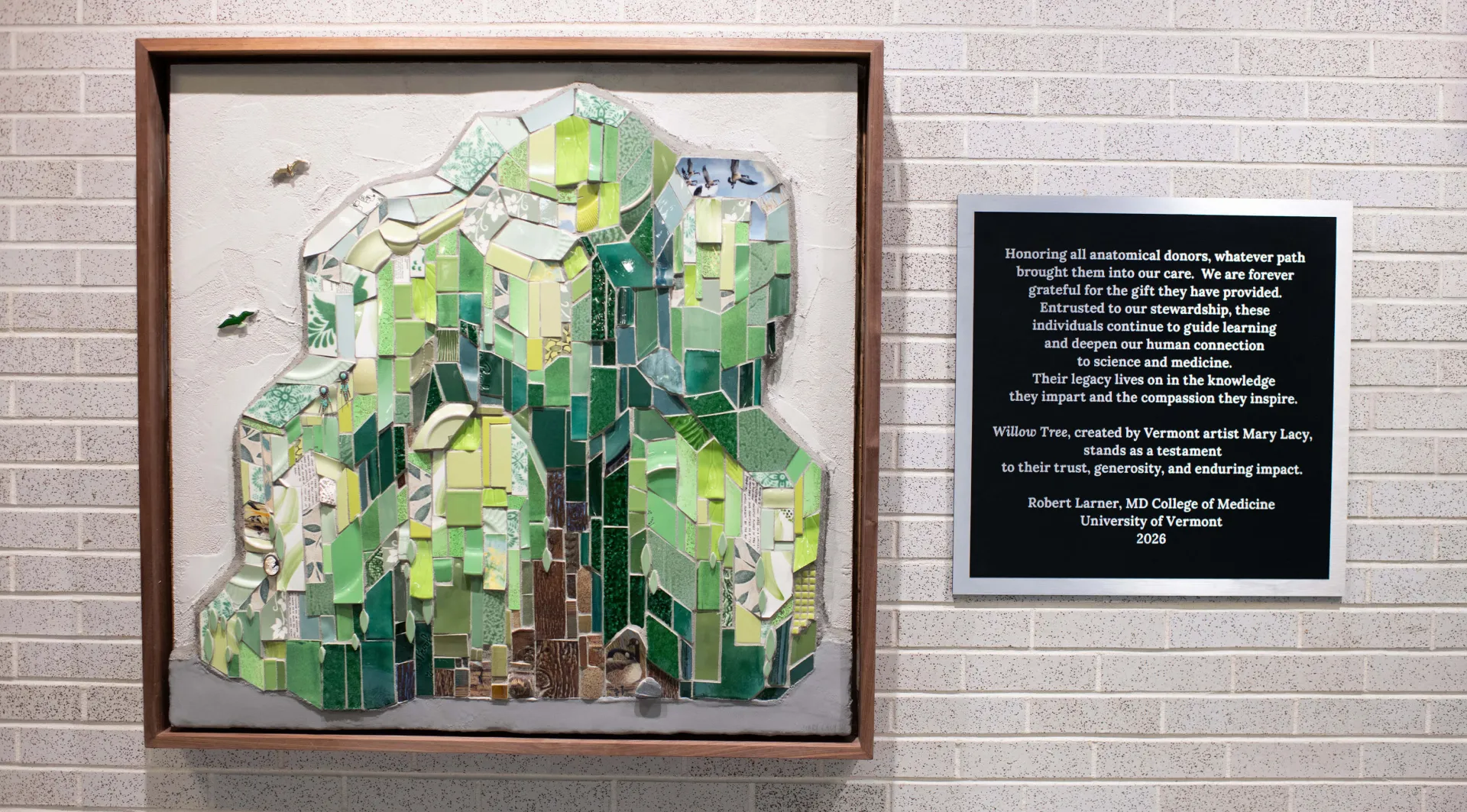
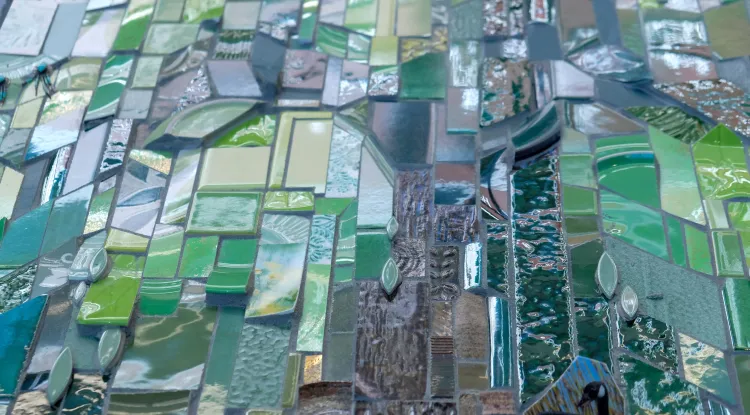
Created by Vermont-based mixed media artist and muralist Mary Lacy, Willow Tree is a large mosaic composed of collected ceramics, mortar, and cement along with found objects and small items with deep personal significance provided by donors’ families, such as earrings, a rock from Shelburne Farms, and a shell from a family trip. The work places humanity, reflection, and gratitude at the center of the college’s Anatomical Gift Program. First unveiled at Larner’s Convocation of Thanks this past spring, Willow Tree now has a permanent home in the Given Medical Building Courtyard alongside a commemorative plaque.
The Anatomical Gift Program has provided generations of Larner medical students with an unparalleled opportunity to learn anatomy while developing a deep appreciation for the individuals whose final gift makes that education possible. The newly installed artwork and commemorative plaque ensure that donors’ contributions remain visible and honored within the college community.
Lacy, known nationally for her large-scale public murals across 15 states, has in recent years shifted her focus from outdoor works to more intimate explorations of the human body. Her artistic journey began after becoming a patient herself, a personal experience that transformed her approach to art and healing.
“That personal connection made her an ideal partner for a project rooted in medical education, empathy, and respect, where art serves as a bridge between science and humanity,” said Margaret A. Vizzard, M.D., vice chair of education and vice chair of basic, clinical, and translational research in the Department of Neurological Sciences at Larner. Dr. Vizzard has overseen the Anatomical Gift Program during her 13 years as vice chair of education.
Commissioned through the generosity of David Coleman, M.D., and his wife, Jill Lacy, M.D. (no relation to the artist), the project was developed through extensive conversations with faculty, staff, and students. Lacy also visited the anatomy laboratory to better understand the profound relationship between donors and learners.
The resulting artwork stands as a tribute to lives lived and lessons learned. Its shifting forms evoke memory, loss, and renewal, symbolizing the profound impact donors have on medical education and the new beginnings that arise from such a deeply personal gift. Through this generosity, students gain knowledge, strengthen compassion, and develop a humanistic approach to medicine that endures throughout their careers.
“Art and the humanities provide perspectives on the world that underlie the compassion and insight necessary for clinical care and biomedical science.” — Richard L. Page, M.D.
Lacy’s large-scale mosaic invites viewers not only to pause and reflect, but also to physically engage with the work by placing their hands upon it as a gesture of connection. The piece honors both individuals who knowingly chose to donate their bodies to science and those whose remains entered medical study in earlier eras, before modern protections and consent processes were established.
For Larner leaders, the memorial represents not only gratitude for donors but also the broader role of the humanities in medicine.
“Art and the humanities provide perspectives on the world that underlie the compassion and insight necessary for clinical care and biomedical science. I hope generations to come will appreciate the beauty of this mosaic, while contemplating the gifts that enhance our students’ journeys,” said Richard L. Page, M.D., dean of the Larner College of Medicine and chief medical affairs officer at UVM.
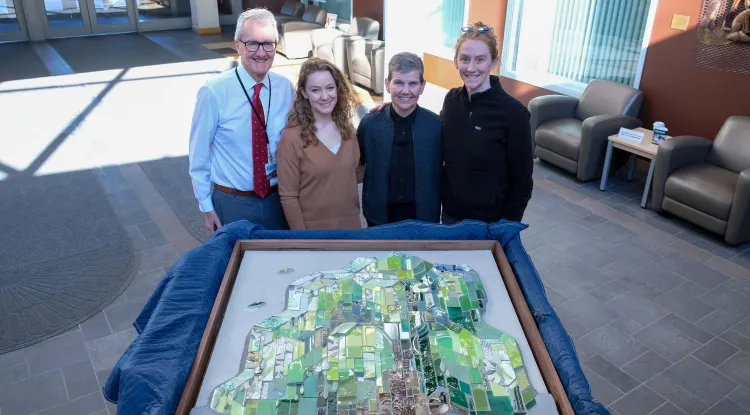
Lacy’s work embodies the mission of the newly formed Arts@Larner Committee while serving a deeper purpose as a lasting tribute to those who have advanced medical education through their final act of generosity. Together, the artwork and commemorative plaque stand as enduring reminders that anatomical gift donors continue to teach long after their lifetimes. Their legacy lives on in every student who learns from them and in every patient who ultimately benefits from that learning.
Together, the artwork and commemorative plaque stand as enduring reminders that anatomical gift donors continue to teach long after their lifetimes.
The memorial also reflects the vision of the Arts@Larner program, led by a committee of faculty, staff, and students dedicated to integrating arts and humanities more deeply into medical education. Through performances, storytelling events, screenings, exhibitions, and discussions, the committee seeks to foster reflection, resilience, empathy, and human connection among future physicians.
The Arts@Larner Committee’s next event, Women+ On The Edge Of Democracy, will take place on October 29 at 5:30 p.m. in the Hoehl Gallery. Presented in partnership with the Flynn theater and the Susan Smith Blackburn Prize, the event will feature live performances of four short plays selected from an anthology featuring 36 playwrights. Written specifically for this initiative, these thought-provoking 10-minute works invite reflection on democracy, civic life, and our shared future.
Learn more about UVM’s Anatomical Gift Program