Each year, celebrating National Rural Health Day raises awareness of the unique health challenges and strengths of our rural communities. While we often think first about rural health as a place, this year I was reminded of the tremendous power of civic engagement and social connections in determining our health.
In the week before the midterm elections, our Larner College of Medicine dean, Richard L. Page, M.D., sent a note to our Larner community inviting us to a short evening event at the medical school featuring live performances of four selected 10-minute plays from an anthology of 36 playwrights from “Women+ On the Edge of Democracy,” an initiative of Burlington’s Flynn Center for the Performing Arts. Sponsored by our Arts@Larner Committee and the American Medical Women’s Association Student Interest Group, these short performances—including one by a Larner student—were designed to “invite reflection on democracy, civic life, and our shared future.” The organizers passed out small pieces of paper and pens, asking us to write down our answer to the question “What does democracy mean to you?” and hand it in for our later conversation. As I sat in one of the rows of white folding chairs, listening to these short plays, I thought about our state and our health, and finally wrote down the words “Freedom,” “Unity,” and “Rabble-rousing” on my paper.
We all know too well the gaps in our rural health outcomes and the statistics. Rural residents in the U.S. die prematurely, experience more chronic diseases and deaths by suicide and substance use, and have trouble accessing health care, impacted by travel, physician shortages, and economic realities. But many experts agree on the importance and impact of community engagement in linking people to needed health services for chronic conditions, such as hypertension, in a way that respects unique community needs and leverages social and cultural strengths.
“Our health begins in our communities, with relationships, trust, and a shared commitment to one another.” — Jan K. Carney, M.D., M.P.H.
And disparities are only a part of the picture. Strengths in rural communities include social connections and networks, volunteerism, help from our neighbors, the beauty and quiet of our natural environment, innovation, and resilience. And while these may not be enough to offset all health-related challenges, these quiet, humble, and enduring relationships—and our ability to listen to them—may help us to build on the strengths of our rural neighbors and improve our collective health.
The World Health Organization defines health as “complete physical, mental, and social well-being,” calling social health “the missing pillar.” In 2022, the National Academy of Medicine included community engagement as the foundation for health equity in health systems. One RAND publication from 2019 wrote about how civic engagement is connected to physical and mental health, through voting, volunteering, or membership in organizations. Healthy People 2030 includes civic participation as a social determinant of health, and other authors note the importance of civic engagement in advancing U.S. health equity. The American Heart Association, in a 2023 Policy Statement on Civic Engagement and Population Health, reinforced the importance of political and nonpolitical strategies. And a provocative 2023 study charted the relationship between access to voting and health outcomes across the U.S., with voting access connected to better population health.
And despite health challenges, and the uniqueness of each rural community in Vermont, we know that we have trust in our research connections and in robust community-academic partnerships that reinforce the power of enduring relationships and community benefits. How we integrate our academic expertise with our deeply held belief that our community partners are experts who shape and inform our work, and especially our successes, resonates with our land-grant mission, brings great rewards, and reinforces our collective commitment to health.
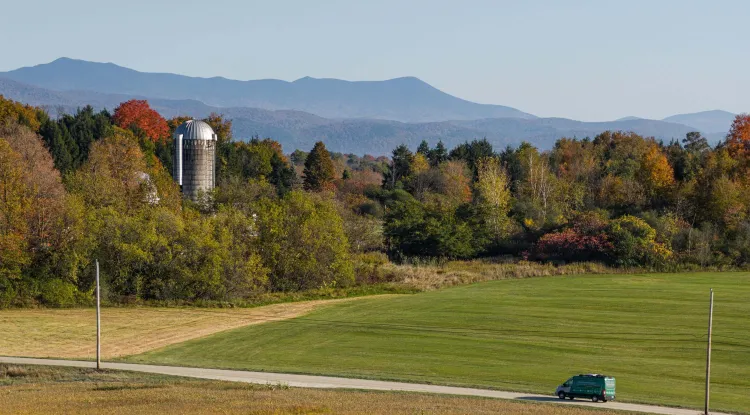
Our health begins in our communities, with relationships, trust, and a shared commitment to one another. Our trusted neighbor might be our child’s teacher, our pharmacist, our physician, or our local public health nurse. And despite intense health challenges, it is not surprising that Vermont, New Hampshire, and Maine fare better than our rural peers. Our rural strengths, if we pay attention to them, can guide us in meeting our health and social needs as well as our societal challenges.
“Our rural strengths, if we pay attention to them, can guide us in meeting our health and social needs as well as our societal challenges.” — Jan K. Carney, M.D., M.P.H.
Civic engagement, social connections, and health are inseparable, and I was glad that our dean brought this event about democracy to our Larner community, to further strengthen our culture and to ensure that future generations of our physicians and health professionals are connected to the values and strengths of our rural state and to our health.
On this National Rural Health Day, I am optimistic. I am grateful for the people, communities, and health professionals who embody these values every day, week, month, and year. In Vermont, we have incredible assets, from our social capital, generations of families, and robust non-profit organizations, to our caring and capable health care professionals and health care organizations—and a public health system that connects us. And in Vermont, it is indeed about the people.