
A pivotal step on the journey from medical student to practicing physician is residency; a rigorous, hands-on training period that begins immediately after medical school. Lasting several years, residency is where newly graduated doctors transform their knowledge into real-world expertise.
During residency, physicians-in-training, known as residents, immerse themselves in their chosen specialties, such as pediatrics, emergency medicine, or obstetrics and gynecology. Working in hospitals and health care settings, they care for patients while being mentored by experienced physicians who help shape their clinical skills and decision-making.
While some students enter medical school with a clear vision of the specialty they want to pursue, many discover that choosing a path is a journey in itself. Exploring different fields, balancing interests, and finding the right fit can be both exciting and challenging, making residency not a requirement, but a defining chapter in a doctor’s career.
At the Larner College of Medicine, Katie Dolbec, M.D., FACEP, CAQSM, an associate professor in the Department of Emergency Medicine and assistant dean for students in the Office of Medical Education, helps advise medical students about what specialty to pursue.
“Students weigh a lot of factors when deciding on a specialty: personal values, the type of people who are in that field (‘Are they my people?’), the nature of the work—microscopes vs. talking with people vs. procedural vs. surgical; the lifestyle, location; the potential for continuity of care; the types of patients you encounter; among others. Sometimes it just ‘feels right.’ Sometimes students need to weigh all the pros and cons,” she says.
“At the end of the day, it’s a very personal decision.” — Katie Dolbec, M.D.
“There are lots of tools available to students in the career exploration process. The physicians they encounter in the pre-clinical years in programs like Doctoring in Vermont, Professionalism, Communication, and Reflection, and other courses are important. Clerkship, where students rotate through various medical specialties, is pivotal. In the final year of their medical education, Advanced Integration also allows for some final career decision-making before applying for a specific residency.”
Dolbec noted, “There are other tools and resources available to students in the career exploration process once they decide on a specialty. These include specialty advisors, road maps, and other specialty-specific materials, professional society resources, and more. Yet at the end of the day, it’s a very personal decision.”
We asked three members of the Larner College of Medicine Class of 2026 who are beginning residency this summer to reflect on their roads to residency.
Aina Rattu matched into Family Medicine at UVM Health–Champlain Valley Physicians Hospital
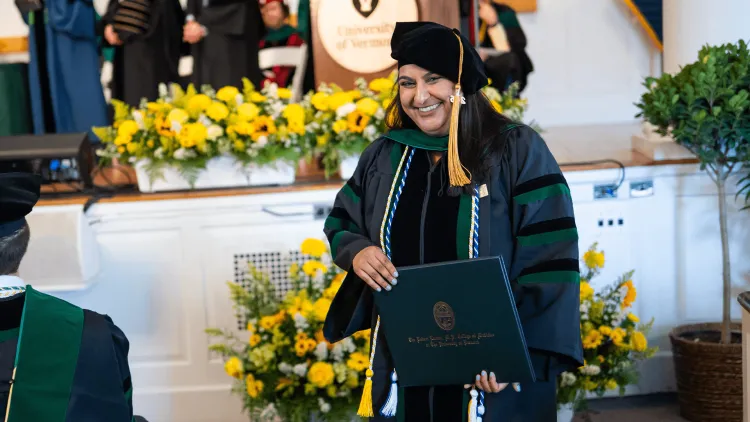
“What happens after they’re discharged? What’s their next step?”
During my third-year clerkships, I kept asking these questions. Often, I was met with the same response: “They’ll follow up with their PCP.” But that answer didn’t placate me. I wanted to know—Would the patient get better after their hospitalization? How would the new parents I met in Labor and Delivery adjust once they brought their newborn home? Would that patient newly diagnosed with heart failure have the support they needed to manage their condition?
In each case, I found myself wondering what would happen next.
After graduating as an undergraduate from college, I didn’t know what I wanted to pursue, but after helping my parents navigate their own health struggles, I knew it would be something in medicine.
To gain more exposure, I began working as a phlebotomist, and shortly after, transitioned into a medical assistant role at a small family clinic in Winooski, Vermont. There, I worked alongside physicians who truly knew their patients. One of them was Dr. Ann Goering, my family’s physician, my mother’s confidante, and the doctor who delivered my younger siblings.
In that clinic, I witnessed the humanity of medicine. Visits began with, “How did your daughter’s tennis match go?” or “It’s been a while, how have you been?” These weren’t just greetings; they reflected relationships built over time. Each appointment felt like a continuation of an ongoing conversation, where medical care played a role in a patient’s life.
“What happens after they’re discharged? What’s their next step?” — Aina Rattu, M.D.’26
Returning to my third year in medical school, I appreciated every rotation for what it offered—acute care management, procedural skills, and diagnostic interventions—but I continued to feel a pull toward a specialty more longitudinal. Meaning I didn’t just want to stabilize patients in their moments of need; I wanted to follow them before and after those moments. I want to be a part of the “what happens next.”
Family medicine offers me this continuity. It allows me to care for patients across all walks of life through a wide range of health care needs. It gives me the opportunity to build trust, to understand the context behind a patient’s health, and to advocate for them beyond a single encounter. I want to be a constant in my patients’ lives—in their moments of uncertainty, recovery, and growth. I want to be there not just for their immediate care, but for what follows.
Lauren Tien matched into General Surgery at Brown University Health–Rhode Island Hospital

When I tell people I am pursuing general surgery, the first question I get is, “Is it anything like Grey’s Anatomy?” And aside from the patients with active bombs in their abdomens, plane / train / ferry crashes, almost killing the patient you fell in love with to manipulate transplant lists, and completely inappropriate workplace relationships—yeah, it’s a lot like Grey’s Anatomy!
My decision toward choosing a specialty was rooted in deciding what kind of doctor I wanted to be. The people and leaders I admire, both in and out of medicine, are confident in what they know and don’t know. They keep cool under pressure and bring a sense of security to the people around them. I knew I wanted to be a doctor who exhibited these qualities, but a few things made surgery specifically stand out.
A characteristic I admired in surgery was the possession of hard skills. In previous non-medical jobs, I felt like a link in the chain that would eventually lead to someone who could find the solution. Everyone in corporate America talks about being a “cog in a machine”—no one talks about being unnecessarily cc’d and unnecessarily cc’ing in mile-long email chains. I felt less like a cog and more like a player in a game of hot potato with a problem no one could solve. I entered medical school wanting to be the person with the solution, the end of the email chain, the holder of the potato.
“The doctor I wanted to be, with the skills I wanted to have, coincided with general surgery.” — Lauren Tien, M.D.’26
Another characteristic I sought was the ability to be a generalist. In a field that is evolving into further hyper-specialization, I feel very strongly that possessing a broad knowledge base makes me more adaptable to a world that will never be predictable. I want to be a doctor who can function in different environments and patient populations, with comprehensive training in both managing the medicine and performing the operation.
Yes, general surgery residency is notoriously difficult. The hours are long, and the stakes of physically operating on someone are high. I found positive aspects in all my other clinical rotations, but nothing could persuade me away from being brutally interrogated about gallbladder anatomy under hot overhead lights. I wanted so deeply to hate my surgery rotation, but then I scrubbed in on a smelly ex-lap and had the time of my life. At a certain point, I had to accept that I knew exactly what I wanted.
The truth is that the characters in Grey’s Anatomy exhibit qualities that I admire. They are confident and resilient. Their work makes tangible impacts on their patients, and they take great pride in being excellent at that. Despite the show being sensationalized, I have witnessed these qualities in great surgeons I have worked with, who I can luckily now call my mentors. The doctor I wanted to be, with the skills I wanted to have, coincided with general surgery.
And to my friends in emergency medicine, I hope you look forward to being asked “Is it anything like The Pitt?”
Tucker Angier matched into Family Medicine at the UVM Medical Center
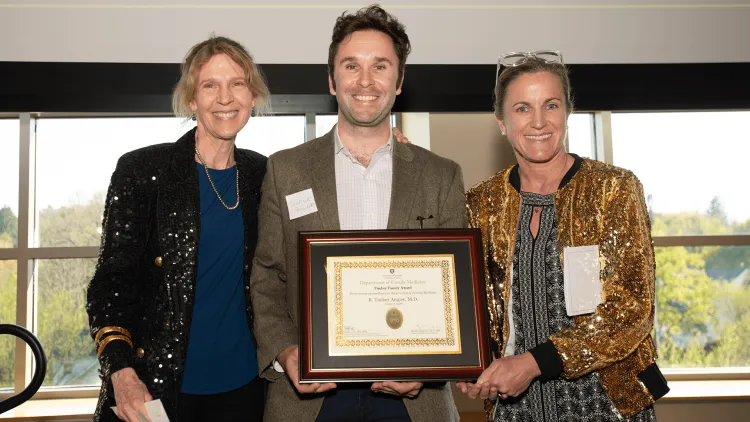
“What do you want to be when you grow up?”
Everyone has heard this question countless times throughout their lives, and for some, their career path could not be more obvious to them and to those around them. This was not me.
Prior to medical school, I worked as an outdoor educator, ski patroller, ski coach, dishwasher, bartender, server, retail manager, medical assistant, scribe, and even spent a few months trying to become a carpenter.
“What kind of doctor do you want to be?”
When I applied to medical school, I thought I wanted to be an emergency room physician. When I got into medical school, I thought I wanted to be a urologist. When I started my clerkships, I had no idea what I wanted to be. During my third year of medical school, I experienced every possible iteration of my medical career. I was Tucker the surgeon, Tucker the internist, Tucker the cardiologist, Tucker the obstetrician. There was not a single specialty that did not speak to me. I was a serial monogamist, with each specialty serving as my partner for six weeks.
“Family medicine, jack of all trades, master of none, often better than a master of one, sounded appealing to a man who wants to be a rural physician, serve as a one-stop shop, and be a Swiss Army knife for his patients.” — Tucker Angier, M.D.’26
My friends watched my frantic search for career clarity, encouraged my deep exploration, and rolled their eyes each time I changed my mind. Meanwhile, my wife, Hannah, a family medicine resident, calmly encouraged me to explore family medicine. Family medicine, jack of all trades, master of none, often better than a master of one, sounded appealing to a man who wants to be a rural physician, serve as a one-stop shop, and be a Swiss Army knife for his patients.
In our first week of medical school, we took an inventory test that was meant to identify which specialty best fit our interests. Mine was family medicine. I took the test again a few months later: family medicine again. I took the test a year later, and again it was family medicine. Was Hannah right?
Eventually, this conclusion hit home. During my outpatient medicine rotation, there was a woman looking to replace her IUD. Medicine does not do those; refer. In the emergency department, I found myself putting patients on my “interesting patient” list just to make sure they got the follow-up they needed.
“What residency are you going into?”
Family medicine.