A medical technology company co-founded by University of Vermont Larner College of Medicine Professor Peter Spector, M.D., recently closed its equity financing Series C funding round, raising a total of $58.1 million needed to bring the startup company’s product closer to the marketplace. The company, called CoreMap, develops advanced tools to enable patient-specific treatments for atrial fibrillation (AFib or AF).
AF is a relatively common and difficult to treat cardiac arrhythmia that increases patients’ risk of stroke and death. An arrhythmia occurs when the heart beats too slowly, too fast, or in an irregular way. The condition affects 52 million individuals globally and contributes to more than 200,000 deaths each year in the U.S., according to the Centers for Disease Control.
Ablating heart tissue with radiofrequency or pulsed field energy can improve health outcomes by destroying cells that drive the disease. However, the effectiveness of ablation depends on the physician’s ability to find and target the cardiac sites responsible for AF.
“AF remains one of the most significant unsolved challenges in electrophysiology, and physicians need better data to guide treatment decisions and improve patient outcomes.” — Peter Spector, M.D.
“AF remains one of the most significant unsolved challenges in electrophysiology, and physicians need better data to guide treatment decisions and improve patient outcomes,” said Dr. Spector, who is a professor of medicine and professor of biomedical engineering and director of cardiac electrophysiology at the University of Vermont Medical Center.
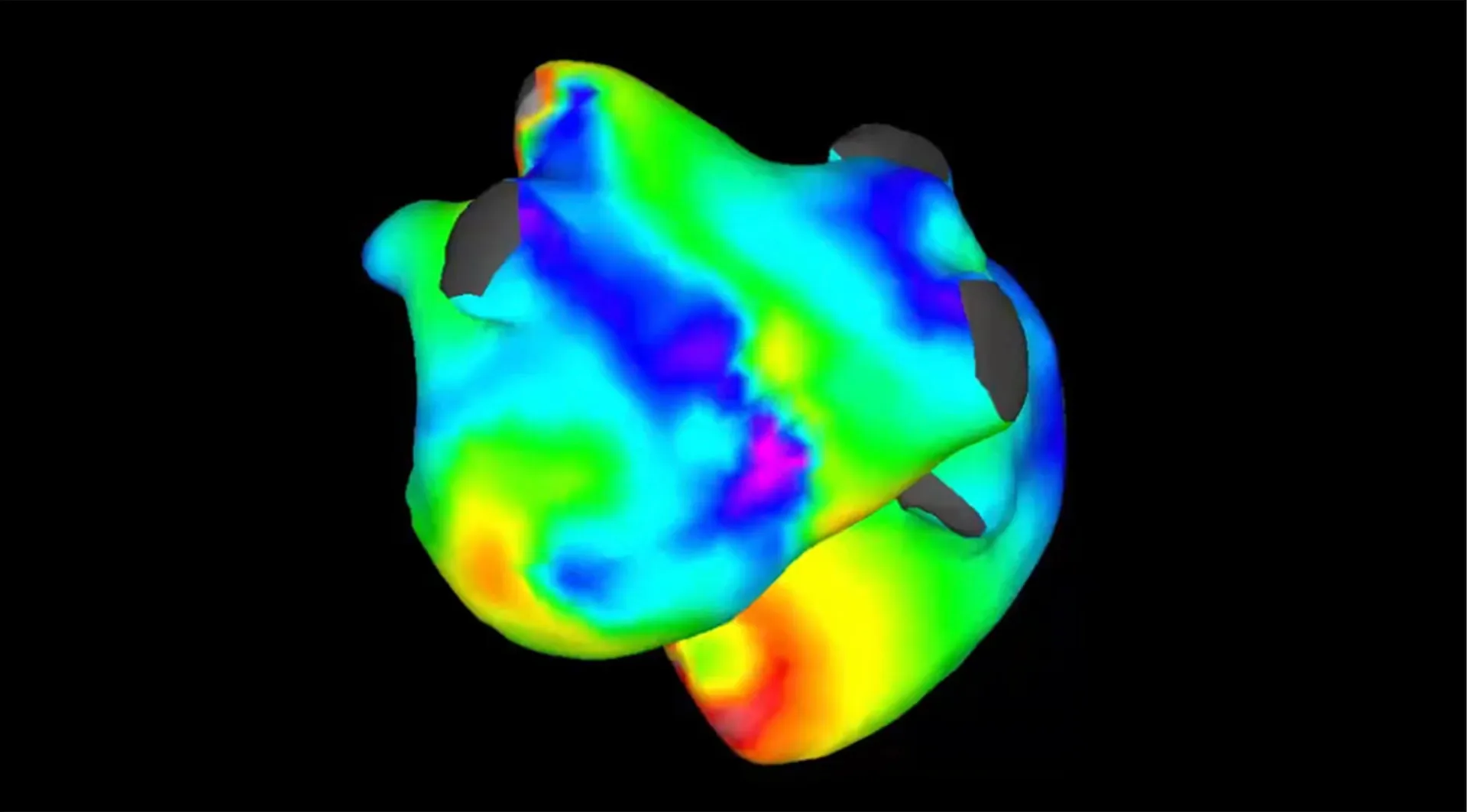
CoreMap uses an ultra-high-resolution electrode array and electrophysiology mapping system that enables physicians to see AF with greater clarity and reveal precisely where physicians should deliver ablation. The mapping system evolved out of research that Spector has done at the University of Vermont over the past 24 years.
“The state of the art for AF treatment currently involves blindly ablating specific anatomic regions of the atria in hopes that these are responsible for perpetuating AF. Unfortunately, these sites often are not the only ones involved and, as such, AF ablation is frequently unsuccessful for treatment of patients with advanced AF,” Spector says. Using CoreMap, he notes, “we find an average of 2.6 ‘drivers’ per patient, with 65 percent found in regions that are currently not ablated with the anatomic approach.”
The CoreMap team completed enrollment in a pilot randomized clinical trial, and interim analysis of the results are very encouraging, Spector says. CoreMap has mapped and ablated more than 125 patients so far. They will begin a larger confirmatory randomized study late this fall at five centers in the U.S. and Europe.
From the Lab to the Marketplace
Spector and medical technology executive Sarah Kalil created CoreMap in 2016 to develop the mapping platform, based on work Spector was doing at the Larner College of Medicine. He had created a system for mapping the electrical activity in the heart during AF, which allowed physicians to precisely identify the sites that perpetuate AF and thus target those sites for treatment. Spector received a SPARK grant from the University of Vermont in 2018 to help move the platform a step closer to the marketplace. CoreMap is now funded completely by private investors.
“Medtronic’s investment … allows us to pursue our vision with urgency and purpose.” — Peter Spector, M.D.
The Series C financing round, which is a late-stage financing step meant to fuel aggressive growth and provide investors with an opportunity to buy equity, raised $37 million from several investors, reflecting strong confidence in the company. Health technology innovator Medtronic, which sells cardiac mapping and ablation systems, contributed the largest investment, along with other institutions and individuals from the Vermont investment community.
“Medtronic’s investment provides the resources for us to rapidly scale CoreMap’s AF mapping platform’s time to market. It allows us to pursue our vision with urgency and purpose,” Spector said.
CoreMap maintains offices in Vermont and Massachusetts. Learn more about the company and its next-generation AF mapping platform on the CoreMap website.
Research like this has contributed to the University of Vermont’s designation by the Carnegie Classification of Institutions of Higher Education as an R1 institution, placing it in the top tier of research universities in the U.S.