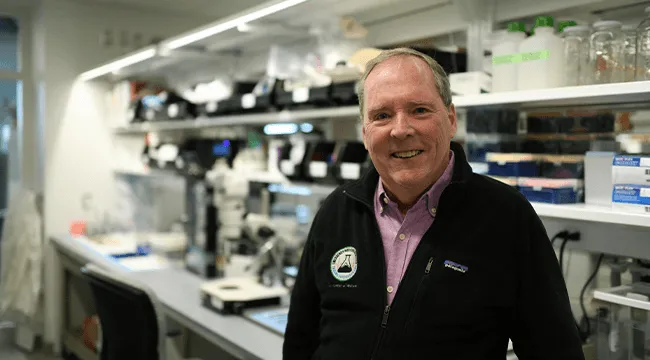
The induction of new fellows will be held on June 30 at the Academy of Medical Sciences and the Royal Society of Medicine in London, England.
Fellowship in the Academy of Medical Sciences, the United Kingdom’s equivalent to the National Academy of Medicine in the United States, celebrates biomedical and health scientists for their outstanding contributions to advancing medical science through discovery, research, translational work, and the application of scientific knowledge in ways that deliver tangible benefits for patients and the wider public. The 2026 cohort includes 60 scientists from 28 institutions. They join an esteemed fellowship of more than 1,500 researchers who are at the heart of the academy’s work to nurture scientific talent and shape research and health policy throughout the UK and worldwide.
“I am honored to be elected a Fellow of the Academy of Medical Sciences … I look forward to collaborating with this inspiring community of research leaders.” — Mark Nelson, Ph.D.
Dr. Nelson joined the UVM Department of Pharmacology in 1986 and was named department chair in 1996. He holds a secondary appointment as professor in the UVM Department of Molecular Physiology and Biophysics and a tertiary appointment as professor in the Department of Surgery.
He is the only 2026 Academy of Medical Sciences Fellow whose primary affiliation is not with a UK institution. According to the academy website, fellows “must have strong and enduring links with the UK medical science community, making a personal and ongoing contribution to contemporary British science.” Nelson holds a part-time professorship at the University of Manchester in England and has served as a visiting professor of pharmacology at the University of Oxford since 2012.
“I am honored to be elected a Fellow of the Academy of Medical Sciences,” Nelson said. “Throughout my career, I have had the opportunity to work with fantastic teams of scientists and clinicians on transformational approaches to health care. I look forward to collaborating with this inspiring community of research leaders.”
World’s Leading Small-Artery Physiologist
Nelson is an internationally renowned scientist studying the link between calcium signaling and vascular function in both health and disease, with particular emphasis on the control of blood supply to the brain. His research over three decades has clarified the mechanisms by which cerebral blood flow meets the diverse and ever-changing demands of active neurons and how these mechanisms are disrupted in small-vessel disease—a major cause of stroke, Alzheimer’s disease, and related dementias.
The Nelson Laboratory at the Larner College of Medicine discovered local calcium signals, or “sparks,” which counter-intuitively oppose vasoconstriction, and uncovered the precise biophysical mechanisms by which small-vessel disease of the brain develops. Nelson’s team has shown that brain capillaries act as a neural activity–sensing network by initiating and transmitting an electrical signal, mediated by potassium channel activation, that propagates through the interconnected cells comprising the capillaries that line all blood vessels. They have identified specific points where targeted medicines could work to slow cognitive decline.
“There can be little doubt that the members of the Academy of Medical Sciences will have intense interest in Mark’s groundbreaking work.” — David Eisner, D.Phil.
Nelson’s nominator described him as “the world’s leading small-artery physiologist.”
“There can be little doubt that the members of the Academy of Medical Sciences will have intense interest in Mark’s groundbreaking work. Indeed, were a member of the Academy to be responsible for the world’s first drug which slowed dementia by improving small artery function in the brain, this would bring wide reputational benefit,” wrote David Eisner, D.Phil., professor of cardiac physiology at the University of Manchester, in his nomination. Eisner is editor-in-chief of the Journal of General Physiology and a Fellow of both the Academy of Medical Sciences and the Royal College of Physicians.
Mentor and Connector
“As important as his own science is, equally noteworthy is the way that he trained so many young scientists and has always given generously of his time to help them,” Eisner said.
Nelson has mentored more than 60 postdoctoral fellows and research faculty and has served as a role model to many early-career investigators. He is a founder and co-director for the Vermont Center for Cardiovascular and Brain Health, which supports emerging investigators studying cardiovascular disease, stroke, and cognitive impairment.
Nelson’s work includes more than 600 research publications in peer-reviewed journals and more than 360 invited lectureships over the past 30 years. His research has been supported by continuous funding from the National Institutes of Health (approximately $65 million in NIH funds to date), the National Science Foundation, the American Heart Association, and philanthropic foundations. He is a Fellow of both the American Heart Association and the Biophysical Society, and a member of the Vermont Academy of Sciences & Engineering and the Vermont Academy of Arts & Sciences.
“Election to the UK Academy of Medical Sciences is an affirmation of the profound impact of Mark Nelson’s research,” said Richard L. Page, M.D., dean of the Larner College of Medicine and chief medical affairs officer at UVM. “As a University Distinguished Professor and member of the National Academy of Sciences, it is gratifying to see his work receive this international recognition.”
“Election to the UK Academy of Medical Sciences is an affirmation of the profound impact of Mark Nelson’s research.” — Richard L. Page, M.D.
Nelson has received numerous accolades and honors throughout his career. In 2019, he became the first faculty member from the University of Vermont to be elected as a member of the National Academy of Sciences, the body that publishes one of the world’s most prestigious peer-reviewed journals, Proceedings of the National Academy of Sciences of the United States of America. He serves on editorial boards for that journal and for Journal of General Physiology and as co-editor for the Annual Reviews of Physiology. He served on the Advisory Council to the National Institute of Diabetes and Digestive and Kidney Diseases from 2020 to 2024.
Nelson earned a B.A. in mathematics and biology at Tufts University and a Ph.D. in neural sciences at Washington University–St. Louis. He did postdoctoral work at the University of Maryland–Baltimore, and at Universität Konstanz, in Konstanz, Germany.
“It is a privilege to welcome this outstanding new cohort to the Fellowship of the Academy of Medical Sciences,” said Academy President Andrew Morris, professor of medicine and vice principal of data science at the University of Edinburgh. “Each of our new Fellows has been recognized by their peers for exceptional achievement for the influence their work has had in advancing medical science and improving health.”
Read the Academy of Medical Sciences’ announcement of the new Fellows for 2026
Learn more about the Nelson Laboratory.
Read Dr. Nelson’s Biosketch on the National Academy of Sciences website