Larner Community ‘Goes Red for Women’
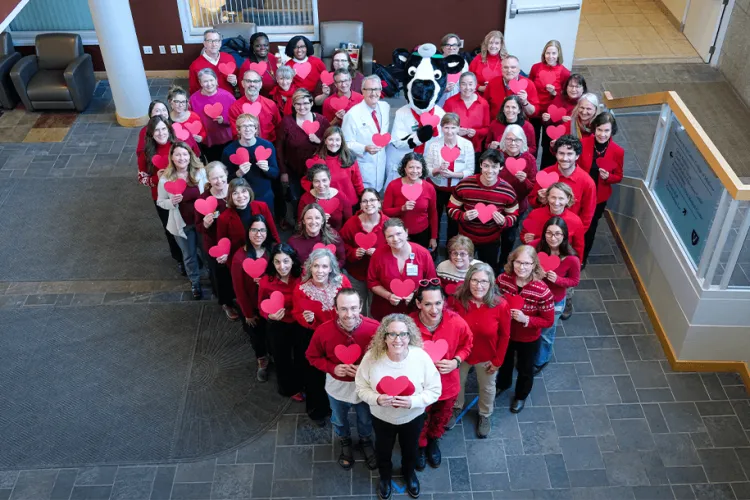
Every year on the first Friday in February, National Wear Red Day® during American Heart Month reminds us why our work matters, and the Larner College of Medicine proudly joins the call to raise awareness about heart disease.
Cardiovascular disease is the No. 1 killer of women—but together, we can change the future of women’s heart health. At Larner, we “Go Red for Women” by wearing red because every heart tells a story, and women at every age, stage, and season of life deserve to be celebrated and supported as we take on our greatest health threat.
But our commitment to heart health doesn’t start—or stop—on Go Red Day. Larner faculty, researchers, clinicians, and students are advancing cardiovascular health every day through:
- Innovative research that deepens our understanding of heart disease and drives new treatments;
- Cutting‑edge medical education that prepares future physicians to prevent, diagnose, and manage cardiac conditions with compassion and expertise;
- Collaborative clinical partnerships that bring evidence‑based heart care to our communities; and
- Public health initiatives that help Vermonters—and beyond—live healthier lives.
The Larner community gathered in the Hoehl Gallery for our annual Wear Red photo to support American Heart Month—because the path to cardiovascular health starts with awareness.
Cardiologist Prospero Gogo, M.D., Advocates at Vermont State House on ‘National Wear Red Day’
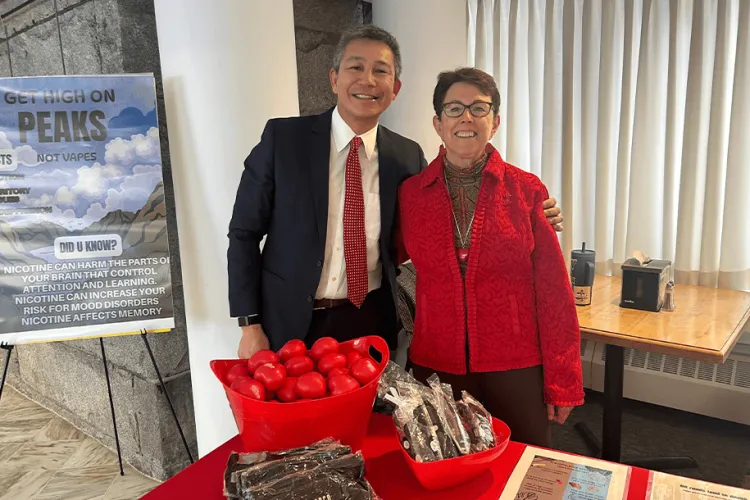
Advocates from across Vermont—including cardiologist Prospero Gogo, M.D., professor of medicine at the Larner College of Medicine, and Colchester resident Jennifer Nachbur, whose family has been impacted by heart disease—gathered at the State House in Montpelier on February 6 for a legislative breakfast to urge action to protect youth from tobacco and vaping products.
The breakfast, hosted by Coalition for a Tobacco Free Vermont, coincided with National Wear Red Day®, a nationwide effort to raise awareness about cardiovascular disease—the leading cause of death. Advocates wore red to symbolize the need to protect heart health across the lifespan, beginning with preventing youth nicotine addiction.
The advocates called on lawmakers to pass legislation that would strengthen Vermont’s tobacco retail licensure laws and help prevent the sale of addictive and harmful products to young people. Discussions highlighted how nicotine addiction often begins in adolescence, increases the risk of lifelong tobacco use, and contributes to serious long-term health consequences, including cardiovascular disease. Advocates emphasized that strengthening tobacco retail licensure laws is a key strategy to prevent illegal sales, limit youth access to nicotine products, and protect the health of Vermont’s young people.
16th Annual Neuroscience, Behavior, and Health Forum
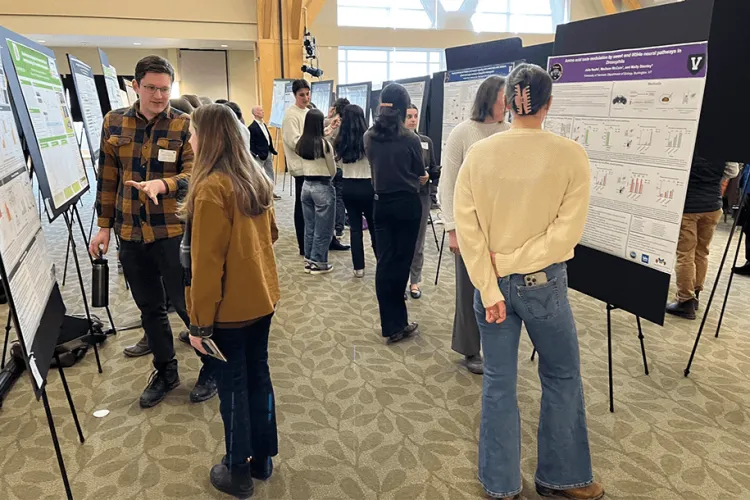
More than 200 scientists attended the 16th annual Neuroscience, Behavior, and Health (NBH) Forum January 30–31 at the University of Vermont’s Dudley H. Davis Center—making this year’s gathering the largest in the event’s history.
Hosted by the Vermont Chapter of the Society for Neuroscience with support from the Department of Neurological Sciences and Neurological Sciences Professor and Chair Peter Calabresi, M.D., the forum featured keynote speaker Francisco Quintana, Ph.D., of Harvard Medical School. Dr. Quintana presented his groundbreaking research on astrocyte regulation of the immune response and its potential implications for glioblastoma treatment.
The keynote of the NBH Forum is dedicated to the memory of Gary Mawe, Ph.D., a basic and translational scientist in the Department of Neurological Sciences at UVM, whose career was defined by collaboration and a contagious enthusiasm for science and for life.
Faculty, graduate and undergraduate students, residents, and research staff from numerous colleges and departments at UVM, including Larner and the College of Arts and Sciences, attended. The VA Hospital in White River Junction, Dartmouth College in New Hampshire, and McGill University in Montreal also took part in the event, sharing new data, emerging findings, and innovative ideas.
More than 70 abstracts were submitted by students and postdoctoral fellows, with an especially strong showing from undergraduate students. This year’s winners from UVM for best presentations included Harrison Morse, a pharmacology graduate student in the Lavoie Lab; Lindsey Earle, an undergraduate student studying neuroscience; Rain Younger, a neuroscience Ph.D. student in the Barry Lab; and Hadi Esfandi, Ph.D., a postdoctoral researcher in the Harraz Lab.
The forum was sponsored by pharmaceutical company UCB, Med Associates Inc., the UVM College of Arts and Sciences, and the UVM Office of the Vice President for Research.
Larner Community Engagement and Social Medicine Students Learn About Advocacy
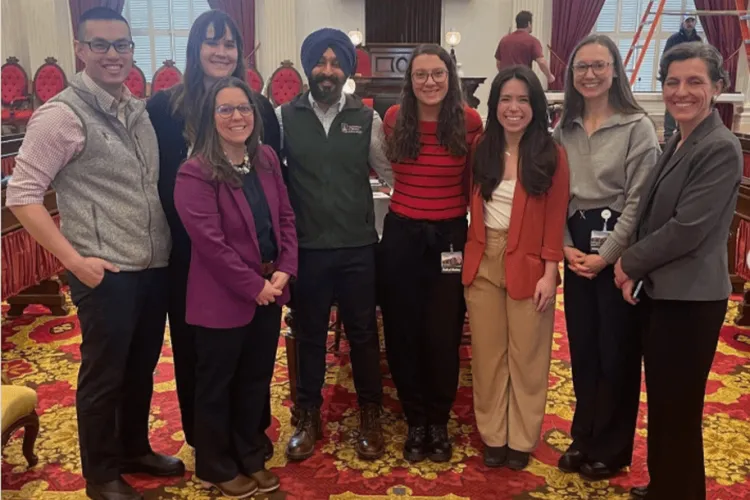
In February, as part of the two‑week Community Engagement and Social Medicine elective, Larner medical students visited the Vermont State House in Montpelier to learn about and participate in policy-related work. During their visit, they attended a presentation by the Vermont Medical Society, toured the State House, and observed active committee meetings.
The broad goal of this elective is to provide students with exposure to health care topics not deeply explored in the Larner College of Medicine curriculum. Course content and activities include exploration of Vermont systems and services related to promoting and maintaining health, particularly for rural, disadvantaged, or underserved populations. This course is held in person with sessions on campus and in various locations around the state over the two weeks.
The course was developed around the following excerpt from the American College of Physicians (ACP) Ethics Manual:
“Physicians should help the community and policymakers recognize and address the causes and social and environmental determinants of health, disease, and disability, including human rights concerns, discrimination, poverty, and violence. They should work toward ensuring access to health care for all persons; act to eliminate discrimination in health care; and help correct deficiencies in the availability, accessibility, and quality of health services, including mental health services, in the community”.
Course discussion centers on the unique role that physicians hold in health care systems, and how that role can be best used to advance effective partnerships and progress toward health equity.
Vermont-based field activities focus on the wide array of community members engaged in supporting health at the individual and population level. The didactic portion is primarily asynchronous to allow flexibility to pursue a variety of field experiences of interest. Reflection prompts encourage students to compare Vermont health systems with those in other states, identify strengths and challenges in Vermont communities, and explore how physicians can provide leadership in addressing issues of availability, accessibility, and quality of health services in the community.
John (“Steele”) Taylor, M.D.’15, Receives A. B. Baker Teacher Recognition Award
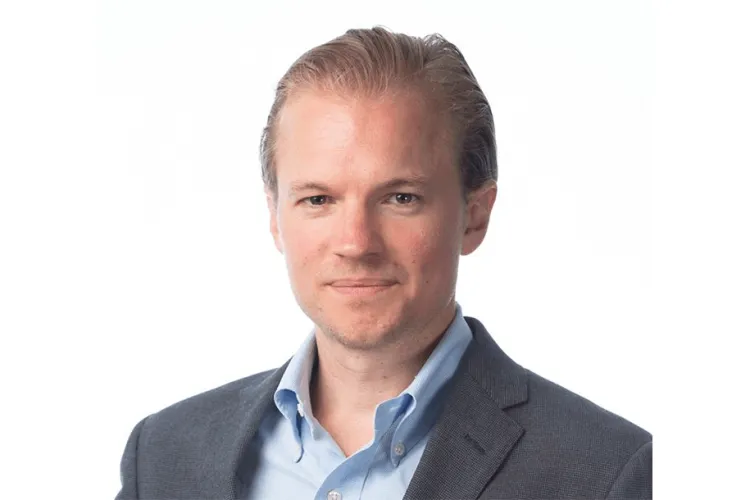
Larner alum John (“Steele”) Taylor, M.D.’15, assistant professor of neurological sciences, has received the A. B. Baker Teacher Recognition Award from the American Academy of Neurology. This prestigious award honors exceptional educators for their contributions to improving neurology now and in the future through their outstanding commitment to teaching and mentorship within the field of neurology.
“Dr. Taylor’s dedication to medical education, his passion for fostering student and trainee development, and his consistent pursuit of excellence have made a lasting impact on our department and the broader neurology community,” said Margaret Vizzard, Ph.D., Colleen A. and Gregory L. Holmes Green and Gold Professor of Neurological Sciences Research. “This recognition is a testament to his hard work, expertise, and unwavering support of learners at every stage.”
Tracy Madsen, M.D., Ph.D., Helps Update AHA Acute Ischemic Stroke Guidelines
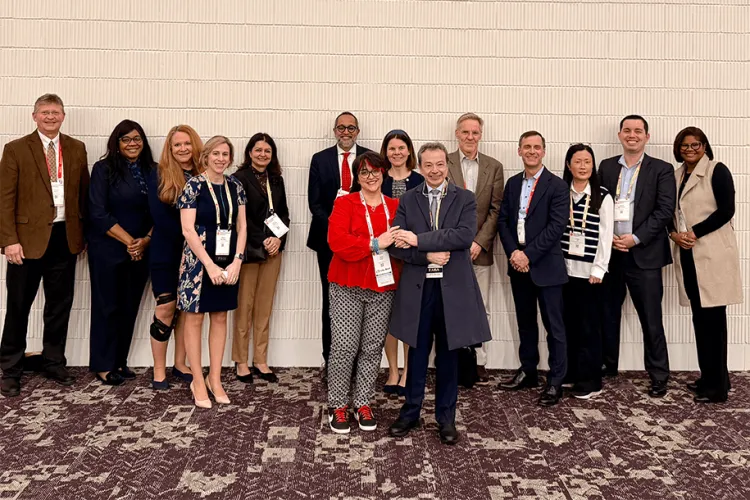
Larner Associate Professor of Emergency Medicine Tracy Madsen, M.D., Ph.D., served on the writing committee and as the Society of Academic Emergency Medicine liaison for new acute ischemic stroke guidelines—including the first detailed recommendations for diagnosing and treating stroke in children—from the American Heart Association (AHA).
The updated recommendations, which replace the 2018 edition and its 2019 update to reflect a surge of new evidence in acute ischemic stroke care, highlight how rapid diagnosis and imaging, extended time windows for stroke treatments, and coordinated care involving emergency services, hospitals, and health care teams can improve survival and recovery.
According to the American Heart Association’s 2026 Heart Disease and Stroke Statistics, stroke is now the #4 leading cause of death in the U.S. Every year, nearly 800,000 people in the U.S. have a stroke, and stroke is also a leading cause of serious, long-term disability. There are several types of strokes; ischemic stroke is the most common type and occurs when blood flow to the brain is suddenly blocked in a vessel, usually by a blood clot.
Dr. Madsen helped publicize the new guideline at the American Heart Association’s 2026 International Stroke Conference, held February 4–6 in New Orleans.
Gordon Lee Jensen, M.D., Ph.D., Honored with ASPEN Lifetime Achievement Award

The American Society for Parenteral and Enteral Nutrition (ASPEN) bestowed the 2026 ASPEN Lifetime Achievement Award upon professor emeritus Gordon Lee Jensen, M.D., Ph.D., a former senior associate dean for research and professor of medicine at the Larner College of Medicine and professor of nutrition and food sciences in the College of Agriculture and Life Sciences at the University of Vermont.
Dr. Jensen is being honored for his unending commitment and significant contributions as a researcher, practitioner, and leader who has advanced parenteral and enteral nutrition, as well as his continuous service to ASPEN. His efforts have challenged long-established approaches to characterizing malnutrition and have promoted a new appreciation for the interplay of malnutrition, inflammation, and disease. Although officially “semi-retired” since 2022, there is little evidence that he has changed his level of work on clinical nutrition.
Jensen received the Lifetime Achievement Award on February 14 at the ASPEN Nutrition Science & Practice Conference in Long Beach, California.
ASPEN is a professional medical organization dedicated to advancing the science and practice of clinical nutrition and metabolism.