
The award, which acknowledges exemplary professionalism, collegiality, and citizenship in the ATS community, is considered a career-defining achievement in respiratory medicine. It not only honors the recipient’s lifetime contributions but also underscores their role in shaping the future of the field through collaboration, innovation, and service. The medal was presented to Dr. Irvin at the ATS 2026 international conference in May in Orlando, Florida.
“Receiving this prestigious award makes all the years of perseverance and hard work worth it. I am so deeply grateful to all of my colleagues and peers,” said Irvin, who has researched lung health and disease for more than 50 years.
An Illustrious Career Dedicated to Pulmonary Science
Irvin is an internationally renowned applied physiologist whose scientific career has focused on understanding the mechanisms of airways dysfunction in patients with chronic obstructive pulmonary disease (COPD) and asthma. Using a multidisciplinary approach that includes cellular and molecular biology, animal models and systems, transgenics, physiology, imaging, and clinical studies, Irvin and his colleagues seek to understand the pathophysiological basis of airways dysfunction to better diagnose and treat patients with chronic airways disease.
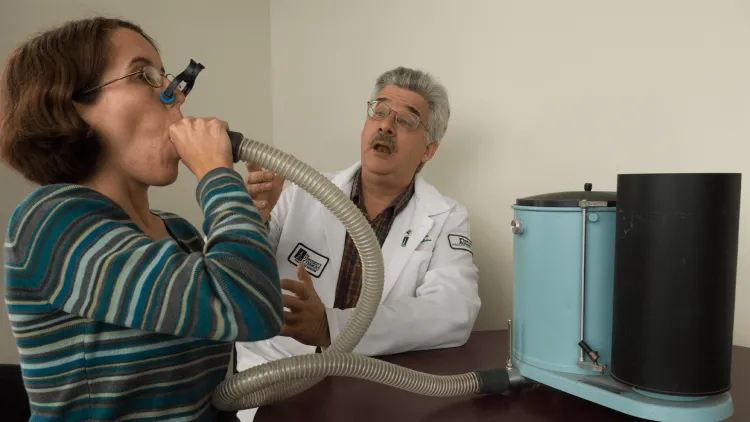
“Receiving this prestigious award makes all the years of perseverance and hard work worth it.” — Charles Irvin, Ph.D.
Irvin’s dedication to pulmonary science began in the 1970s during his Ph.D. studies at the University of Wisconsin–Madison, where Professor Emeritus William Busse described him as “driven and humble.” Following postdoctoral training at McGill University from 1978 to 1980, Irvin joined the University of Colorado–Denver, where he directed the Pulmonary Function Laboratory for nearly 20 years, a remarkable accomplishment for a non-clinician scientist, demonstrating how his research in lung physiology translated directly to human health. Irvin has been continuously funded by the National Institutes of Health (NIH) since 1976.
Mentor, Leader, Institution-Builder
Upon joining the University of Vermont in 1998, Irvin continued his pioneering research while serving as a mentor, leader, and institution-builder. As director of the Vermont Lung Center from 1998 to 2019, he has sustained a world-class research and training environment and served as site principal investigator for the American Lung Association Airways Clinical Research Center. At UVM, he was instrumental in securing an NIH Centers of Biomedical Research Excellence (COBRE) grant for Translational Research in Lung Biology in 2000 and has overseen the continuous funding of a program in developing faculty researchers. He has trained 33 postdoctoral fellows and mentored numerous junior faculty, the vast majority of whom are now successfully engaged in research careers. He is a distinguished educator of the Larner Teaching Academy.
“He has given of himself so others may achieve satisfaction and success, and in doing so, has left a lasting and inspiring impression on those around him.” — Matthew Poynter, Ph.D.
“From offering interpretation of difficult spirometry results to patients, fellows, and experienced pulmonologists, to helping a graduate student identify individual aspirations, to guiding faculty as they grow, sustain, or transition their careers, Charlie has leveraged his experience and knowledge to help others achieve what they might otherwise not,” said Matthew Poynter, Ph.D., professor of medicine and current director of the Vermont Lung Center. “He has developed courses, clinics, programs, and individual friendships whose beneficiaries are nearly innumerable. He has given of himself so others may achieve satisfaction and success, and in doing so, has left a lasting and inspiring impression on those around him.”
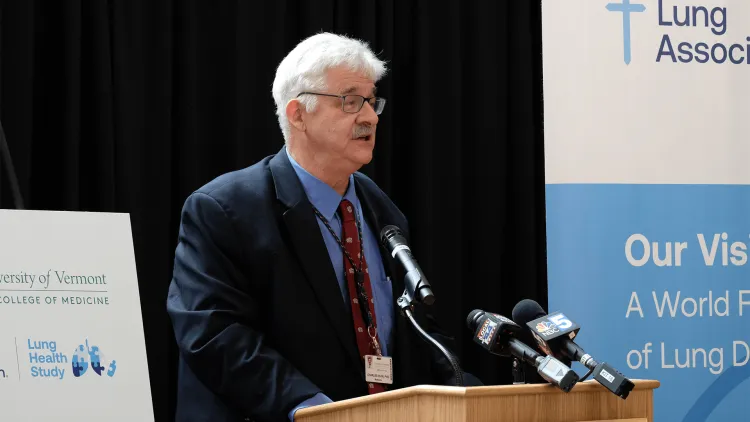
Irvin has more than 265 peer-reviewed publications to his credit and has published an additional 145 chapters, reviews, and editorials. He is an inaugural Fellow of the European Respiratory Society and the American Thoracic Society and has served on the board of directors of the ATS. A frequent invited professor with an international reputation, he has served on numerous grant review panels, including the National Institutes of Health, the American Heart Association, and the American Lung Association, and he has been a chairman of a Lung Association grant review committee as well as chairing many NIH review panels.
Vision and Leadership
The Vermont Lung Center’s rise to national and international prominence in pulmonary medicine and research can be traced to Irvin’s vision and leadership, said Amali Samarasinghe, Ph.D., associate professor of allergy and immunology at the University of Wisconsin School of Medicine and Public Health: “Charlie not only fostered the development of a first-class research institute but also, perhaps even more importantly, instigated a culture of mentoring that has nurtured the careers of numerous young scientists. As one of the few Ph.D. scientists to have bridged basic discovery, translational application, and clinical collaboration so seamlessly, his career exemplifies the spirit of Edward Livingston Trudeau: compassionate science in service of humanity.”
“His career exemplifies the spirit of Edward Livingston Trudeau: compassionate science in service of humanity.” — Amali Samarasinghe, Ph.D.
The Trudeau Medal, the highest honor bestowed by the ATS, is named in honor of Edward Livingston Trudeau, M.D., a founder and the first president of the American Lung Association. Dr. Trudeau established a tuberculosis (TB) sanatorium and research laboratory in Saranac Lake in the 1800s. The Trudeau Medal is awarded to an individual who has made major contributions to the prevention, diagnosis, and treatment of lung disease, critical illness, or sleep disorders through leadership in research, education, or clinical care.
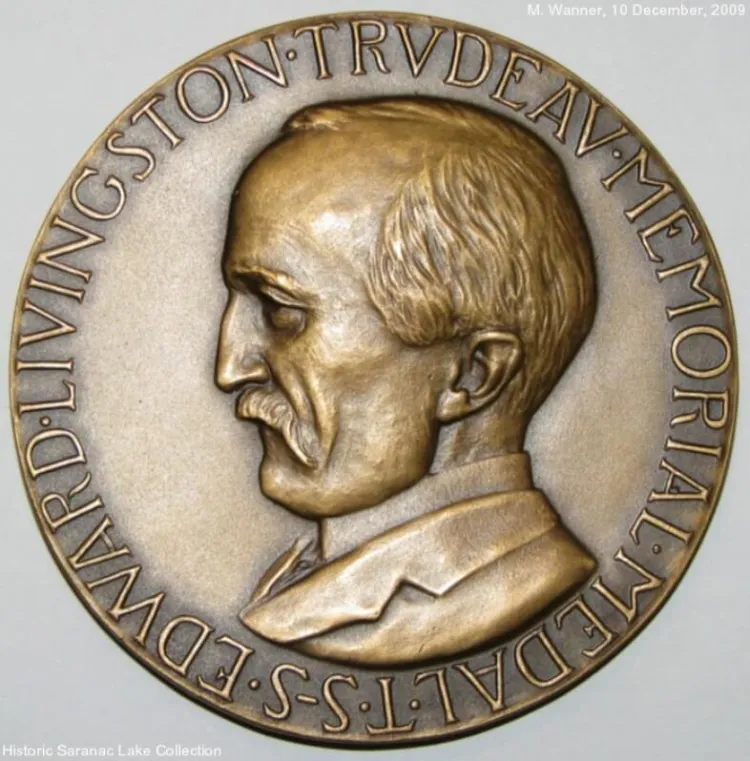
The American Thoracic Society improves global health by advancing research, patient care, and public health in pulmonary disease, critical illness, and sleep disorders. Founded in 1905 to combat tuberculosis, the ATS has grown to tackle asthma, COPD, lung cancer, sepsis, acute respiratory distress, and sleep apnea, among other diseases.