This September, UVM and the Larner College of Medicine announced two landmark research projects. Davi Bock, Ph.D., associate professor of neurological sciences, received $19 million from the National Science Foundation to design and build ultra-high-resolution “connectomics” brain mapping tools. Following close on the heels of that announcement was a $38 million award to UVM trauma surgeon and Larner researcher Gary An, M.D., professor of surgery, to develop an AI-powered “digital twin” that has the potential to shorten ICU stays by as much as 25 percent.
The backdrop to these impactful announcements was the Dean’s Celebration of Excellence in Research, Larner’s annual week of events that empowers and highlights research being done by the college’s faculty and students.
Connection Through Conversation
The celebration started on Monday, September 28, with the Research Laureate Lecture given by Margaret Vizzard, Ph.D., Colleen A. and Gregory L. Holmes Green and Gold Professor in Neurological Sciences Research. In Dr. Vizzard’s presentation, titled “I have Accomplished Almost Nothing on My Own: The Community Behind My Research Journey,” she cited her colleagues, friends, and family members who have all had a part in her success as a scientist.
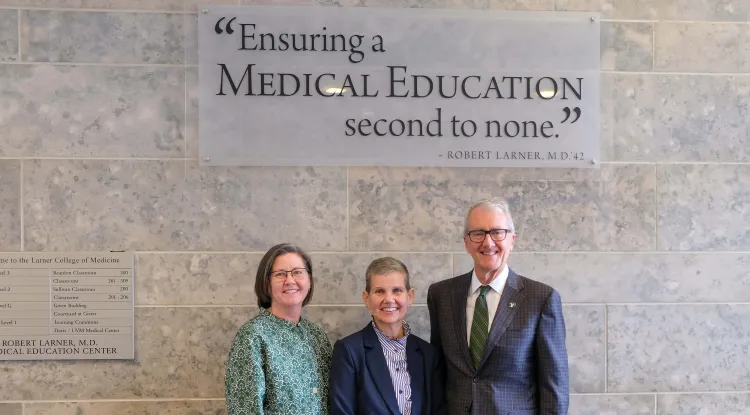
Vizzard noted that through her own experience with an absent mentor, she makes it a point to do the best she can to guide, learn from, and give back to her students. Moreover, her goal is to be a cheerleader for them, and she hopes that each of her mentees “leaves my lab with a sense of empowerment to contribute to science in a meaningful way.” Vizzard touched on her research as a urologist studying painful bladder syndrome. During her postdoc, she created 2 additional pain models for the syndrome—intermediate and chronic—that are actively and frequently referenced by urologists to this day. Her final thanks were to her three kids and her husband, Declan McCabe, Ph.D., professor of biology at Saint Michael’s College, for their continued support.
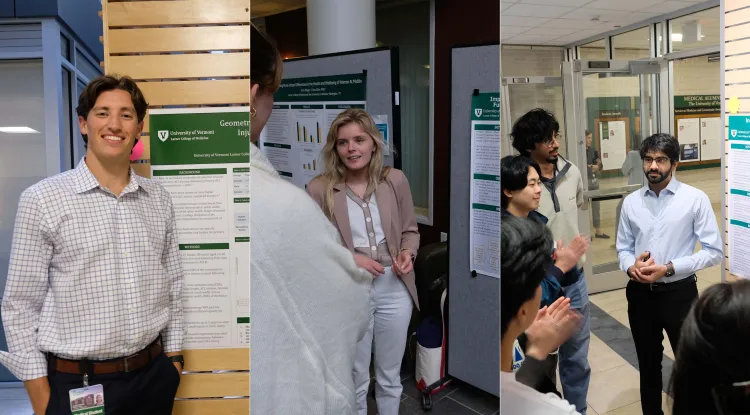
Fifty-five medical student and 16 graduate students hung their posters and proudly answered questions from curious minds about their research on Tuesday in a session that spread throughout the Given Courtyard and the Hoehl Gallery at the Larner College of Medicine. Class of 2029 medical students Foster Horton and Jack Pearce reflected that “it is inspiring to see how rigorous everyone’s research is and how motivated everyone is to make contributions to science.” Pearce went on to say that “this research is going on to train the next generation of physician scientists.”
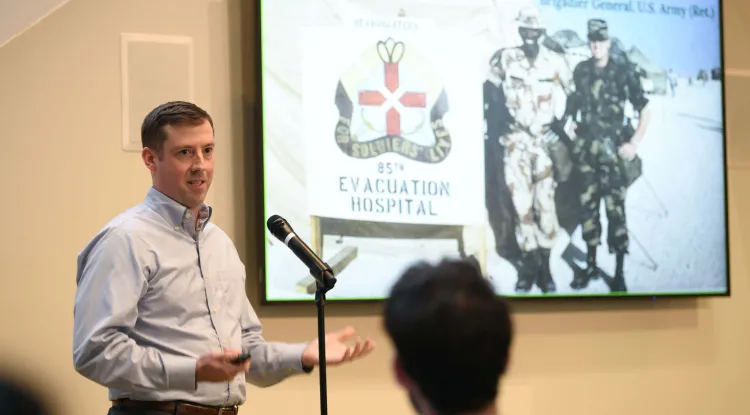
Wednesday evening celebrated Larner faculty with presentations from seven health professionals ranging from the UVM Cancer Center to the Division of Public Health to researchers in Firestone. The Research Rally and Reception’s concluding presentation, “On the Road to a National Observatory,” was given by Davi Bock, Ph.D., who expanded on his recent National Science Foundation grant of $19M to establish a national coordinating hub at Larner that will seek to design and build an observatory to allow researchers to investigate some of life’s smallest structures in three dimensions. Other presentations included Emily Bruce, Ph.D., on “Virology in the Time of COVID” and Tom Griffin, Ph.D., M.A., on “From Afghan Deserts to Ambulance Deserts: Mapping My Research Origin Story.” The Rally was also livestreamed to allow the members of the Larner community who reside off campus to learn more about the emerging discoveries at the Larner College of Medicine.
The Awards Presentation and Research Celebration Address on Thursday kicked off with awards given to Larner researchers in several categories.
Outstanding Research Publication
- Graduate Student: Victoria Gibson, M.S.
- Postdoctoral Fellow: Hassan Zafar, Ph.D.
- Resident: Jane Ehret, M.D.
Dean’s Excellence in Research Awards
- Clinical Research Coordinator: Laurie Chassereau, senior clinical research nurse
- Scientific Research Staff: Ben McElvany
- Clinical Trials: Alissa Thomas, M.D., associate professor in neurological sciences
- Research Laureate: Marilyn Cipolla, Ph.D., M.S., professor of neurological sciences
- Research Mentor: Bob Gramling, M.D., D.Sc., professor of family medicine
- New Investigator: Matthew Caporizzo, Ph.D., assistant professor of molecular physiology and biophysics
- Mid-Career Investigator: Tracy Madsen, Ph.D., M.D., M.S., associate professor of emergency medicine
The Awards Presentation was followed by the Research Celebration Keynote Address by Kate Tracy, Ph.D., senior associate dean for research, which dove into the science of the connectome. A connectome is a map of all of the neurological connections and wiring within the brain of an organism.
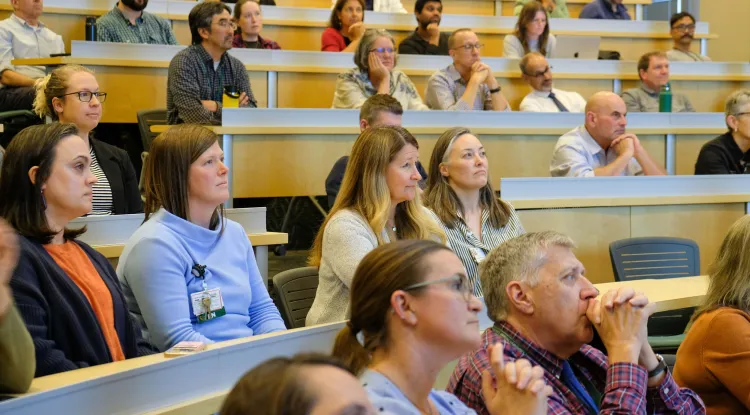
“No single neuron thinks,” Dr. Tracy stated. “The network does.” Tracy emphasized that here at Larner everyone works together to produce this groundbreaking research. Larner hosts a total of 709 clinical scholars, 111 tenure-pathway professors, 56 education scholars, and 48 research scholars, in addition to the 900+ learners, 400+ staff, and ~1,400 volunteer faculty who all have a hand in the R1 research that comes out of our college. Tracy ended her keynote by quoting Canadian psychologist and neuropsychologist Donald O. Hebb, saying, “Neurons that fire together, wire together.” Tracy urges us all to keep firing together and building connections throughout our work to continue making a difference in the lives of those who can be helped by this research.
The week culminated in a presentation by Jennifer A. Lewis, Sc.D., Jianmin Yu Professor of Arts and Sciences, Hansjörg Wyss Professor for Biologically Inspired Engineering at the Paulson School of Engineering and Applied Sciences, Harvard University, who presented the annual Stetson Lecture on Friday. Dr. Lewis has earned many accolades for her accomplishments, including election to the U.S. National Academy of Engineering, the U.S. National Academy of Inventors, and the American Academy of Arts and Sciences. She has also received prestigious awards for her research, including the Lush Prize for Scientific Research, the Materials Research Society Medal, and the Department of Defense Vannevar Bush Faculty Fellowship.
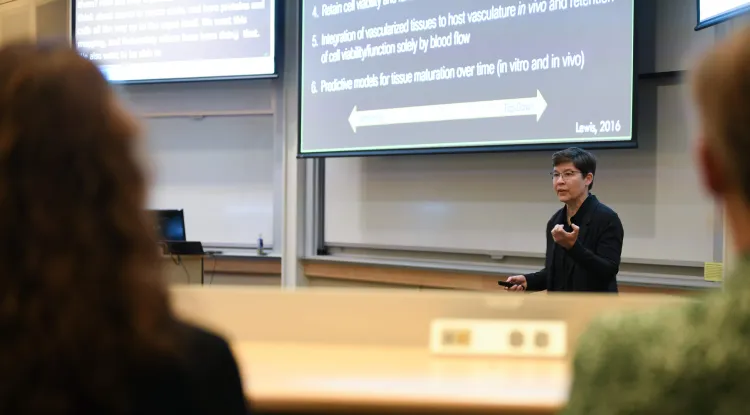
Lewis’s goal in her research is to create patient-specific human tissues. Her work maps major organs, creates scalable models of different cell types and organ building blocks, prints vascularized human tissues (and eventually organs), and integrates these vascularized tissues into the host organism. Lewis said, “I’m really thrilled that this work is emerging and that these patients have a path forward in the interim, to sort of close the gap between the donor need and the donor population.” This research shows that the future is bright in organ transplantation, and Lewis stated that “[while] we’re not all the way where we want to be yet, we’ve made an impact on drug development.” This research is already being implemented, as multiple startups are commercializing technology—ranging from printed electronics to kidney tissue therapeutics—from her research lab.
Meaningful Engagement in Research
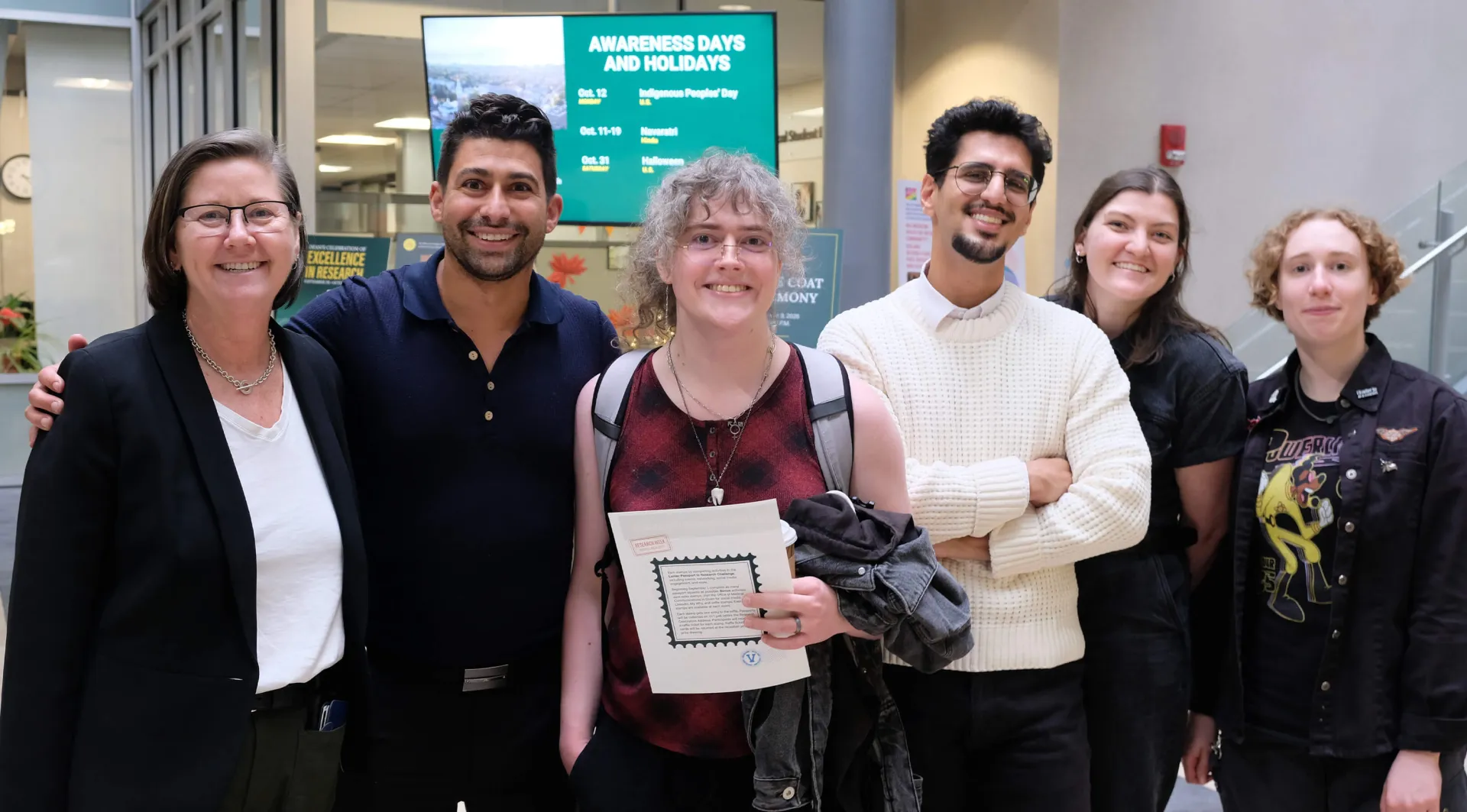
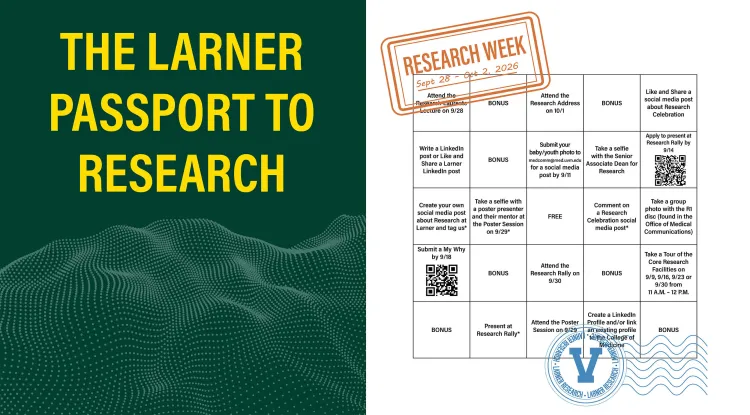
The Passport to Research was a new addition to this year’s celebration. The bingo-type card had spaces that could be stamped to reward Larner community members for attending lectures, reposting Larner research on social media, presenting at the poster session, and engaging with other researchers throughout the week. Each activity garnered a raffle ticket, and those individuals with the most stamps were announced at Wednesday’s Research Address in the Hoehl Gallery.
The raffle winners were:
- Faculty (cash prize for research)
- $10,000: Gail Rose, Ph.D., assistant professor of psychiatry at Larner
- $5,000: Jess Badlam, M.D., pulmonologist and critical care medicine physician, assistant professor at Larner
- $2,500: Julie Dumas, Ph.D., M.A., professor of psychiatry, vice chair of academic affairs
- Staff - Gift basket and Larner apparel: Vivian Aeder, AEMT, clinical research coordinator, research in emergency medicine
- Graduate student - $1,000 award toward travel to a professional conference: Sarah Beard, clinical research coordinator, research in emergency medicine
- Medical student - $1,000 award toward travel to a professional conference: Cameron Kurisko ’30
Research like this has contributed to the University of Vermont’s designation by the Carnegie Classification of Institutions of Higher Education as an R1 institution, placing it in the top tier of research universities in the U.S.