From discomfort to clarity to confidence … That’s how scientists described their learning journey at the first annual media training and PitchFest hosted by the Vermont Center for Cardiovascular and Brain Health (VCCBH).
The event, held March 13 at the Larner College of Medicine, challenged four Larner researchers to distill their complex research into clear, engaging language that any audience could grasp, in three minutes or less, to create a “pitch.” The pitch acts as an oral tool for researchers to quickly spark interest, secure funding, find collaborators, or introduce their work at conferences and networking events. The scientists presented their pitches before a panel of five judges representing media outreach, donor relations, and science journalism, as well as an audience of faculty and students in health science professions.
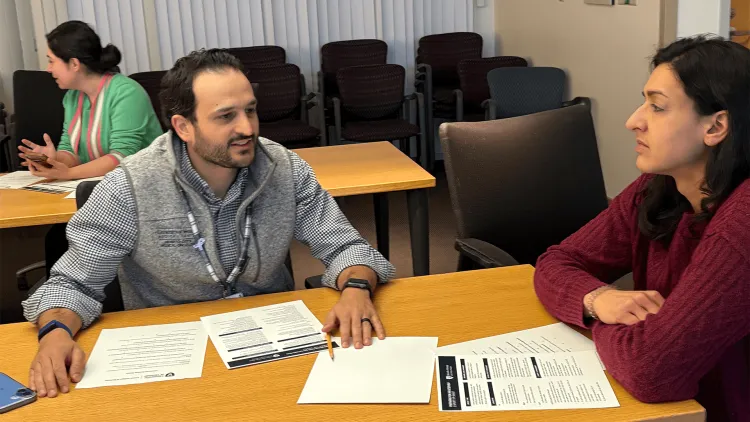
Prior to the PitchFest, interested researchers participated in a media training hosted by the Larner Office of Medical Communications. They learned how to craft a persuasive pitch that defines the problem their research aims to solve, describes their process, and highlights anything novel or important about their project. They then practiced delivering pitches to one another in a series of timed rounds beginning at six minutes.
At first, delivering a research pitch “felt unnatural, out of my comfort zone,” said Mansour Gergi, M.D., who delivered the winning pitch. “The training session helped significantly to guide me through it, and with a lot of preparation it got more and more comfortable.” An assistant professor of medicine and the medical director for the UVM Cancer Center Hematology Clinic, Dr. Gergi presented research on tools to assess risk of internal bleeding and prevent bleeding events for hospitalized cancer patients. The win came with a prize of $1,000 from the VCCBH to support Gergi’s research.
The judges remarked that the decision to choose the top pitcher was difficult, as all four pitches were excellent and the scores were extremely close. “Everyone did a great job, contestants and judges,” said Mary Cushman, M.D., M.Sc., professor of medicine and co-director of the VCCBH, who served as moderator. “I think the audience learned some things, too.”
“I knew how to explain my science in layman’s terms, but the PitchFest helped me give my explanation direction and purpose. I feel my pitch can make others as excited about my research as I am,” said Maria-Cristina Bravo, Ph.D., assistant professor of pathology and laboratory medicine. Dr. Bravo presented research on predictive clues for blood clots in pregnancies with and without preeclampsia, a potentially fatal complication that impacts 1 in 15 pregnancies in the U.S. “If we can measure the amount and functional clotting properties of vesicles—sub-cellular components that are released from cells—across pregnancy and into the postpartum period, that could serve as a predictive clue … and potentially lower the risk of developing a clot,” improving outcomes for mothers and babies, Bravo told the judges.
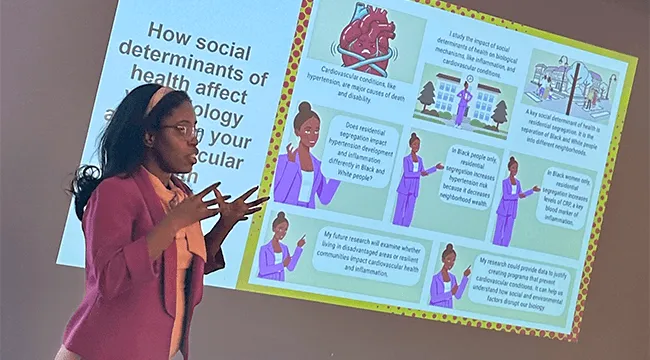
Debora Kamin Mukaz, Ph.D., assistant professor of medicine, presented research on how social determinants of health affect a person’s biological mechanisms and shape their cardiovascular health. Dr. Kamin-Mukaz showed an infographic that complemented her spoken words and helped the audience understand how this research could lead to policy changes that improve environmental and economic circumstances in predominantly Black neighborhoods.
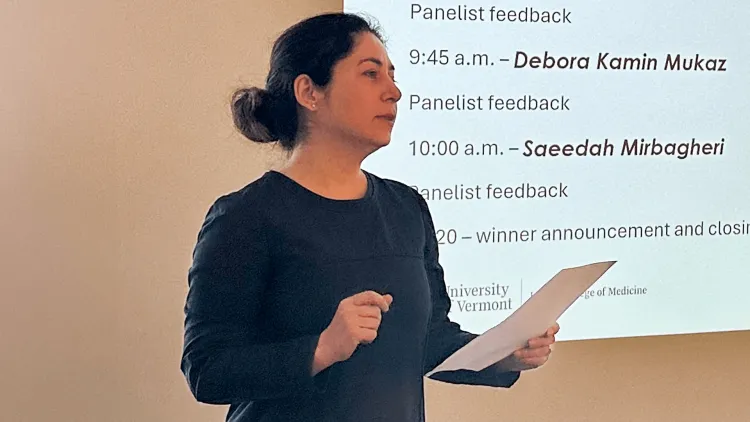
Saeedeh Mirbagheri, M.D., assistant professor of radiology, presented research on hidden problems in neck arteries that may help explain cryptogenic strokes—those in which the cause is not known—which includes about one of every three strokes. “We are studying the artery plaques and checking whether they are located on the same side of the brain where the stroke occurred,” Dr. Mirbagheri told the judges. “If we can identify these hidden artery problems, doctors may be able to treat patients more precisely and prevent future strokes.”
“The PitchFest helped me give my explanation direction and purpose. I feel my pitch can make others as excited about my research as I am.” — Maria-Cristina Bravo, Ph.D.
The judges included Stephanie Knific, executive director for strategic communications and marketing at the Larner College of Medicine; Janet Franz, creative content manager for the Larner Office of Medical Communications; Basil Waugh, media relations director for the University of Vermont; Lauren Mauter, major gifts officer for the University of Vermont Medical Center Foundation; and Lexi Krupp, an independent science and health reporter and engagement producer at KFF Health News.
Research like this has contributed to the University of Vermont’s designation by the Carnegie Classification of Institutions of Higher Education as an R1 institution, placing it in the top tier of research universities in the U.S.