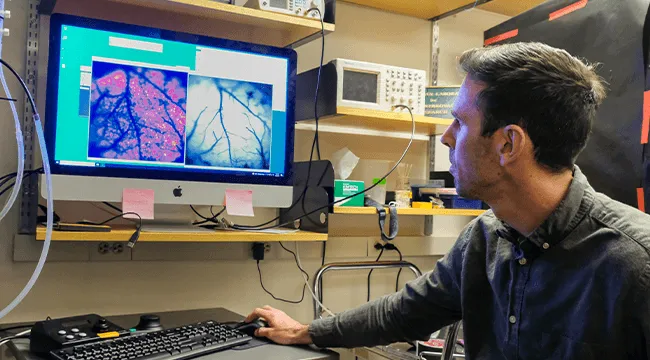
Nicholas R. Klug, Ph.D., assistant professor of pharmacology, received a competitive grant from the Brain Research Foundation (BRF) to investigate how the nearly 500 miles of blood vessels in the brain communicate with neural tissue to ensure a constant supply of oxygen and glucose to more than 100 billion brain cells. This process is disrupted in many cerebrovascular and neurodegenerative conditions, including stroke, migraine, and Alzheimer’s disease.
“By defining how these cells control brain oxygen levels, we can strategically target them to restore oxygen delivery and mitigate brain damage during disease.” — Nicholas R. Klug, Ph.D.
The $100,000 BRF Seed Grant is designed as start-up funding to support early-career investigators and high-risk, innovative ideas, accelerating pioneering neuroscience research. The foundation annually invites research institutions, including the University of Vermont, to nominate a single faculty member to submit a letter of intent. The principal investigator must be a full-time assistant or associate professor working in the field of neuroscience. UVM selected Dr. Klug to apply for the grant.
“I was fortunate to be selected by UVM, and grateful that the foundation found the project compelling enough to fund,” Klug said, adding that the foundation supported approximately 15 projects this year.
The Klug Laboratory at the Larner College of Medicine investigates the smallest blood vessels—the capillaries—in the brain. Klug uses a combination of electrophysiological and advanced imaging approaches to define the receptors and ion channels that govern normal vascular function and how these mechanisms fail in disease.
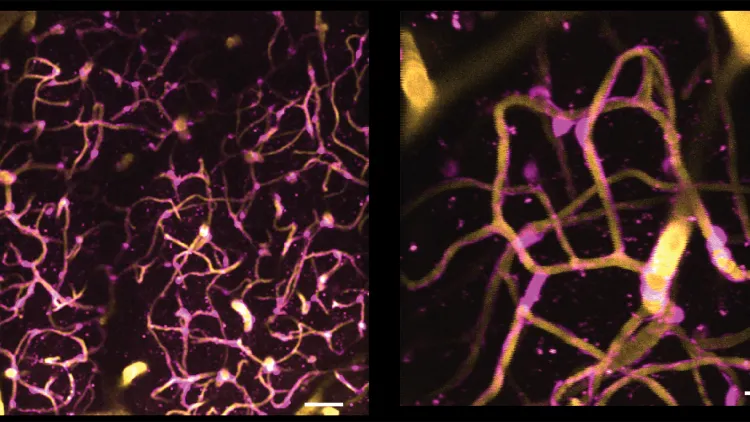
For this research project, Klug will investigate pericytes, tiny cells that act as gatekeepers on brain capillaries to control local blood flow and oxygen. He will use a new imaging technique with bioluminescent proteins derived from sea shrimp, making it possible to watch oxygen levels across the brain in real time. Klug’s research team will observe how pericytes restore oxygen when the brain is stressed and how pericytes also constrict blood vessels, actively choking off the oxygen supply in a brain with a disease like stroke or dementia. This knowledge will help guide future treatments aimed at improving blood flow and protecting brain tissue.
“Your brain depends on a steady supply of oxygen to function, yet it has almost no ability to store it. Even brief drops in oxygen can harm brain cells,” Klug explains. “Surprisingly, we are only beginning to understand how oxygen supply is controlled at the smallest blood vessels in the brain. By defining how these cells control brain oxygen levels, we can strategically target them to restore oxygen delivery and mitigate brain damage during disease.”
Read about research in the Klug Lab
Read more about the Brain Research Foundation
Research like this has contributed to the University of Vermont’s designation by the Carnegie Classification of Institutions of Higher Education as an R1 institution, placing it in the top tier of research universities in the U.S.